Key Takeaways
- Spirituality and religion are not the same, and people in recovery often report that spirituality, more than religion specifically, is what made the difference 6.
- The evidence is real but modest: a 2026 meta-analysis linked spirituality to a 13% reduction in harmful substance use risk, rising to 18% with weekly community engagement 4.
- Effective programs keep medical detox, counseling, group work, and 12-step support at the center, with Bible study, prayer, and meditation offered as optional doors rather than requirements 9.
- Spiritual gains fade without continuing care, so look for programs that pair trauma-informed practice with family work, community connection, and structured follow-up after discharge 11.
What faith-curious people actually want to know before treatment
You probably did not type “spiritual recovery programs” into a search bar because you wanted a sermon. You typed it because someone you love is hurting, or because you are, and you want to know if faith can sit at the table with real medical care without taking it over.
The honest answer is yes, with conditions. Spiritual support seems to help many people in recovery when it is offered as one part of a bigger plan, not the whole plan 9. People in recovery often say spirituality, more than religion specifically, made the difference for them 6. That is a meaningful clue about how thoughtful programs should treat this part of care.
So here is what you actually want to know, named plainly:
- Will I be pressured into a faith I do not hold?
- Does spirituality really make a measurable difference, or is that wishful thinking?
- How does it fit with detox, counseling, and 12-step work?
- What does a regular day look like?
- What happens if I have religious wounds from the past?
The rest of this guide walks through each of those questions, with evidence where it exists and honesty where the science is still working things out. You do not need to have your beliefs figured out before you start. You just need a program that lets you bring whatever you have.
Spirituality is not religion, and that distinction matters
Here is a small word that carries a lot of weight: spirituality. People sometimes hear it and assume it means church on Sunday, a specific denomination, or a set of rules they have to follow. It does not have to mean any of that.
Spirituality is broader. It is the part of you that asks what your life is for, who you want to be, and what holds you steady when everything else is falling apart. Religion is one structured way of answering those questions, with shared scripture, ritual, and community. Some people find their spirituality through religion. Some find it in nature, in service, in their kids’ faces, in a quiet sense that they are not alone. Both can be real.
This distinction is not just word play. When researchers asked people in recovery what helped them most, many said spirituality more than religion specifically made the difference 6. That is a signal worth listening to. A good treatment program does not need to know your denomination, or whether you have one. It needs to know that something in you is reaching for meaning, hope, or a steadier center, and to make room for that reaching.
If you grew up religious and walked away, you are welcome here. If you have never set foot in a church and do not plan to, you are welcome here too. If you are somewhere in between, curious but cautious, that is probably the most common starting point of all. The work is not to fit you into a box. It is to help you find what gives you ground to stand on while you rebuild.
What the evidence says about spirituality and recovery
The 2026 meta-analysis and what its numbers actually mean
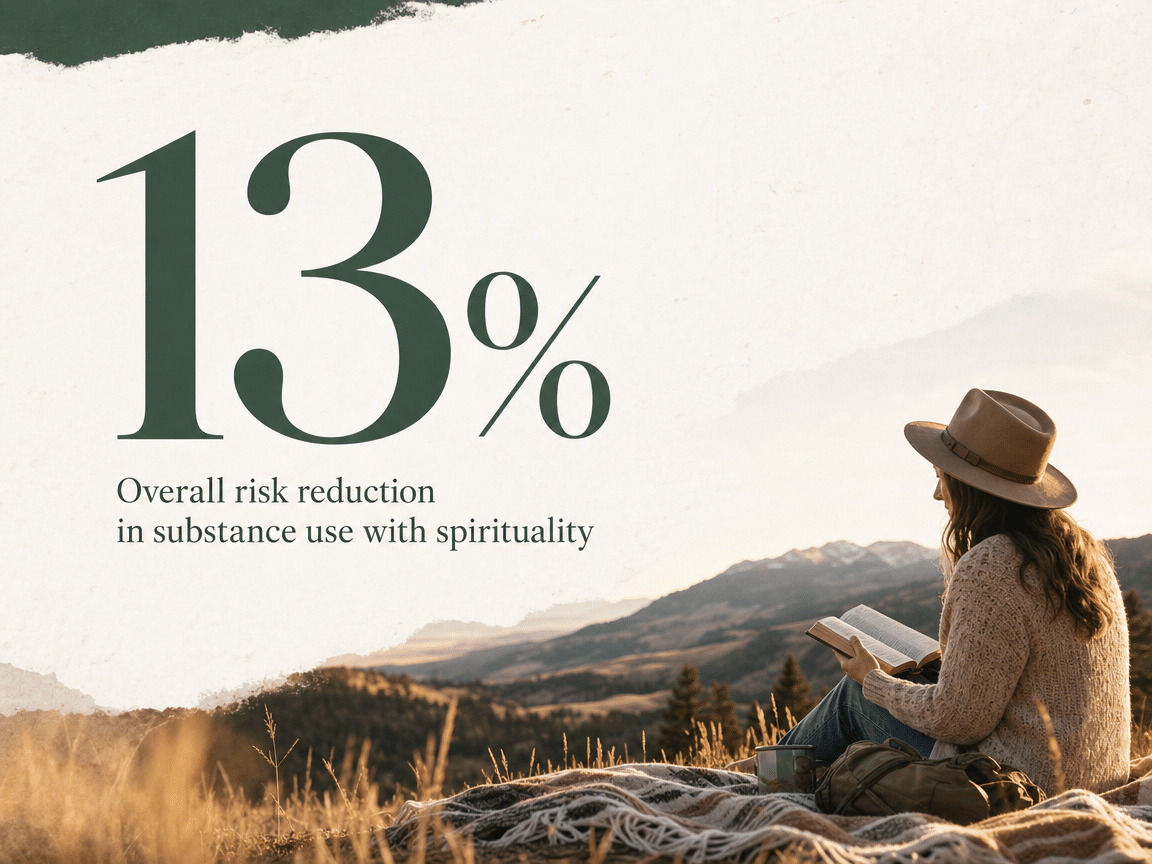
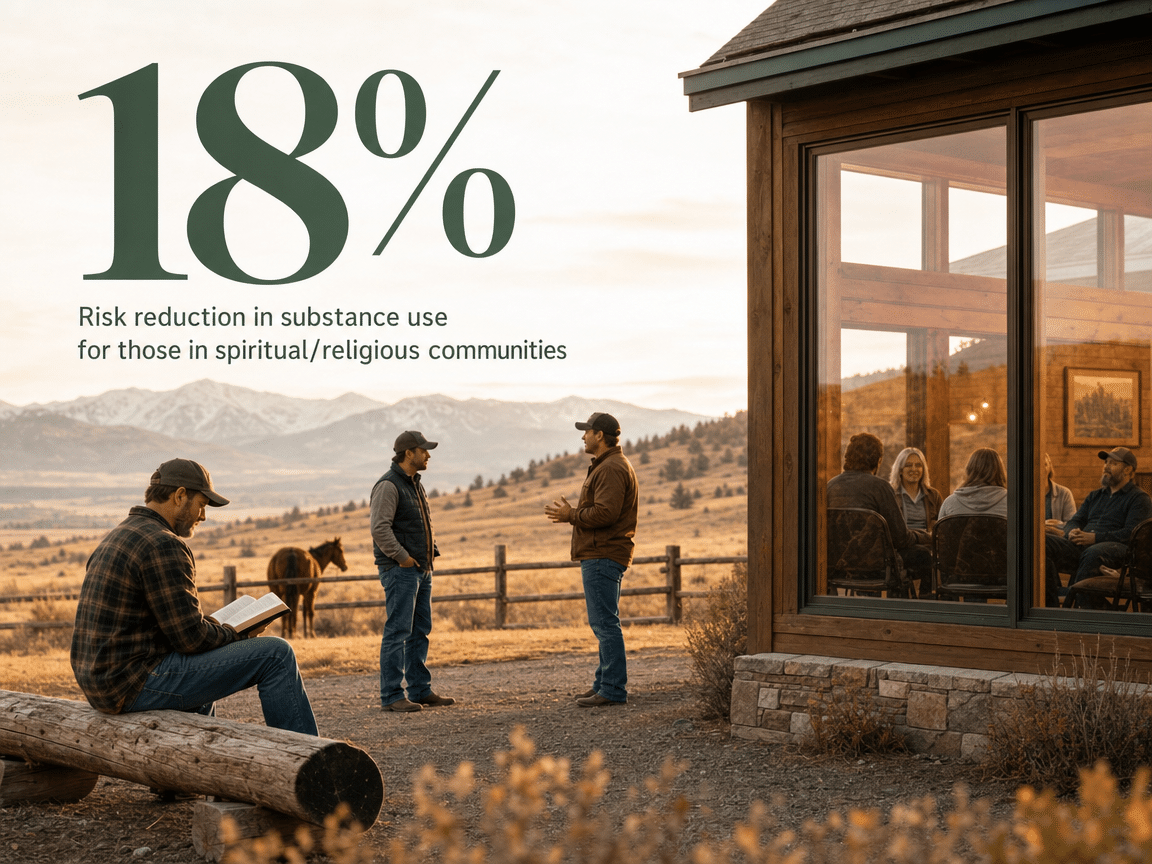
You deserve a real number, not a vibe. Here is the strongest one currently available: a 2026 meta-analysis pulling together 55 studies and 540,712 participants found that spirituality was associated with a 13% reduction in risk for harmful or hazardous alcohol and other drug use overall. Among people who engaged in spiritual or religious communities on a weekly basis, that reduction rose to 18% 4.
The other thing worth naming out loud: this is an association, not a proven cause. The studies in the meta-analysis observed that people with stronger spiritual lives or community involvement tended to fare better. They did not randomly assign half the world to be spiritual. So while the pattern is real and the sample is huge, no honest clinician will promise that adding prayer will produce a specific percentage of improvement for you. What the data does say is that this part of your life is worth taking seriously, not dismissing, and not overselling.
Where spirituality helps, and where it does not
The most useful way to read the broader research is this: spirituality tends to help by feeding the things that already help. Meaning. Hope. Coping skills when cravings hit at 2 a.m. A sense that you are part of something larger than the worst chapter of your story 5.
A systematic review of 29 studies on spirituality, religion, and recovery found at least some evidence of a beneficial relationship, especially around abstinence and staying in treatment long enough for it to work 2. Randomized trials of spiritual interventions show a small but statistically significant added effect compared with other approaches 3. Structured spiritual group work has improved spiritual health and quality of life for people already receiving medical care 17.
And the honest counterweight: spirituality is not uniformly protective in every context. A newer review of behavioral addictions found the relationship is complex, and in some studies spirituality can even sit alongside risk rather than reduce it 7. Translation: rigid or shame-based religious framing can hurt. Forced participation can hurt. A program that treats faith as a hammer instead of an invitation can hurt.
That is why the best programs offer spiritual support as a door you can walk through, not a wall you have to climb.
Will I be pushed into a faith I don’t share?
Short answer: no. Not in a program worth your time.
The fear behind this question is real, and it usually comes from somewhere specific. Maybe you sat through a meeting once where someone insisted the only way out was their way. Maybe a relative used scripture as a weapon. Maybe you just do not want to be handed a tract on day one of the hardest thing you have ever done. Whatever the reason, you get to keep your guard up here. A thoughtful residential program will not try to lower it for you.
The clinical guidance on this is clear. Spirituality belongs in treatment as one piece of a wider plan, not as the plan itself 9. That means the core of your care is medical and clinical, and the spiritual pieces are doors you choose to open.
Here is what that looks like in practice. The core, non-negotiable elements are the same for everyone:
- medically supervised detox
- individual counseling
- group counseling
- 12-step support
- family involvement
- continuing care after you leave
The optional layer, available if you want it, includes things like Bible study, prayer practices, meditation, and faith-based reflection. You can take all of it, some of it, or none of it. Your treatment plan does not change based on what you pick.
The research backs this approach. People engage more, and tend to do better, when the support around them respects their actual beliefs rather than asking them to perform someone else’s 14. Forcing a faith fit you do not feel does not produce real spiritual growth. It produces resentment, and resentment is fuel you cannot afford right now.
A day inside a whole-person residential program
Mornings: detox stabilization, medical care, and quiet
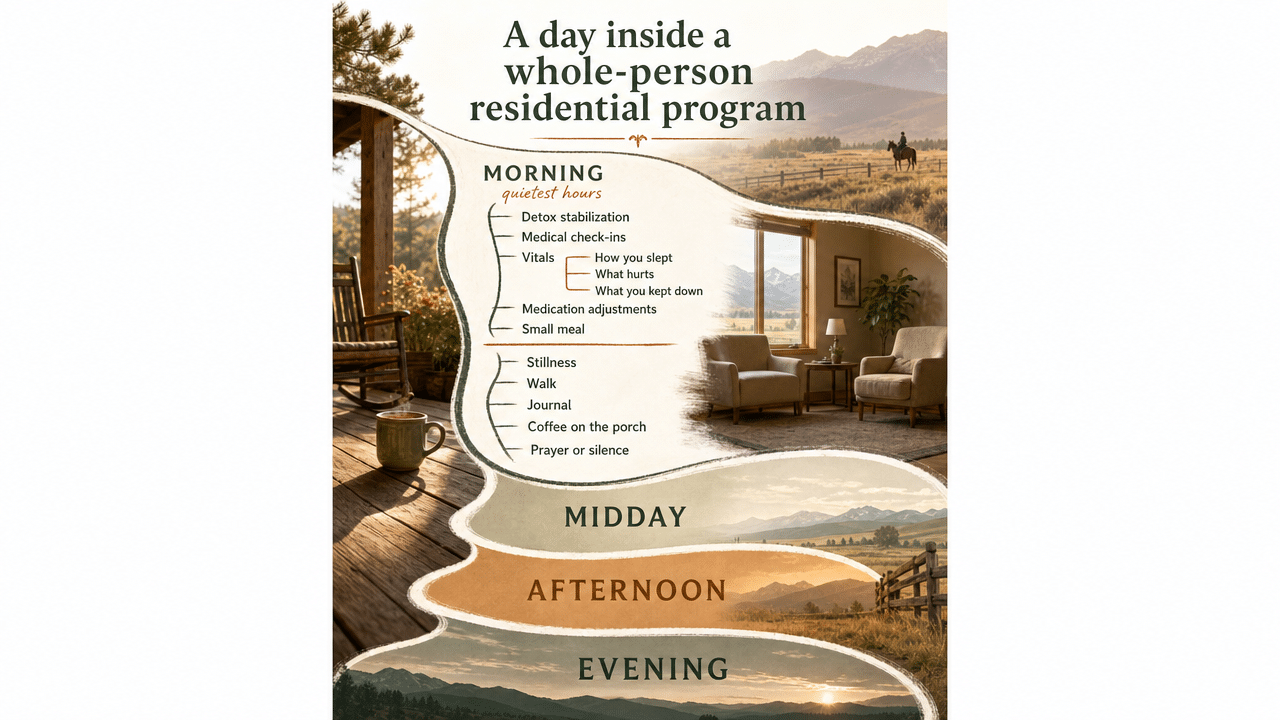
The first hours of the day in a residential program are usually the quietest, and on purpose. If you are in early detox, mornings center on medical check-ins. A nurse takes vitals. A counselor or medical staff member asks how you slept, what hurt, what you kept down. Medications are adjusted. You eat something small if you can.
This part is not glamorous. It is also not optional, no matter what you believe about anything else. Medically supervised detox is the floor under everything that comes next, because nothing spiritual reaches you when your body is in crisis.
Around the medical care, mornings tend to leave room for stillness. A walk. A journal. Coffee on a porch where no one is asking you to perform. Some people pray here. Some sit with a few minutes of silence and call it that. SAMHSA frames spirituality and professional care as working together 19, and morning quiet is often where that pairing first feels real, before the day’s harder work begins.
Midday: individual and group counseling, with 12-step woven in
By midday, the schedule sharpens. You sit one-on-one with a counselor, often someone who has been in recovery themselves, and you do the work of telling the truth about your life. What you used. When it started. What you were trying to outrun. This is not a spiritual exercise on paper, but for many people it becomes one. Honesty has a way of doing that.
Group counseling usually follows. A circle of chairs, a topic on the whiteboard, eight or ten people who all came in carrying some version of the same weight. You listen more than you talk at first, and that is fine. The point is not performance. It is recognition.
12-step principles tend to thread through the day rather than sit in one block. Step work, readings, and group discussions about powerlessness, honesty, and asking for help. The NIAAA’s facilitation manual describes the goal plainly: building commitment to participation and openness to a power greater than your own willpower 10. That power can be God, the group, the program itself, nature, or simply the part of you that wants to live. The frame is wide enough to hold you wherever you are starting from.
Afternoons: equine work, movement, and the Montana landscape
Afternoons often shift outside, and the body finally gets a say. Equine therapy is one of the more surprising parts of whole-person care. You do not need to know anything about horses. You stand near one, you breathe, you notice what comes up. Horses respond to what is actually happening inside you, not the version you have rehearsed. People who could not cry in a counselor’s office have cried in a pasture next to a thousand-pound animal who simply stayed there with them.
Other afternoons might bring hiking, recreation, or time on the gym floor. The point is movement, and the point is also the land. Big sky. A line of mountains in the distance. Cold air that reminds you that you are still here.
For people open to it, this becomes a kind of spiritual practice without needing the word. Meaning, hope, and steadier coping skills are part of how spirituality seems to support recovery in the first place 5. The landscape just gives that work somewhere to happen.
Evenings: optional Bible study, prayer, meditation, and reflection
Evenings are where the optional layer of care lives. Dinner ends, the pace softens, and you choose what to do with the last block of the day.
Some nights, that means a 12-step meeting on site. Other nights, there might be an optional Bible study for people who want one. Some residents sit with a few minutes of prayer or meditation in their room. Others write in a journal, call family, or stay in conversation with someone from group who said something earlier that landed.
None of this is required, and none of it changes your treatment plan. Structured spiritual group work has been shown to improve spiritual health and quality of life when offered alongside clinical care 17. The key word is alongside. Evening reflection is not the medicine. It is what some people lean on while the medicine works, and it is one of the gentler ways a day ends when the rest of it has asked a lot of you.
How 12-step principles carry spiritual work without forcing belief
The 12-step framework gets a lot of side-eye for the word “God,” and that is fair. If you grew up hearing that word weaponized, the steps can feel like a closed door before you have even read them. Here is what the actual treatment manual says, plainly: the goal is to build commitment to participation and openness to a power greater than your own willpower 10. Greater than your willpower. That is a low bar, and it is on purpose.
Your higher power can be God in the way you grew up understanding the word. It can also be the group sitting around you. It can be the program itself, the part of you that called for help, the steady weight of a horse in a Montana pasture, or simply the recognition that whatever you have been doing alone has stopped working. The steps care that you are reaching for something steadier than yourself. They do not specify what.
The measurable contribution of this work in early recovery is real. A 2023 study of people in early recovery found that higher spiritual well-being predicted less frequent substance use, and greater 12-step involvement predicted fewer substance-related consequences 11. Both effects weakened over time, which is not a flaw in the framework. It is the strongest argument for continuing care after you leave residential treatment. Weekly group meetings, Zoom check-ins, follow-up calls at 30, 60, 90, 180, and 365 days. The spiritual muscle, like any other, needs to keep getting used.
And there is a quieter outcome worth naming. People who described having a spiritual awakening through 12-step work scored higher on measures of wisdom, while meeting attendance alone did not produce the same effect 15. The inner work is what carries the spiritual weight, not the chair you sat in. That is good news if you are wary of performance.
Practical spiritual tools you can use this week
You do not have to wait for a treatment bed to start using a few small tools. None of these are a substitute for medical care, and none of them will carry you alone. But they are real, they are simple, and a growing body of research suggests they can take the edge off a hard hour.
Short prayer practices are one of the most studied. A 2025 systematic review pulling together 22 studies found that brief prayer practices were linked with reductions in craving and improvements in emotional regulation 20. The keyword is brief. A few seconds of asking for help when a craving hits. A single sentence repeated quietly until your breathing steadies. You do not need fluent words. You need a habit your nervous system can find under pressure.
Meditation and slow breathing work on the same principle. Sit. Notice your breath. When your mind sprints, bring it back without scolding it. Two minutes counts.
Gratitude, written down, is the third one. Three things, end of the day, even small ones. Gratitude work shows up in 12-step recovery as one of the threads linked to spiritual growth, better life satisfaction, and less negative affect over time 16. The coffee was warm. Someone called. You did not pick up.
Pick one. Use it for seven days. You are not failing if it feels awkward. You are just beginning.
Trauma, gentleness, and why spiritual care must be optional
Most people walking into residential treatment are carrying more than a substance problem. They are carrying the things that happened first. Childhood, loss, violence, the relationships that taught them to numb out in the first place. Trauma sits underneath addiction more often than not, and any spiritual care that ignores this will hurt people instead of helping them.
This is why federal guidance pairs spirituality with trauma-informed care rather than treating them as separate tracks. SAMHSA describes spirituality and professional care as working together, not competing for the wheel 19. In practical terms, that means a counselor never assumes what a word like “God,” “prayer,” or “surrender” means to you. Those words can be a comfort or a trigger, sometimes both in the same hour. A good program asks before it offers.
Family, community, and life after discharge
Residential treatment ends. Life does not pause while you were gone, and your people did not pause either. Family work inside a good program usually happens partway through your stay, often in a structured few days where parents, partners, siblings, or adult children come in to learn what addiction actually did, ask the questions they have been swallowing for years, and start naming the patterns that need to change on both sides. It is hard. It is also where a lot of the real reconnecting starts.
The community piece matters just as much. Federal public health leaders see faith communities and recovery groups as part of the long-term support landscape, not extras 18. A weekly 12-step meeting, a church small group if that fits, a sponsor, a sober friend who picks up the phone at 11 p.m. These are the things that keep the work going after the schedule is gone.
And the science is honest about why this matters. Spiritual well-being and 12-step involvement predicted better outcomes in early recovery, but those effects weakened over time when the practice stopped 11. Continuing care closes that gap. Weekly Zoom groups, follow-up calls at 30, 60, 90, 180, and 365 days, and a community that stays. You are not meant to do this alone.
Finding a program that respects where you are
A program worth your trust will not ask you to declare your beliefs on intake paperwork. It will ask what you have used, how long, what your body is doing, who is at home waiting, and what you want your life to look like a year from now. Spiritual care comes up later, as a question, not a requirement.
A few things to listen for when you are calling around:
- Ask whether faith-based supports are optional or built into the daily schedule as required programming.
- Ask how the clinical team handles religious trauma.
- Ask what continuing care looks like after discharge, because the gains from early recovery tend to fade without ongoing support 11.
- Ask whether the staff includes people who have walked this themselves.
If you are in Montana or willing to travel to it, the residential team at Rocky Mountain Treatment Center can talk you through what a 30, 60, or 90-day stay actually involves, and where Bible study, prayer, and meditation fit if you want them. Bring your questions. Bring your doubts. Both are welcome.
Frequently Asked Questions
Will I be required to follow a specific religion in a spiritual recovery program?
No. A program worth your trust keeps faith-based supports like Bible study, prayer, and meditation as choices, not requirements. Clinical guidance treats spirituality as one piece of a wider plan, not the plan itself 9. Your treatment plan does not change based on what you opt into or skip.
What is the difference between a spiritual recovery program and a religious one?
Religion involves shared scripture, ritual, and community within a specific tradition. Spirituality is broader, covering meaning, hope, and connection to something larger than yourself. People in recovery often report that spirituality, more than religion specifically, made the difference for them 6. Good programs make room for both, without forcing either.
Does spirituality actually improve outcomes in addiction recovery?
The evidence points to a real but modest association. A systematic review of 29 studies found at least some beneficial relationship between spirituality and outcomes like abstinence and treatment retention 2. Randomized trials show a small but statistically significant added effect 3. It helps. It does not replace medical care or counseling.
How do 12-step principles work if I don’t believe in a higher power?
The treatment manual frames it plainly: the goal is openness to a power greater than your own willpower 10. That power can be the group, the program, nature, or simply the part of you reaching for help. You do not need a defined God to start. You just need willingness.
Can spiritual care work alongside medical detox and counseling?
Yes, and the research supports this pairing. Structured spiritual group therapy improved spiritual health and quality of life in people already receiving medical treatment 17. Federal guidance frames spirituality and professional care as working together, not competing 19. Medical detox and counseling stay central. Spiritual practice supports the work happening there.
What if I have religious trauma or feel disconnected from faith?
You are welcome exactly as you are. A trauma-informed program never assumes what words like God, prayer, or surrender mean to you, and never pushes participation. SAMHSA pairs spirituality with trauma-informed care for this reason 19. You can skip faith-based offerings entirely and still do the deepest work of your life in counseling and group.
References
- A scoping review of spirituality in relation to substance use disorders. https://pubmed.ncbi.nlm.nih.gov/36772834/
- Relationship of spirituality or religion to recovery from substance abuse: a systematic review. https://pubmed.ncbi.nlm.nih.gov/24335768/
- A systematic review and meta-analysis of randomized controlled trials. https://pubmed.ncbi.nlm.nih.gov/31349206/
- Spirituality and Harmful or Hazardous Alcohol and Other Drug Use. https://pubmed.ncbi.nlm.nih.gov/41706493/
- Spirituality, Religiosity and Addiction Recovery: Current Perspectives. https://pubmed.ncbi.nlm.nih.gov/29895258/
- THE ROLE OF SPIRITUALITY AND RELIGIOUSNESS IN AIDING RECOVERY FROM ALCOHOL AND OTHER DRUG PROBLEMS. https://pubmed.ncbi.nlm.nih.gov/33767804/
- Spirituality and behavioural addictions: narrative review. https://pubmed.ncbi.nlm.nih.gov/40291985/
- Religiosity/spirituality and substance use in adolescence as related to positive youth development. https://pubmed.ncbi.nlm.nih.gov/24335772/
- Guidelines for integrating spirituality into the prevention and treatment of substance use disorders. https://pmc.ncbi.nlm.nih.gov/articles/PMC10288482/
- Project Match Volume 1: Twelve Step Facilitation Therapy Manual. https://www.niaaa.nih.gov/sites/default/files/match01.pdf
- The impact of spiritual well-being and social support on substance use and substance use consequences in early recovery among Black/AA adults. https://pmc.ncbi.nlm.nih.gov/articles/PMC10947916/
- Religious and spiritual beliefs and attitudes towards addiction and addiction treatment: a systematic review. https://pmc.ncbi.nlm.nih.gov/articles/PMC8664870/
- Religious Beliefs, Treatment Seeking, and Treatment Completion in Persons with Substance Abuse Problems. https://pmc.ncbi.nlm.nih.gov/articles/PMC8080176/
- Religiosity and Participation in Mutual-Aid Support Groups for Alcoholism and Narcotics Addiction. https://pmc.ncbi.nlm.nih.gov/articles/PMC2095128/
- What Promotes Wisdom in 12-Step Recovery?. https://pmc.ncbi.nlm.nih.gov/articles/PMC4051299/
- The 12-Step Pathway to Spiritual Growth and Gratitude and Its Contribution to Recovery from Compulsive Sexual Behavior Disorder. https://pmc.ncbi.nlm.nih.gov/articles/PMC10861752/
- Effectiveness of Religious-Spiritual Group Therapy on Spiritual Health and Quality of Life in Methadone-Treated Patients. https://pmc.ncbi.nlm.nih.gov/articles/PMC6904977/
- Faith and Community Engagement – SAMHSA. https://www.samhsa.gov/communities/faith-based-community-engagement
- Spirituality and trauma: Professionals working together | SAMHSA. https://www.samhsa.gov/resource/dbhis/spirituality-trauma-professionals-working-together
- Short Prayer-Based Interventions for Addiction Recovery in Adults: A Systematic Review. https://pmc.ncbi.nlm.nih.gov/articles/PMC12503004/