Key Takeaways
- Slow, shallow, or stopped breathing is the most reliable overdose sign — watch the chest for 15 seconds, because fentanyl can silence breathing before other symptoms appear.8
- Blue, gray, or purple lips and fingernails signal the body is starving for oxygen right now, and the color change won’t reverse without breathing support.14
- Pinpoint pupils that don’t react to light confirm an opioid overdose alongside slow breathing and unresponsiveness, though they may be absent when other drugs are involved.13
- A person who won’t wake up to a loud voice, firm shake, or sternal rub is in overdose — don’t waste minutes trying, because their brain isn’t getting oxygen.4
- A limp, floppy body with no muscle tone — arms dropping like they aren’t attached — paired with other signs moves the situation from maybe to yes.4
- Choking, gurgling, or loud wet snoring means the airway is partly blocked and the muscles that protect it have gone slack — roll them onto their side.5
- Pale, cold, clammy skin with a faint or absent pulse shows the emergency has entered later stages, but naloxone and rescue breaths still matter.8
If you’re scared for someone right now, start here
If you’re reading this because your hands are shaking a little, or because you just walked past someone’s bedroom door and listened for a breath, you’re already doing the thing that matters. You’re paying attention. That’s not nothing. That’s the first move that saves lives.
Here’s what you need in the next few minutes: a clear picture of what a fentanyl overdose warning signs looks like on a real person, in a real room, with real lighting. Not medical terms. Not statistics. Just what you’d actually see and hear if you found your son on the couch, your wife in the bathroom, your friend slumped in the driver’s seat.
You’ll get seven signs you can spot fast, and you’ll get exact steps to take the moment you see them. Call 911. Give naloxone if you have it. Help them breathe. Stay close. That’s the shape of it.5
If the person you love survives this, there’s a road back. Rocky Mountain Treatment Center in Great Falls has walked that road with families across Montana since 1983, and more than 80% of our staff have lived it themselves. But right now, in this minute, let’s focus on keeping them here. Keep reading.
Why fentanyl overdose looks different from other opioid overdoses
You might already know what a heroin or pain-pill overdose looks like from movies or a hard year in your family’s history. Fentanyl can look similar, but it moves faster and hits harder, and that changes what you need to watch for.
Fentanyl is far more potent than heroin or oxycodone, which means a tiny amount can shut down breathing before the person even finishes what they’re doing. The DEA describes overdose from fentanyl as producing stupor, changes in pupil size, cold and clammy skin, blue discoloration, and respiratory failure that can lead to coma or death. The classic opioid picture — pinpoint pupils, slowed breathing, and someone you can’t wake up — still applies. It just tends to arrive quicker.8,13
Here in Montana, this isn’t a distant story. The share of opioid overdose emergency department visits coded as fentanyl overdoses climbed from 11.3% in 2021 to 47.8% in 2024. In three years, fentanyl went from a small slice of ED visits to nearly half of them. If someone you love uses any street drug, the risk profile you’re planning around today is not the one from five years ago.7
Two other things make fentanyl different in a practical way. First, one dose of naloxone may not be enough — some people need repeat doses, and breathing can slip back down after the first reversal. Second, fentanyl can tighten chest muscles and leave fluid in the lungs, which is why medical monitoring for 12 to 24 hours after a serious exposure matters, not just a quick check and release. Keep both of these in your back pocket. They’ll shape the choices you make in the next few sections.5,12
The 7 warning signs you can spot in 60 seconds
Sign 1: Breathing that’s slow, shallow, or stopped
The first thing to check is the chest. Not the face, not the pulse — the chest. Watch it for a full 15 seconds and count. A healthy adult at rest takes somewhere between 12 and 20 breaths a minute. In an opioid overdose, breathing slows way down, gets very shallow, or stops entirely.2
Put your ear close to their mouth. Can you hear air moving? Can you feel it on your cheek? Look at the chest — is it rising and falling in a real way, or is it barely moving? If you’re counting fewer than one breath every five or six seconds, that’s an emergency. If you can’t detect breathing at all, that’s the emergency.
Fentanyl is especially dangerous here because it can shut breathing down fast, sometimes before other signs even show up. The person may still look almost peaceful. Don’t let the calm face fool you. Breathing is the sign that tells the truth.8
Sign 2: Blue, gray, or purple lips and fingernails
When someone isn’t getting enough oxygen, the color drains out of the places you can see it fastest. Look at their lips first. Then their fingernails, and if you can, their toenails. In lighter skin, you’ll see a bluish or purple tint. In darker skin, the color change may show up more clearly around the lips, inside the mouth, or under the nail beds — look for gray, ashy, or dusky tones instead of blue.16
The Montana Department of Public Health lists blue lips, fingernails, and toenails right alongside slow breathing as a core overdose sign to watch for.14
This color change means their body is starving for oxygen right now. It’s not a subtle warning — it’s the body telling you the emergency is already underway. Don’t wait to see if the color comes back on its own. It won’t, not without help breathing.
Sign 3: Pinpoint pupils that don’t react to light
Gently lift an eyelid. In a fentanyl overdose, the pupils — the black centers of the eyes — shrink down to tiny dots, sometimes described as pinpoints. Shine a phone flashlight briefly across the eye and watch. In a normal response, the pupil gets smaller when light hits it and opens back up when the light moves away. In an overdose, the pupils are already so small they barely react.11
This is one of the three classic signs clinicians look for together: pinpoint pupils, slowed breathing, and someone you can’t wake up. When you see all three, you’re looking at an opioid overdose until proven otherwise.13
One honest note: pinpoint pupils aren’t always present, especially if the person also took other drugs. So use this sign to confirm what you’re seeing, not to rule things out. If breathing is slow and the person won’t wake up, act — even if the eyes look normal.13
Sign 4: Won’t wake up, won’t respond, won’t speak
Say their name loud. Call it again. Shake their shoulder firmly. If they don’t stir, try what first responders call a sternal rub — make a fist and rub your knuckles hard against the flat bone in the center of the chest for a few seconds. It’s uncomfortable, and that’s the point. A person who is just sleeping heavily will react. A person in overdose will not.4
They may not be able to speak. Their eyes may be closed or half-open and unfocused. They might make a small groan and then go silent again. NIDA describes this simply as an inability to speak and unconsciousness. MedlinePlus adds extreme sleepiness and decreased responsiveness to the list.2,16
If you have to work harder than a firm shake and a loud voice to get any response — and especially if you get no response at all — treat it as an overdose. Don’t spend three minutes trying to wake them. That’s three minutes their brain isn’t getting oxygen.
Sign 5: A limp, floppy body
Lift their arm a few inches and let it go. In a normal deep sleep, there’s still some muscle tone — the arm might drift down. In an overdose, the arm drops like it isn’t attached to anything. The whole body goes limp. Legs slide off the couch. The head lolls to one side.4
The NIH describes this bluntly: limp body, along with pale, clammy skin and blue lips.4
A limp body paired with any of the earlier signs — slow breathing, blue lips, no response — moves this from a maybe to a yes. Get help on the way and get naloxone in.
Sign 6: Choking, gurgling, or snoring sounds
Sometimes the sound is what wakes a family member up. It’s a loud, wet snoring — the kind you’ve never heard from them before. Or a gurgling that sounds like water in the back of the throat. Or a choking sound with nothing coming up. People sometimes call it the death rattle, and that name is grim for a reason.11
This sound means the airway is partly blocked and the person can’t clear it themselves. The muscles that normally protect the airway have gone slack. Saliva or vomit may be pooling in the throat. SAMHSA lists choking or gurgling sounds and a snoring noise among the core overdose signs to act on.5
If you hear this, roll them onto their side — the recovery position — so anything in their throat can drain out and they don’t choke while you wait for help. Then keep going with the response steps. The sound is a signal, not a snore. It means breathing is in trouble right now.
Sign 7: Pale, cold, clammy skin and a faint or absent heartbeat
Touch their forehead, then their hand. In an overdose, the skin often feels cold and damp — clammy is the word most guides use. The face looks pale or ashen. The DEA describes cold and clammy skin and blue discoloration as part of the overdose picture. First-aid guides pair clammy skin, paleness, and bluish lips as signs of the body going into shock.3,8
Try to feel a pulse at the wrist or side of the neck. It may be very slow, very faint, or hard to find at all. Don’t spend forever hunting for it. If breathing is bad and the person won’t wake up, the response is the same whether the pulse is faint or absent: call 911, give naloxone, start rescue breaths.6
Cold, pale, clammy skin with a weak heartbeat is your body’s way of showing you the emergency has moved into its later stages. It doesn’t mean it’s too late. It means every second from here counts more than the one before it. Move.
What to do in the first three minutes
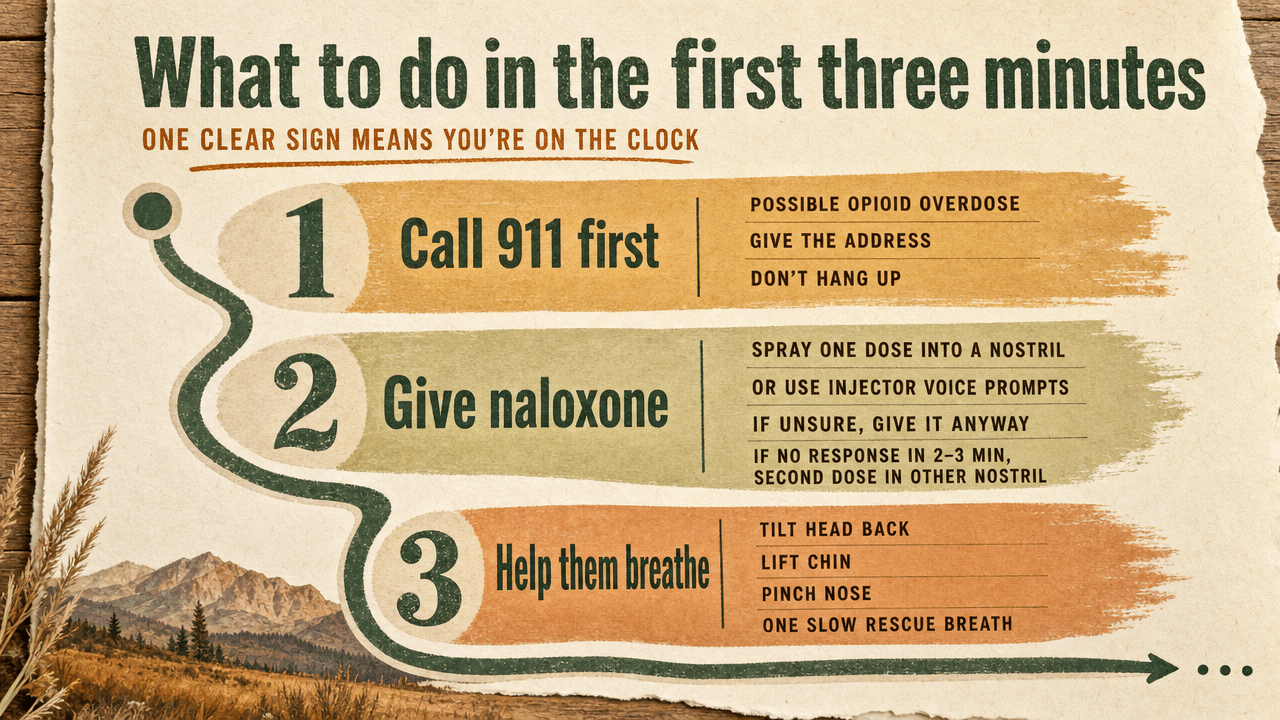
Once you’ve seen even one clear sign — breathing that’s off, lips going blue, a body that won’t stir — you’re on the clock. Here’s the sequence, in the order that actually keeps someone alive.3,5,15
- Call 911 first, or shout for someone else to call. Say the words “possible opioid overdose” and give the address. Don’t hang up. The dispatcher can talk you through the next steps while you work.
- Give naloxone if you have it. Spray one dose into a nostril, or follow the injector’s voice prompts. If you’re not sure whether it’s an overdose, give it anyway — naloxone won’t hurt someone who doesn’t need it. With fentanyl, one dose is often not enough. If there’s no response in two to three minutes, give a second dose in the other nostril.
- Help them breathe. Tilt the head back, lift the chin, pinch the nose, and give one slow rescue breath every five seconds. You’re looking for the chest to rise. This is the single most important thing you can do while waiting for naloxone to work — their brain needs oxygen right now.
- Roll them onto their side. Once they’re breathing on their own, put them in the recovery position — on their side, top knee bent, head tilted so anything in their mouth can drain out. This keeps them from choking if they vomit.
- Stay with them until help arrives. Don’t leave, even if they wake up and seem okay. Naloxone can wear off before the fentanyl does, and breathing can slide back down. Talk to them. Keep watching the chest. When paramedics arrive, tell them what you gave, when you gave it, and anything you know about what the person took.
You may feel shaky, sick, or oddly calm afterward. All of that is normal. What you just did is the reason they have a next chapter.
Hidden fentanyl: counterfeit pills and contaminated stimulants
Here’s the part that catches families off guard: your loved one may not know they took fentanyl at all.
The DEA has been clear that fentanyl is showing up pressed into counterfeit pills made to look like oxycodone, Xanax, Adderall, or Percocet — the kind of pill someone might buy from a coworker, a dating app connection, or a friend of a friend who “knows a guy.” One pill can look identical to a real prescription and still contain a fatal dose. There is no way to tell by looking, tasting, or smelling.8
It’s also turning up in stimulants. A CDC report on a cluster in New Haven documented a group of people who thought they were using cocaine and instead had rapid, sudden loss of consciousness and respiratory failure — the classic fentanyl picture, in people who didn’t believe they were touching an opioid. If someone in your house uses cocaine, meth, or pills that didn’t come from a pharmacy, they are at fentanyl risk whether they think so or not.18
This is why the seven signs matter even when the story doesn’t add up. If you find them unresponsive after a “pill” or a “line,” don’t wait to sort out what was in it. Treat what you see. Give naloxone. Call for help.
After the reversal: why the next 24 hours matter
Here’s something a lot of families don’t know until they live it: waking up after naloxone isn’t the end of the emergency. It’s the middle of it.
Naloxone works fast, but it wears off faster than fentanyl does. That means someone can open their eyes, sit up, insist they’re fine, even feel angry or embarrassed — and then slide back into slowed breathing 20, 40, 90 minutes later once the naloxone leaves their system. This is why SAMHSA and other guides tell you to stay with the person, keep watching, and let paramedics take them in.5
If they push back on going to the hospital, keep it simple and warm. Tell them you love them. Tell them you need them to be watched by someone with oxygen and monitors, just for tonight. Then let the paramedics do their job.
Progress in Montana, and why vigilance still matters
Here’s a piece of news that deserves to be held gently: Montana isn’t losing this fight quietly. State Crime Lab data show preliminary fentanyl-linked overdose deaths dropped from 80 in 2023 to 55 in 2024. That’s real. That’s families who still have their people. That’s naloxone in glove boxes, harder conversations at kitchen tables, treatment beds filled, and neighbors who learned the signs.17
If you’ve been part of that — carried naloxone, made a call, sat up with someone through a bad night — you helped make that number smaller. Let that sit with you for a second.
And then hold the other truth next to it. Those numbers are preliminary and don’t capture the full statewide picture. Fentanyl hasn’t left. It’s still showing up in pills that look like anything, in powders sold as something else, in doses no one can measure by eye. The DPHHS April 2025 alert about a spike in overdoses is a reminder that the trend line isn’t a straight line — it moves week to week, county to county.6,17
So the takeaway isn’t relief. It’s this: what you’re learning right now still matters. Keep naloxone within reach. Keep watching for the signs you just read about. Keep saying yes to hard conversations. The progress in the data was built by people doing exactly what you’re doing on this page.
From surviving to recovering: what comes next
The person you love is breathing. Maybe they’re in an ER bed right now, or riding home in the passenger seat, quieter than usual. Maybe you’re the one who woke up in the ambulance and is reading this at 3 a.m. because you don’t know what to do with the fact that you almost didn’t wake up at all.
This is the window. The days right after an overdose are when the door to real treatment opens widest. Not because anyone should have to nearly die to earn help, but because the fear and clarity of what just happened tend to burn off the usual excuses on both sides.
Fentanyl withdrawal is hard, and it’s the reason a lot of people go straight back to using within hours of leaving the hospital. That’s where medically monitored detox matters — a place with nurses, medications to take the edge off, and people who won’t be shocked by anything the body does next. From there, a 30, 60, or 90-day residential stay gives the brain time to actually settle. At Rocky Mountain Treatment Center in Great Falls, more than 80% of the staff have walked this road themselves, and complimentary pickup from anywhere in Montana is one call away.
You survived the sign. Now the next step is one you don’t have to take alone.
Frequently Asked Questions
How is a fentanyl overdose different from other opioid overdoses?
The signs look similar — pinpoint pupils, slowed breathing, and someone you can’t wake up— but fentanyl is far more potent, so breathing can shut down faster and with a smaller amount. It can also cause chest muscle rigidity and fluid in the lungs, and one dose of naloxone may not be enough to keep breathing going.5,1213.
How much naloxone does a fentanyl overdose need?
Start with one dose in a nostril. If there’s no response in two to three minutes, give a second dose in the other nostril. Some fentanyl cases have needed doses beyond 4 mg with recurring respiratory failure, so keep watching breathing even after they wake up. Always pair naloxone with a 911 call — reversal alone isn’t the whole rescue.5,9
Can someone overdose on fentanyl without knowing they took it?
Yes, and it happens often. Fentanyl gets pressed into counterfeit pills made to look like oxycodone, Xanax, or Adderall, and it turns up in cocaine and meth. A CDC report described people who thought they were using cocaine and had sudden loss of consciousness and respiratory failure. If the story doesn’t add up, treat what you see anyway.8,18
What should I do if the person wakes up after naloxone and refuses to go to the hospital?
Stay warm, stay close, and keep pushing gently. Naloxone wears off before fentanyl does, so breathing can slip back down 20 to 90 minutes later. Tell them you love them and you need them watched by someone with oxygen and monitors, just for tonight. If they still refuse, don’t leave — keep watching the chest until paramedics arrive.5
How long should someone be monitored after a fentanyl overdose reversal?
Medical guidance points to 12 to 24 hours of observation after significant fentanyl toxicity, not a quick ER check and release. That window catches delayed breathing problems, chest rigidity, and fluid in the lungs — a cough with pink, frothy sputum is a red flag that needs a hospital. SAMHSA also recommends at least four hours of watching for recurrent toxicity.5,12,15
What happens after the crisis — how does someone move from surviving to recovery?
The days right after an overdose are when the door opens widest. Medically monitored detox helps the body through fentanyl withdrawal safely, and a 30, 60, or 90-day residential stay gives the brain time to settle. At Rocky Mountain Treatment Center in Great Falls, more than 80% of staff have walked this road themselves, and complimentary Montana pickup is one phone call away.
References
- Opioid Overdose. https://medlineplus.gov/opioidoverdose.html
- Opioid intoxication: MedlinePlus Medical Encyclopedia. https://medlineplus.gov/ency/article/000948.htm
- Drug use first aid: MedlinePlus Medical Encyclopedia. https://medlineplus.gov/ency/article/000016.htm
- How Naloxone Saves Lives in Opioid Overdose. https://medlineplus.gov/medlineplus-videos/how-naloxone-saves-lives-in-opioid-overdose/
- Five Essential Steps for First Responders. https://library.samhsa.gov/sites/default/files/five-essential-steps-for-first-responders.pdf
- State Health Officials Report Significant Increase in Overdoses. https://dphhs.mt.gov/news/2025/April/SignificantIncreaseinOverdoses
- Summary of Opioid Use in Montana. https://dphhs.mt.gov/assets/publichealth/EMSTS/Data/Opioid_Drug_Use_Summary.pdf
- Facts about Fentanyl | U.S. Drug Enforcement Administration. https://www.dea.gov/resources/facts-about-fentanyl
- Multiple Fentanyl Overdoses — New Haven, Connecticut, June 23, 2016. https://pmc.ncbi.nlm.nih.gov/articles/PMC5657834/
- Multiple Fentanyl Overdoses — New Haven, Connecticut, June 23, 2016. https://www.cdc.gov/mmwr/volumes/66/wr/mm6604a4.htm
- SAMHSA Overdose Prevention and Response Toolkit. https://library.samhsa.gov/sites/default/files/overdose-prevention-response-kit-pep23-03-00-001.pdf
- Fentanyl: Incapacitating Agent | NIOSH – CDC. https://www.cdc.gov/niosh/ershdb/emergencyresponsecard_29750022.html
- Opioid Toxicity – StatPearls. https://www.ncbi.nlm.nih.gov/books/NBK470415/
- Drug Overdose Morbidity in Montana, 2025 YTD. https://dphhs.mt.gov/assets/publichealth/Epidemiology/DOSE_Quarterly_Report.pdf
- Naloxone – StatPearls. https://www.ncbi.nlm.nih.gov/books/NBK441910/
- Naloxone DrugFacts | National Institute on Drug Abuse. https://nida.nih.gov/publications/drugfacts/naloxone
- Fentanyl seizures decrease, felony arrests and other drug seizures increase in 2024. https://dojmt.gov/attorney-general-knudsen-fentanyl-seizures-decrease-felony-arrests-and-other-drug-seizures-increase-in-2024/
- Multiple Fentanyl Overdoses — New Haven, Connecticut, June 23, 2016. https://www.cdc.gov/mmwr/volumes/66/wr/mm6604a3.htm