
Key Takeaways
- Look honestly at your drinking patterns first, noting frequency, quantity, and what happens when you stop, since clear self-observation shapes every conversation that follows with doctors or admissions staff.
- A five-minute screening like the AUDIT, done yourself or with a primary care doctor, turns rough impressions into a severity rating that guides the right level of care 4.
- Decide whether withdrawal needs medical supervision before quitting cold, because daily heavy drinking, past seizures, or morning drinking raise the risk of dangerous symptoms within 6 to 24 hours 12.
- Match care intensity to your situation using ASAM criteria, ranging from weekly outpatient counseling to intensive inpatient with detox, based on severity, withdrawal risk, home environment, and past attempts 17.
- Verify a nearby program in one phone call by asking for license numbers, accreditation, detox capability, length-of-stay options, family programming, aftercare, insurance, and staff background.
- Get a written verification of benefits before committing, asking whether detox is covered separately, who handles pre-authorization, and what happens if your insurer wants to step you down early.
- Line up continuing care before admission, including scheduled follow-ups at 30, 60, 90, 180, and 365 days, local meetings, and therapist coordination, because recovery holds when support continues 6, 18.
- The first week centers on physical stabilization during detox, then shifts into counseling and group work by days four or five, with the next concrete step being a single phone call 3.
If you’re searching this at 2 a.m., start here
If you’re reading this in the quiet hours, maybe after a hard night or a conversation you can’t stop replaying, take a breath. The fact that you typed those words into a search bar already means something. You’ve stopped pretending things are fine, and that takes more courage than people give it credit for.
Here’s what the next few minutes can give you: a clearer map. Finding alcohol treatment near you isn’t one giant decision. It’s a short sequence of smaller ones, and you only have to take the next step, not all of them at once. You’ll learn how to read the signs, when withdrawal needs a doctor’s eyes on it, what level of care fits your situation, and how to check that a program near you is the real thing. If you’d rather talk to someone right now than keep reading, SAMHSA runs a free, confidential helpline at 1-800-662-HELP that’s open 24/7, every day of the year, and it can point you toward local options 3. Keep this tab open too. You can come back when you’re ready, and we’ll walk through the rest together.Read the signs honestly before you read reviews
Before you start comparing programs, give yourself five quiet minutes to look at your own drinking without flinching. Not to shame yourself. Just to see it clearly. Reviews and price sheets won’t matter if you’re not honest about what you’re actually dealing with.
Alcohol use disorder lives on a spectrum. It can be mild, moderate, or severe, and it usually shows up as some mix of craving, drinking more or longer than you meant to, trouble cutting back, and feeling sick or shaky when you stop 11. Doctors use eleven specific questions from the DSM-5-TR to gauge severity, but you don’t need a clinician in the room to start noticing patterns 4. Have you promised yourself you’d stop at two and ended at six? Have mornings gotten harder? Has someone you love asked, gently or not, if you’re okay? Here’s something that might take a little weight off your shoulders: heavy drinking is far more common than the silence around it suggests. In 2024, of the 134.3 million Americans age 12 and older who currently drink alcohol, 57.9 million — about 43.1% — were past-month binge drinkers, based on SAMHSA’s National Survey on Drug Use and Health (self-reported data from people who already drink) 13. That doesn’t make your situation less serious. It just means you’re not the only person sitting with a quiet, scary question tonight. Write down, on paper or in your phone notes, the answers to three things: How often do you drink? How much, in a typical sitting? What happens when you try to stop for a few days? Those notes will do real work later — when you talk to a doctor, when you call a helpline, when you’re asked by an admissions counselor what’s been going on. You don’t need perfect words. You just need true ones.Take a five-minute screening (or ask your primary care doctor to)
Once you’ve jotted down those notes about your drinking, a short screening turns rough impressions into something more useful. You can do one yourself, or you can hand the job to a primary care doctor who screens patients for this all the time. Both work. The point is to get a clearer reading before you start calling programs.
The most common self-screens are the AUDIT and the shorter AUDIT-C, which ask about how often you drink, how much, and whether drinking has caused problems. You can find them free on health sites or by asking your doctor to walk you through one. It takes about five minutes. Your answers, paired with what you already wrote down, give a clinician enough to gauge severity on the mild-moderate-severe spectrum that NIAAA uses to talk about alcohol use disorder 4. That severity rating matters because it shapes everything that comes next — whether outpatient counseling is enough, whether residential care makes more sense, or whether you’ll need medically supervised detox first. If calling a treatment center feels like too big a leap right now, your primary care doctor is a softer landing. The CDC has shown that routine screening plus a short counseling conversation in primary care actually reduces heavy drinking for many people, so a regular checkup is a legitimate first step, not a delay tactic 10. Tell your doctor what you wrote down. Ask for the screening. Ask what they’d recommend. Not ready for either yet? Call SAMHSA’s helpline at 1-800-662-HELP. The people who answer are trained to ask the right questions and connect you with local options, and the call is free and confidential 3. Making that call counts as progress.Decide whether withdrawal needs medical supervision
This is the step people most often try to skip, and it’s the one that can hurt you. If you’ve been drinking heavily for a while, stopping cold on your own isn’t just uncomfortable — it can be dangerous. Your body has adapted to alcohol being in your system, and pulling it out suddenly can send your nervous system into overdrive.
Mild withdrawal looks like the morning after you’ve quit a few times before: anxiety, sweating, a racing heart, trouble sleeping, maybe some nausea or shakiness. Those symptoms tend to start within 6 to 24 hours of your last drink 12. For some people, that’s where it stops. For others, it climbs. Severe withdrawal can bring hallucinations, seizures, and a condition called delirium tremens that, untreated, can be fatal 12. The hard part is that you can’t always predict in advance which category you’ll land in. Medically supervised detox isn’t a hospital horror story. In a residential setting, it usually means a small medical team checks your vitals on a regular schedule, manages symptoms with medication if needed, and keeps you safe through the hardest 3 to 5 days. After that, you can step straight into the counseling and group work that does the longer-term repair 9. You don’t have to white-knuckle this part. Asking for medical help during withdrawal isn’t weakness — it’s the same logic as not setting your own broken arm. Call your doctor, call SAMHSA’s helpline at 1-800-662-HELP, or call a residential program in your area and ask whether they offer on-site detox 3. That one question tells you a lot about whether a program is equipped for where you actually are.Match the level of care to your situation
Outpatient, IOP, residential, or intensive inpatient: a placement guide
There’s no single right answer here, and that’s actually good news. The same disorder gets treated at different intensities depending on where you are on the spectrum and what your life looks like outside the program. Clinicians use the ASAM criteria to make placement decisions, which weigh four things together: how severe your alcohol use disorder is, your withdrawal risk, what your home environment is like, and whether you’ve tried treatment before 17.
Outpatient counseling usually fits mild AUD. You meet with a therapist once a week, maybe attend a support group, and keep working and living at home. It can be the right starting point if you’re catching things relatively early, your withdrawal risk is low, and the people you live with are stable and supportive 5. Intensive outpatient (IOP) bumps that up to roughly 9 to 15 hours of group and individual sessions per week, often in the evenings. It’s a real option for moderate AUD when you can still safely sleep at home but need more structure than a weekly appointment provides 17. Residential treatment is a 24-hour structured setting where you live on-site for weeks at a time 17. It tends to be the right call when one or more of these is true: your drinking is moderate to severe, your home environment makes sobriety harder (a drinking partner, easy access, a stressful or unsafe situation), you’ve tried outpatient and it didn’t hold, or you have a co-occurring mental health condition that needs steady attention 7. The point isn’t that you’re worse off than someone in outpatient. It’s that you need physical distance from the patterns and triggers that keep pulling you back. Intensive inpatient with medical detox is the highest level and is built for severe AUD with significant withdrawal risk — the situations described in the previous section 8, 9. Many residential programs include this on the front end so you don’t have to transfer between facilities to get through the first week safely. If you’re genuinely unsure where you fall, that’s a fair place to be. An admissions counselor at a residential program, or your primary care doctor, can do a structured assessment in under an hour and tell you what fits.What a 30/60/90-day residential stay actually looks like
If residential keeps coming up as the right fit, it helps to know what you’re actually signing up for, because the word “rehab” carries a lot of TV-show baggage that doesn’t match the reality.
A typical day has a rhythm. Mornings start with breakfast and a short check-in or meditation. Then individual counseling or group therapy fills the late morning — this is where the real work happens, looking at what alcohol has been doing for you, what it’s been doing to you, and what’s underneath both. Afternoons mix in education sessions, 12-step meetings, and experiential pieces like recreation, nature time, or, in some Montana programs, equine therapy where you work alongside horses. Evenings tend to be quieter: a group meeting, journaling, or just downtime with the people you’re going through this with 6, 18. The length you choose isn’t arbitrary. A 30-day stay gets you stable, breaks the daily cycle, and gives you a foundation. Sixty days lets you go deeper into the patterns and the family or trauma history that often sits underneath drinking. Ninety days is what many clinicians quietly consider the sweet spot for moderate-to-severe AUD, because it’s long enough for new habits to actually take root before you’re back in the world that shaped the old ones 7. Smaller facilities feel different from large institutional settings. In a 26-bed program, your counselor knows your name on day two, your roommates become people you trust, and the staff — many of whom have walked this path themselves — are reachable without an appointment. That’s not a small thing when you’re rebuilding your sense of safety. Whatever length you choose, the goal is the same: leave with sobriety, with skills, and with a plan for the day after discharge.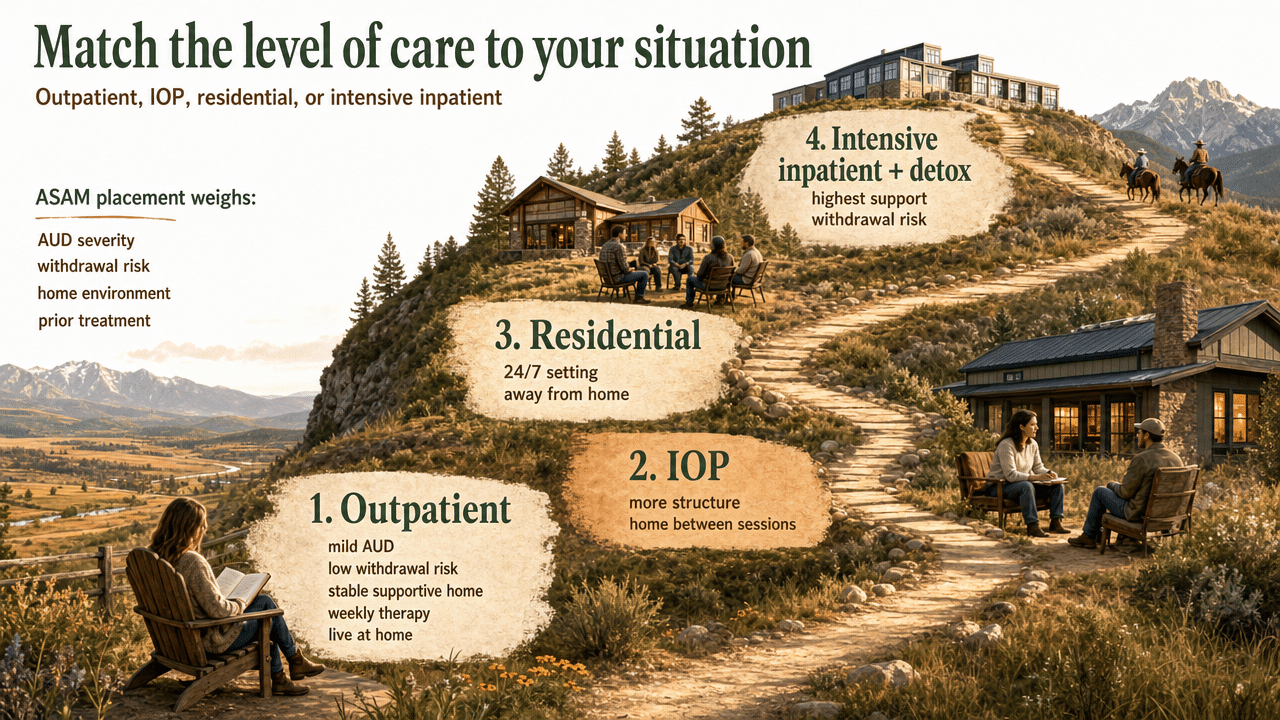
Verify a nearby program in one phone call
Once you’ve narrowed it down to a few programs within driving distance, one phone call can tell you almost everything you need to know. You don’t need a clinical background to ask good questions — you just need a short checklist and the willingness to keep asking until the answers are clear.
Start with licensure. In Montana, substance use disorder facilities have to meet state requirements set by the Department of Public Health and Human Services, and the Licensure Bureau is the office that actually approves and oversees them 14. You can confirm a facility’s status through Montana DPHHS, which maintains the official application and oversight area for SUD facilities 16. The state’s Treatment Bureau oversees substance use disorder services for adults and adolescents across Montana, so a properly licensed program will sit inside that system, not outside it 15. Ask the admissions person directly: “Are you licensed by Montana DPHHS, and can you give me your license number?” A real program will answer without hesitation. Then ask about accreditation. Joint Commission accreditation is a national quality marker that means the facility has been independently surveyed against clinical and safety standards. It’s not required, but it’s a good sign when it’s there. Here’s the rest of the checklist to work through in that same call:- Detox capability. Do you offer on-site medically supervised detox, or do I need to detox somewhere else first? If you’ve already worked through the withdrawal-risk questions earlier in this process, you know which answer you need 9.
- Length of stay options. Do you offer 30, 60, and 90-day programs, and how do you decide what’s right for someone?
- Family programming. Is there structured family involvement — a family week, family counseling, education for spouses or parents?
- Aftercare. What does continuing care look like after I leave? Are there scheduled follow-ups at 30, 60, 90, 180, and 365 days? Weekly group meetings online?
- Insurance. Which insurance plans do you accept, and can you verify my benefits before I commit?
- Staff. Who will I actually be working with? How many of your counselors have lived experience with recovery themselves?
Pay for it: insurance, self-pay, and what to ask before admission
Money is the question that keeps a lot of people from picking up the phone, so let’s get it out in the open. Residential treatment isn’t cheap, but it’s also rarely the full out-of-pocket number you might be imagining. Most major insurance plans now cover substance use treatment as an essential health benefit, which means a real chunk of your stay is often paid before you ever see a bill.
When you call a program, ask admissions to run a verification of benefits before you commit to anything. They do this every day. Give them your insurance card number and they’ll come back with what’s covered, what your deductible looks like, and what your daily or per-stay responsibility might be. Get the estimate in writing if you can. Ask three follow-ups: Is detox covered separately from residential days? Is there a pre-authorization requirement, and will you handle it? What happens if my insurer wants to step me down before my clinical team thinks I’m ready? If you don’t have insurance, or your plan won’t cover the level of care you need, ask about self-pay rates, payment plans, and whether the program works with healthcare lending partners. Some Montana facilities don’t accept Medicaid or Medicare, so confirm that early rather than at admission. SAMHSA’s helpline can also point you toward programs in your area that match your coverage situation, free and confidential, any hour 3.Line up continuing care before you ever pack a bag
Here’s the part most people don’t think about until they’re already in the middle of treatment: what happens on day 31, or day 61, or day 91 — the morning you walk out the door. That morning is a real thing, and the version of you who walks out is going to be tired, hopeful, and a little raw. Lining up support before you arrive is one of the kindest things you can do for that future version of yourself.
Continuing care isn’t optional polish on top of treatment. It’s part of the treatment. Strong residential programs build it in from the first week — mapping out who you’ll see, what meetings you’ll attend, and who will check on you at the 30, 60, 90, 180, and 365-day marks after discharge. Recovery science backs this up: combining behavioral therapy, mutual-support groups like 12-step meetings, and (when appropriate) FDA-approved medications works best when those threads keep going long after the structured stay ends 6, 18. Ask any program you’re considering exactly what this looks like. Do they run weekly online groups you can join from your kitchen table? Do they help you find local 12-step meetings near home before you leave? Do they coordinate with an outpatient therapist or your primary care doctor for medication follow-up? Is there an alumni community you can actually reach? If the answers are vague or stop at “we’ll give you some referrals,” keep looking. One small thing you can do this week: write down the names of two or three people — a sibling, a friend, a pastor, a sponsor you don’t have yet — who you’d want in your corner on day 31. You don’t have to call them. Just having the list makes the bag you eventually pack feel a little lighter.What the first week feels like — and how to take the next step
The first week is the one most people are scared of, so let’s name it honestly. Days one through three, if you need medically supervised detox, are about getting your body steady — a quiet room, regular vitals checks, medication if your symptoms call for it, and people who’ve seen this before keeping watch 9. You’ll sleep more than you expect. You’ll eat when you can. You won’t be asked to do heavy emotional work yet.
By day four or five, the fog starts to lift. That’s usually when group meetings, individual counseling, and the first 12-step sessions begin to feel less like a blur and more like something you’re actually part of 6. You’ll meet your counselor. You’ll meet the people in the room with you. Some of them will become the reason the second week feels easier than the first.Frequently Asked Questions
How do I know if I need rehab or if I can quit on my own?
If your drinking is mild, you’ve had no withdrawal symptoms when you’ve stopped before, and your home life supports sobriety, cutting back with your doctor’s help or outpatient counseling may be enough 5. Rehab tends to be the right call when drinking is moderate to severe, you’ve tried to stop and couldn’t, your home environment makes it harder, or you have a co-occurring mental health condition that needs steady attention 7.
Is medically supervised detox really necessary, or can I just stop drinking?
For some people, yes — it’s a safety issue, not a comfort one. If you drink daily, have been drinking heavily for months or years, or have had shakes, seizures, or hallucinations during past attempts to stop, withdrawal can become dangerous within 6 to 24 hours 12. Medically supervised detox keeps vitals monitored and symptoms managed through the hardest few days 9. Ask your doctor or call 1-800-662-HELP before deciding 3.
How long does residential alcohol treatment usually last?
Most residential programs offer 30, 60, or 90-day stays, and the right length depends on the severity of your alcohol use disorder and what’s happening in your life 7. Thirty days breaks the daily cycle and builds a foundation. Sixty gives you room to work on what’s underneath the drinking. Ninety is often recommended for moderate-to-severe AUD because new habits need time to hold before you return to the world that shaped the old ones.
How can I check that a treatment center near me is properly licensed?
In Montana, substance use disorder facilities must be licensed by the Department of Public Health and Human Services, and the Licensure Bureau approves and oversees them 14. You can confirm a facility’s status through Montana DPHHS, which maintains the official application and oversight area for SUD facilities 16. The state’s Treatment Bureau also oversees SUD services across Montana 15. Ask admissions directly for their license number — a real program answers without hesitation.
Will my insurance cover alcoholism treatment?
Most major insurance plans cover substance use treatment as an essential health benefit, though what’s covered varies. Call the program you’re considering and ask them to run a verification of benefits using your card — they do this every day and can come back with covered days, your deductible, and any pre-authorization requirements. Ask specifically whether detox is covered separately from residential days. If you don’t have insurance, ask about self-pay rates and payment plans.
What happens after I leave a residential program?
Good programs build continuing care in from day one, because the morning you walk out is when the real test starts. Expect scheduled follow-ups at 30, 60, 90, 180, and 365 days, weekly online groups, help finding local 12-step meetings, and coordination with an outpatient therapist or your primary care doctor. Combining behavioral therapy, mutual-support groups, and medications when appropriate works best when those threads keep going long after discharge 6, 18.
References
- Treatment Options for Substance Use Disorder – SAMHSA. https://www.samhsa.gov/substance-use/treatment/options
- Alcohol Use Disorder: Causes, Symptoms, Treatment & Help – SAMHSA. https://www.samhsa.gov/substance-use/learn/alcohol
- SAMHSA’s National Helpline. https://www.samhsa.gov/find-help/helplines/national-helpline
- Alcohol Use Disorder: From Risk to Diagnosis to Recovery. https://www.niaaa.nih.gov/health-professionals-communities/core-resource-on-alcohol/alcohol-use-disorder-risk-diagnosis-recovery
- Treatment for Alcohol Problems: Finding and Getting Help. https://www.niaaa.nih.gov/publications/brochures-and-fact-sheets/treatment-alcohol-problems-finding-and-getting-help
- Recommend Evidence-Based Treatment: Know the Options. https://www.niaaa.nih.gov/health-professionals-communities/core-resource-on-alcohol/recommend-evidence-based-treatment-know-options
- Treatment of Alcohol Use Disorder. https://www.ncbi.nlm.nih.gov/books/NBK561234/
- Alcohol Withdrawal in Hospitalized Patients – NCBI Bookshelf. https://www.ncbi.nlm.nih.gov/books/NBK604324/
- The ASAM Clinical Practice Guideline on Alcohol Withdrawal Management Pocket Guide – SAMHSA. https://www.samhsa.gov/resource/ebp/asam-clinical-practice-guideline-alcohol-withdrawal-management-pocket-guide
- Screening for Alcohol Use and Brief Counseling of Adults – CDC. https://www.cdc.gov/mmwr/volumes/69/wr/mm6910a3.htm
- Alcohol Use Disorder (AUD) – MedlinePlus. https://medlineplus.gov/alcoholusedisorderaud.html
- Alcohol Withdrawal Syndrome – StatPearls – NCBI Bookshelf. https://www.ncbi.nlm.nih.gov/books/NBK441882/
- SAMHSA Releases Annual National Survey on Drug Use and Health. https://www.samhsa.gov/newsroom/press-announcements/20250728/samhsa-releases-annual-national-survey-on-drug-use-and-health
- Dear Prospective Substance Use Disorder Facility Service Provider. https://dphhs.mt.gov/assets/oig/LicensureBureau/SUDFLetterUpdated_20251.pdf
- Substance Use Disorder Services and Resources – Montana DPHHS. https://dphhs.mt.gov/BHDD/SubstanceAbuse/
- Substance Use Disorder Facility – Montana DPHHS. https://dphhs.mt.gov/oig/licensure/healthcarefacilitylicensure/lbfacilityapplications/lbsubstanceusedisorderfacility
- Treatment Programs for Substance Use Disorder. https://www.ncbi.nlm.nih.gov/books/NBK584391/
- Advances in the science and treatment of alcohol use disorder. https://pmc.ncbi.nlm.nih.gov/articles/PMC6760932/