Key Takeaways
- The second week home is when structure disappears and cravings return, making staying tethered to a recovery community more decisive than willpower alone.
- Structured continuing care roughly doubles the odds of remission, with the strongest results when support runs a full 12 months rather than tapering after 90 days.13
- Rocky Mountain’s 30, 60, 90, 180, and 365-day check-ins, weekly Zoom groups, and 12-step habits work together to reinforce the four pillars of recovery capital: personal, family, community, and housing.4
- A slip is a signal that one pillar thinned out, not a verdict — the next move is calling a counselor or sponsor and reconnecting sooner, not starting over.1
The Second Week Home Is Harder Than Anyone Warned You
The first week home, you rode the momentum. You unpacked. Someone made your favorite dinner. Your phone buzzed with people checking in. You told yourself, I’ve got this.
Then the second week arrives, and the house gets quiet.
Everyone else goes back to their regular Tuesday. The coffee tastes the same as it did before treatment, but you’re drinking it alone at 6 a.m. with a whole day stretching out in front of you. No group at 9. No lunch with people who understood what a Wednesday craving actually feels like. Just the dog, the dishes, and a brain that has suddenly gotten very loud again.
If that’s where you are right now, you are not doing recovery wrong. You are doing it exactly how it feels for most people who have finished residential care. The structure that held you up for 30, 60, or 90 days is gone, and your nervous system notices.
Here is the part nobody puts on a discharge folder: staying sober at home is not a test of willpower. It is a test of connection. The people who make it through this stretch are not the ones with the strongest resolve. They are the ones who stayed tethered to the community they built in treatment, kept picking up the phone on day 30 and day 60 and day 90, and let a few key people keep showing up for them.
That tether is what alumni support after rehab is. And at Rocky Mountain Treatment Center, it is not an afterthought. It is built into what comes after the barn, the bunk room, and the last group. This article walks you through what that looks like, why it works, and how to use it when your second week gets quiet.
What the Research Actually Says About Staying Connected
You might be wondering, quietly, whether any of this alumni stuff actually does anything. It is a fair question to ask yourself at 6 a.m. with cold coffee. The honest answer is yes, and the research is not subtle about it.
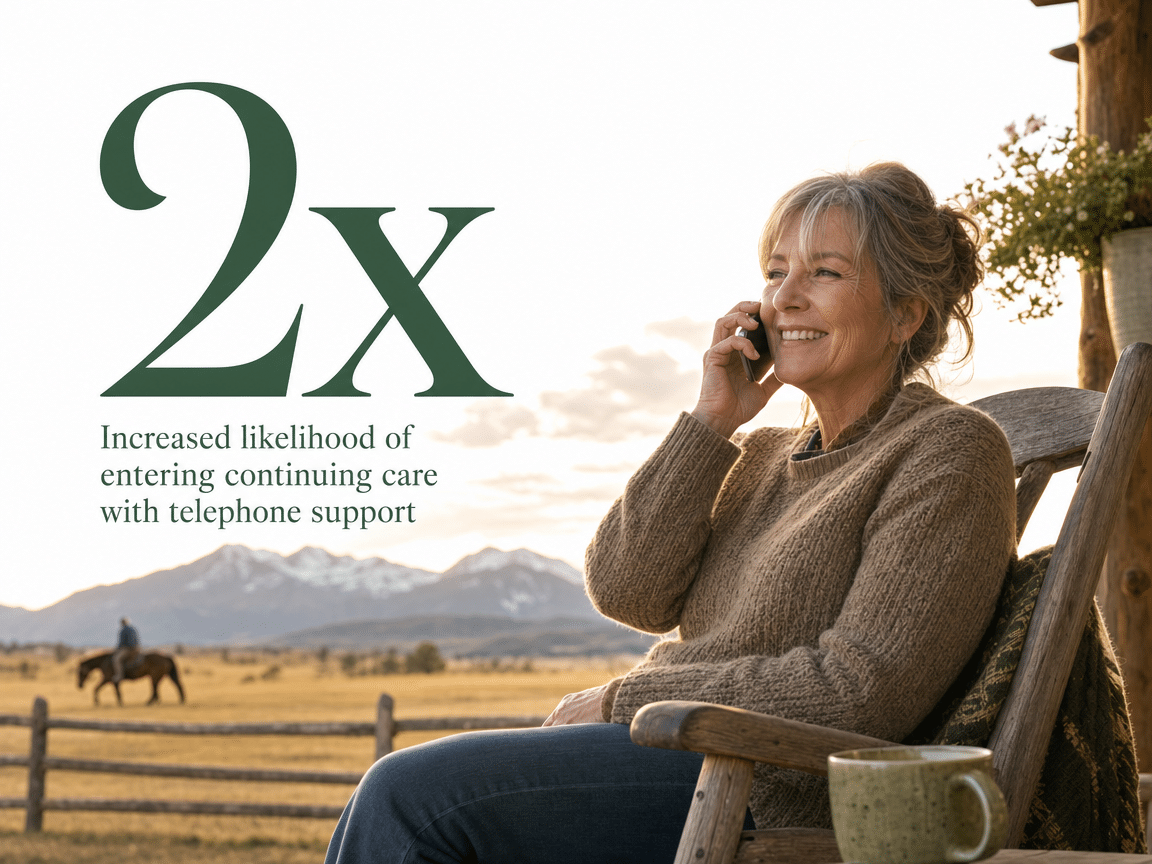
In a randomized trial of adults leaving intensive outpatient treatment for alcohol and cocaine dependence, people who received structured telephone continuing care were more than twice as likely to actually stay engaged in continuing care compared with those left to arrange follow-up on their own. They also reported fewer substance-related problems at the three-month mark. That is the exact shape of a 30, 60, and 90-day check-in: a person on the other end of the line, calling on purpose, at a time when your motivation is thinner than it was in the bunk room.2
Longer studies push the finding further. A nine-year look at adults in a managed care system found that people who received consistent continuing care had roughly twice the odds of reaching remission compared with those who did not. Not twice the good vibes. Twice the odds of the outcome you actually want.13
A meta-analysis pooling 19 randomized trials landed in the same place, more cautiously worded: continuing care produces small but reliable improvements in substance use outcomes, with stronger effects when programs keep engaging people over longer stretches rather than fading out after a month. That last part matters, because it is exactly why Rocky Mountain’s follow-up does not stop at 90 days.15
Read those studies together and a plain pattern shows up. Structured contact after discharge roughly doubles the odds that you keep doing the things that keep you sober. It does not require heroic willpower on your part. It requires a phone that rings, a group that meets, and a few people who know your name and your story. That is what alumni support after rehab is built to be.
None of this promises perfection. What it does say is that people who stay connected have measurably better odds than people who try to go it alone, and those odds hold up in studies that followed folks for years, not weeks. If you are in your second week home and wondering whether picking up that first call is worth it, the numbers are quietly on your side.
The Rocky Mountain Follow-Up Cadence: 30, 60, 90, 180, 365
Here is what the calendar actually looks like after you leave Great Falls.
On day 30, your phone rings. Not a robocall, not a reminder text — a real person from the team you already know, asking how the first month has gone. What’s the sleep like. Are you eating. Did you find a meeting. Is there a Tuesday night that feels shaky. That call happens again at 60 days, and again at 90. Then it comes back at 180 days, right around the time most people quietly assume everyone has forgotten about them. And it comes one more time at a year, on day 365, when you have made it further than you probably thought you would when you were unpacking that duffel bag.
That cadence is not random. Research on the continuing care model is clear that recovery from alcohol and drug use disorders needs support for at least 12 months after treatment, and that regular involvement in aftercare over that stretch is what pushes abstinence rates above roughly 65%. A 30-day check-in alone will not do it. Ninety days will not do it either. The evidence points to the full year, which is exactly why Rocky Mountain’s schedule does not taper off after the first three months.14
Each check-in has a shape. Early on, at 30 and 60 days, the conversation tends to be about the concrete stuff: is your sponsor returning texts, are you making it to meetings, is your family adjusting, are you sleeping. By 90 days, the questions widen a little — work, relationships, boredom, the new-and-sober version of Friday night. At 180, the counselor is usually asking about the harder maintenance questions: are you drifting away from meetings, are you white-knuckling anything, has anything happened that you have not told anyone about yet. And at 365, it is often a conversation about identity — who you are now, what your recovery looks like, and what the next year might need.
The people making these calls are, in most cases, people in recovery themselves. Roughly 80% of Rocky Mountain’s staff has sat in the chair you sat in. That matters when the question is real and the answer is complicated. You are not explaining a craving to someone who has only read about it.
Between calls, the weekly Zoom groups keep the thread alive so you are not waiting a full month to talk to someone who understands. Add in the alumni events — cookouts, holiday gatherings, the occasional trip back to the barn — and the year post-discharge is scaffolded end to end. If you miss a call, someone tries again. If you go quiet at 90 days, they notice. That is the point of building the cadence this way: to make sure that when your second week home gets loud, there is already a plan for someone to reach you.
Weekly Zoom Groups and the People on the Other End of the Call
A month between phone calls is a long time when your brain is loud. That is why the check-ins are not the whole picture. In between them, Rocky Mountain runs a weekly Zoom group — same day, same time, same faces starting to feel familiar again.
You log on from your kitchen table in Missoula, or a break room in Billings, or a bedroom two states away. Someone else logs on from Great Falls. Someone from the group you were in three months ago is there. So is a counselor you already trust. The conversation is not scripted. Someone talks about a hard weekend. Someone else shares a small win — a wedding they got through, a fight with a spouse they didn’t drink over, a first month back at work. You listen. Eventually, you talk too.
Online support has become a real part of how recovery works now, not a substitute. A review of digital recovery support services found that online meetings, apps, and text-based tools can extend the reach of traditional care and help people stay engaged in recovery activities between in-person contacts. Translation: the Zoom group is not a lesser version of showing up in person. It is a bridge that keeps you connected on the Tuesday nights when driving to a meeting feels like too much.7
What makes these groups land is who is in them. Roughly 80% of Rocky Mountain’s staff has been where you are — they got sober themselves before they ever sat across from a client. When your counselor asks how you are really doing at week seven, they are not reading it off a form. They remember week seven. That kind of witness is hard to fake, and it is what makes a Zoom square feel like a room.
You do not have to talk the first time. You do not have to have anything figured out. You just have to click the link.
12-Step Meetings: The Habit That Started in Treatment
You already know what a meeting feels like. You sat in one at Rocky Mountain. Folding chairs, bad coffee, someone reading the preamble, someone else saying the thing you were too scared to say out loud. That was not a warm-up act. That was practice for the rest of your life.
The research on this is unusually direct. A cohort study of people leaving drug treatment found that weekly or more frequent 12-step attendance was linked with abstinence from both drugs and alcohol, while less-than-weekly attendance did not track with good outcomes. Once a week is not a suggestion. It is roughly where the benefit shows up.3
The other piece of evidence is about how the habit gets started. A study of onsite 12-step meetings during treatment found that 30% of people who attended those meetings while in care went on to attend continuously for the entire following year — compared with just 3% of people who did not attend during treatment. Ten times the odds of staying in the rooms, based on whether the habit started before discharge. That is why Rocky Mountain builds 12-step meetings into the residential schedule instead of handing you a printout on your way out.16
Here is the alumni piece. Finding a home group in your town is the single most concrete thing you can do this week. Ask the counselor on your 30-day call which meetings alumni in your area are hitting. Get a sponsor. Trade phone numbers with two people. Show up on a Tuesday when you do not feel like it. The people you sat with in Great Falls are still in your corner — the meeting on Main Street is where you find your new corner.
Family Week Isn’t a Formality
Addiction does not happen in a vacuum, and neither does recovery. The people who love you have been running their own quiet marathon while you were in treatment — the spouse who stopped sleeping through the night, the adult kid who learned to check your voicemail with dread, the parent who has been holding a breath for years. When you come home, they come home to a version of you they don’t quite know yet, and you come home to a house full of old patterns.
That is why Rocky Mountain’s three-day Family Week is not a courtesy. It is a working session. Your family sits in the same room, learns the language of what actually happened to you, gets to ask the questions they have been sitting on, and starts practicing the harder conversations before you have them at the kitchen table on a Tuesday night. Your counselor is in the room. So are other families going through the same thing, which cuts the shame in half just by existing.
The research on family involvement is quietly striking. In a randomized trial, adults who received a brief family intervention after inpatient detox had nearly twice as many days of continuing care attendance and about two-thirds fewer days of substance use compared with people who got usual care. That is not because families performed some clinical magic. It is because someone who loves you and understands the plan is a lot better at helping you keep the plan than someone who is guessing.6
Family involvement does not end when Family Week does. The follow-up cadence includes room for the people at home — check-ins that ask how the household is doing, not just how you are doing, and Zoom groups where a spouse or parent can find their own footing. Recent reviews of family-inclusive continuing care describe this stretch as the recovery support phase, where sustained family engagement helps hold gains in place. In plain terms: your family gets support too, because they need it, and because their steadiness becomes part of yours.5
If you are dreading Family Week, that is normal. Show up anyway. The people in that room want the same thing you want.
What You Carry Home from the Barn
Ask any Rocky Mountain alum what they remember about treatment, and a horse’s name will come up. Maybe it was the gelding who stood still while you cried into his shoulder. Maybe it was the mare who refused to move until you got your breathing under control. Whatever it was, that hour in the arena stuck to you in a way that a worksheet never could.
That is not sentiment. That is how equine therapy works. A systematic review of equine-assisted services for substance use disorders found that participants were significantly more likely to complete treatment and to stay engaged for 90 days or longer, with qualitative gains in self-efficacy, emotional regulation, and motivation to keep going. The horse does not judge you, does not follow the script, and does not let you fake it. You either regulate yourself or the animal walks away. That kind of feedback loop teaches something the body remembers on a Tuesday afternoon in your kitchen, months later, when your chest gets tight and you have to talk yourself down.17
Here is the alumni connection. What you learned at the barn is portable. The breathing you practiced before approaching a 1,200-pound animal is the same breathing that gets you through a hard family dinner. The patience you built waiting for a horse to trust you is the patience you now extend to yourself on the days recovery feels slow. When you dial into a Zoom group and someone asks what is grounding you this week, you have a real answer — not a concept, a memory with a name and a smell to it.
Bring the barn up on your check-in calls. Counselors know exactly what you mean. That shared vocabulary is part of what makes an alumni network feel like coming home to people who were there.
Building Recovery Capital: The Four Pillars Under Your Feet
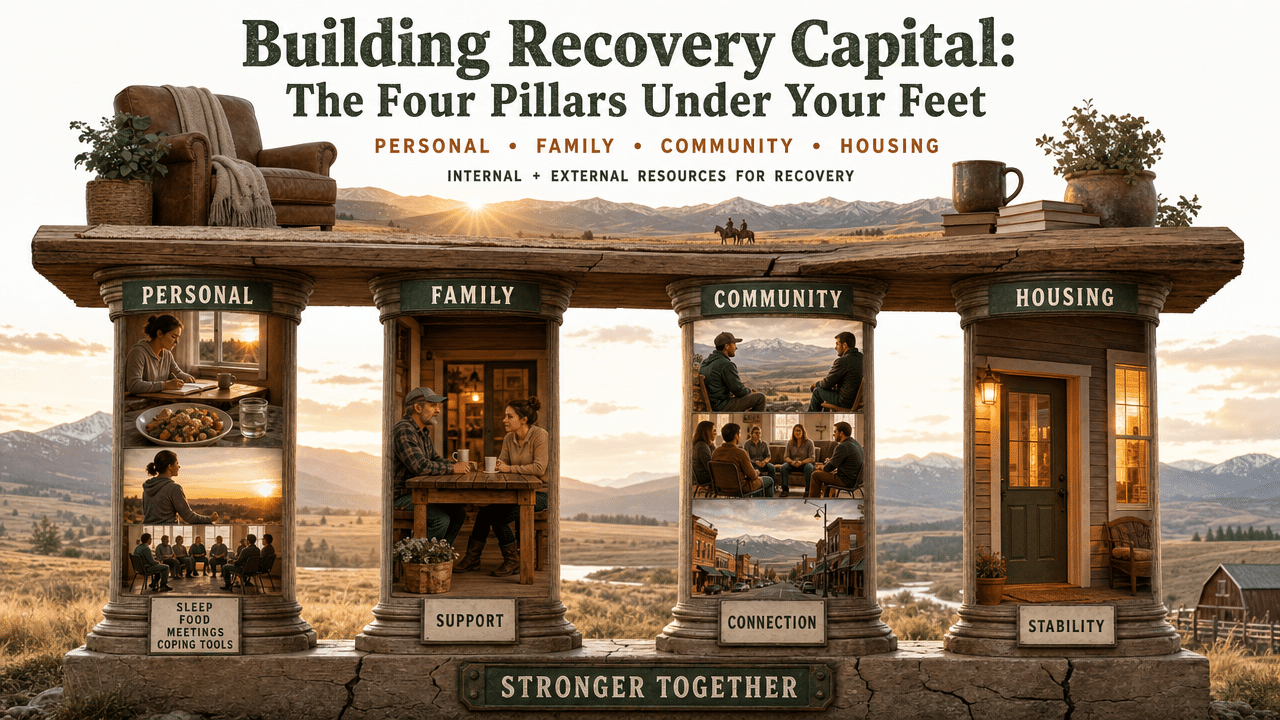
Researchers have a name for the stuff that actually keeps you sober. They call it recovery capital — the internal and external resources you can draw on to start and sustain recovery. A systematic review of the concept found that people with stronger social networks, family support, stable housing, and community engagement have measurably better long-term outcomes than people who try to rebuild in isolation. Think of it as four pillars holding up the same floor. Take one out and the floor tilts. Take two out and it collapses.4
- The first pillar is personal.
- Your sleep, your food, your meetings, your coping tools, the breathing you learned in the arena. Rocky Mountain’s 30, 60, and 90-day check-ins are built around this pillar — the counselor on the line is asking about your daily habits because they are the load-bearing wall.
- The second pillar is family.
- The people at home either steady the floor or shake it, and Family Week plus ongoing family check-ins are how Rocky Mountain helps them become steadying weight instead of unpredictable weight.
- The third pillar is community.
- This is your home group, your sponsor, the Rocky Mountain Zoom on Sunday, the alumni cookout, the two people whose numbers you actually use. Community is what turns “I know I should call someone” into “I already texted Dave.”
- The fourth pillar is housing.
- Where you sleep matters more than most discharge conversations admit. A review of sober living houses found that residents showed significant improvements in alcohol and drug use, employment, arrests, and psychiatric symptoms over 18 months, with the strongest gains when residents also stayed in outpatient care and mutual-help groups. If home is not safe or steady yet, tell your counselor on the next call. They know which houses have good track records and which do not, and part of the alumni role is helping you land somewhere the other three pillars can actually hold.10
You do not build all four pillars at once. You shore up whichever one is shakiest this month and let the rest hold while you do. That is the quiet work of the year after discharge.
When You Slip: Relapse as a Signal, Not a Verdict
Here is the part that is hard to write and harder to read. Some of you will slip. Not because you failed, and not because treatment did not work — because addiction is a chronic condition, and chronic conditions flare. NIDA is direct about this: long-term recovery often involves more than one treatment episode and ongoing support, the same way managing any long-term illness does.1
If it happens, the first move is not shame. It is the phone.
Call your counselor. Call your sponsor. Log into the next Zoom group, even if you have to keep your camera off. The people who answer are not going to be surprised, and they are not going to lecture you. Roughly 80% of Rocky Mountain’s staff got sober themselves before they ever worked in recovery — a slip is a language they already speak. What they will do is help you figure out what shifted, what pillar wobbled, and what the next 24 hours need to look like.
The research points the same direction. Relapse prevention is not a one-time skill you learn in residential; it is ongoing coping practice, social support, and structured follow-up that hold gains in place over time. A slip means one of those supports thinned out. It does not mean you have to start over from zero. It means you reconnect, harder and sooner, to the community that already knows you.11
A slip is data. It tells you where the crack was. Then you call, and you keep going.
Frequently Asked Questions
How long should I stay connected to alumni support after leaving rehab?
What actually happens on a 30, 60, or 90-day check-in call?
Do I have to go to AA or NA to stay involved in alumni support?
How can my family stay involved after I come home?
What should I do if I slip or relapse after treatment?
Can I join alumni Zoom groups if I live far from Montana?
References
- NIDA DrugFacts: Treatment Approaches for Drug Addiction. https://nida.nih.gov/publications/drugfacts/treatment-approaches-drug-addiction
- A randomized controlled trial of Telephone Continuing Care for alcohol and cocaine dependence. https://www.ncbi.nlm.nih.gov/pmc/articles/PMC2789918/
- After drug treatment: are 12-step programs effective in maintaining abstinence?. https://pubmed.ncbi.nlm.nih.gov/10078980/
- Recovery capital: A systematic review of the literature. https://www.ncbi.nlm.nih.gov/pmc/articles/PMC3767416/
- Family Involvement in Treatment and Recovery for Substance Use Disorders: What Do We Know and Where Do We Go From Here?. https://www.ncbi.nlm.nih.gov/pmc/articles/PMC8380649/
- Brief Family Treatment Intervention to Promote Continuing Care of Substance Users in Aftercare. https://pmc.ncbi.nlm.nih.gov/articles/PMC2287373/
- Digital Recovery Support Services: Current Evidence and Future Directions. https://www.ncbi.nlm.nih.gov/pmc/articles/PMC6478854/
- NIDA DrugFacts: Alcohol Use Disorder. https://nida.nih.gov/publications/drugfacts/alcohol-use-disorder
- One-year outcomes of telephone case monitoring for patients with substance use disorder. https://pubmed.ncbi.nlm.nih.gov/22651986/
- Sober living houses for alcohol and drug dependence: A review of the research. https://www.ncbi.nlm.nih.gov/pmc/articles/PMC4639399/
- Relapse Prevention and the Maintenance of Substance Use Disorder Treatment Outcomes. https://www.ncbi.nlm.nih.gov/pmc/articles/PMC3241377/
- Impact of Continuing Care on Recovery From Substance Use Disorder. https://pmc.ncbi.nlm.nih.gov/articles/PMC7813220/
- Continuing Care and Long-Term Substance Use Outcomes in Managed Care. https://pmc.ncbi.nlm.nih.gov/articles/PMC3242696/
- The Continuing Care Model of Substance Use Treatment. https://pmc.ncbi.nlm.nih.gov/articles/PMC4007701/
- How effective is continuing care for substance use disorders? A meta-analytic review. https://pmc.ncbi.nlm.nih.gov/articles/PMC3840113/
- An exploration of the effect of onsite 12-step meetings on post-treatment outcomes. https://pmc.ncbi.nlm.nih.gov/articles/PMC2396509/
- Equine-assisted services for individuals with substance use disorders: A systematic review. https://pmc.ncbi.nlm.nih.gov/articles/PMC9749232/
- Principles of Drug Addiction Treatment: Behavioral Therapies (NIDA Guide). https://nida.nih.gov/publications/principles-drug-addiction-treatment-research-based-guide-third-edition/evidence-based-approaches-to-drug-addiction-treatment/behavioral-therapies