
Key Takeaways
- Open with something as simple as ‘Can we talk?’ — a plain, non-cornering invitation that signals importance without triggering defensiveness or launching into a rehearsed speech.1
- Name what you have actually seen using specific moments and dates rather than general accusations, because concrete observations land as love while vague worry lands as judgment.2
- Listen without fixing, asking open questions and receiving whatever comes — denial, anger, or silence — so honesty with you feels safe before information takes over.2,11
- Offer one concrete piece of help, not a menu or an ultimatum, keeping the choice with them so the door stays open instead of hardening into resistance.
- Be patient if the answer is no, because change from a single conversation is rarely immediate and continued steady love often reopens the door later.2
Before You Say Anything: What This Conversation Actually Is
You have probably rehearsed this in your head a hundred times. In the shower. On the drive home. At 3 a.m. when the house is quiet and your worry is loud. And still, when you picture actually saying the words out loud to someone you love, your throat closes up.
Here is the first thing to know: this is not one big dramatic scene. It is not the movie version, where you corner someone in the kitchen and they either fall apart in your arms or storm out the door. Learning how to talk to a family member about addiction is usually quieter, shorter, and more repeatable than that. It is a prepared act of care, and you may have several of them before anything shifts.
What actually helps is planned, non-judgmental talk that focuses on what you have seen and what help is available, not on blame. Federal guidance from SAMHSA suggests starting with something as simple as, “Can we talk?”. That is the whole opener. You do not need a speech.1,2
Your role matters more than you think. Research on “support persons” — the concerned significant others in someone’s life — shows that engaged family members are not peripheral to recovery. You are often central to it. So take a breath. You are already doing the hard part by being here, reading this, learning the words. That counts.9
Getting Ready: The Week Before the Talk
Write Down What You’ve Actually Seen
Before you say anything out loud, get it out of your head and onto paper. Not a novel. A short list. What have you actually seen, heard, or worried about in the last few weeks?
Maybe it’s the empty bottles behind the garage. The missed pickup at your kid’s school. The way your brother’s voice sounded on the phone Tuesday night. Write those down. Dates if you have them. Actual sentences he said, if you remember them.
This matters because when you sit down to talk, vague worry lands as judgment. Specific observation lands as love. SAMHSA’s guidance on starting these conversations recommends expressing specific concerns rather than general accusations. “You seemed really out of it at Sunday dinner” gives your loved one something real to respond to. “You’ve been acting weird lately” gives them something to argue with.2
Read your list once. Then read it again and cross out anything that sounds like a lecture. What’s left is what you’ll actually say.
Pick the Setting, Pick the Moment
Where you talk shapes how the talk goes. A crowded restaurant is a bad idea. So is the middle of a family gathering, or a text message, or the car ride to something else they’re already dreading.
Look for a private place where neither of you will be rushed. A quiet morning on the porch with coffee. A slow walk with the dog. The kitchen after everyone else has gone to bed. Somewhere your loved one can react — cry, get quiet, get up and pace — without an audience.2
Timing matters too. Avoid moments when they’ve been drinking or using. Avoid the aftermath of a fight. Look for a stretch of time when they’re relatively steady and you’re not exhausted from your own long day.
You will not find a perfect moment. There isn’t one. Pick a good-enough one and stop waiting for a better one to appear.
Have One Concrete Next Step Ready
Here’s what separates a conversation that fizzles from one that moves: having something specific to offer if they say yes, or even just maybe. Not five options. One.
Before you sit down with your loved one, line up a short list of resources for yourself so you’re not scrambling later. Keep it simple:3
- SAMHSA’s National Helpline number: 1-800-662-HELP (4357). It’s a free, confidential, 24/7 treatment referral and information service for individuals and families.
- One local treatment option you’ve already looked into. In Montana, that might be Rocky Mountain Treatment Center in Great Falls — a residential program with medically monitored detox, family therapy, and a staff where most counselors are in recovery themselves. Having one real place in mind means you can say, “I’ve already looked into somewhere. Can I tell you about it?”
- A doctor’s contact — theirs or yours — who can help with a referral or a next appointment.
- The quiet time and place you picked in the last step.
- The one specific worry you wrote down that matters most to you.
The Montana Department of Public Health and Human Services points families toward SAMHSA’s guides and reinforces that parents, family, and friends play a central role in helping a loved one with substance use. You are not overstepping by having a plan. You are showing up prepared, which is what people who love someone in trouble do.10
You don’t have to present all of this at once. Most of it, you’ll never say out loud. It’s for you. So that if the door opens even a crack, you can walk through it with something real to offer.
The Five-Step Conversation, Step by Step
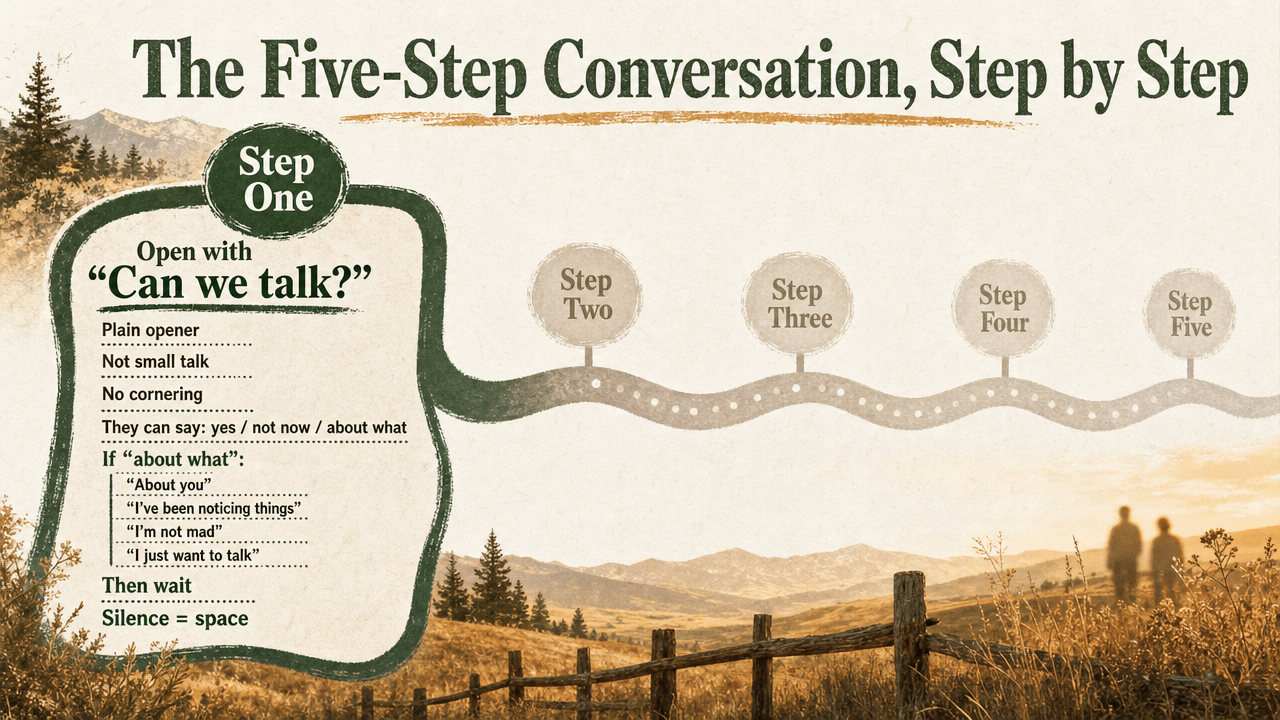
Step One: Open With ‘Can We Talk?’
You do not need a monologue. You need three words.
SAMHSA’s family guidance suggests opening with something as plain as, “Can we talk?”. That is the whole door. It signals that this is not small talk, but it does not corner anyone. Your loved one gets to say yes, or not now, or what’s this about — and any of those answers is workable.1
Try it out loud before you say it to them. Seriously. In the car, in the bathroom mirror, wherever. The first time you hear your own voice ask the question, it feels enormous. The tenth time, it feels like a sentence you can actually say.
If they say “about what,” resist the urge to launch. Say, “About you. About some things I’ve been noticing. I’m not mad. I just want to talk.” Then wait. Silence is not failure here. It’s the space where they decide to sit down with you.
Step Two: Name What You’ve Seen, Specifically
Now pull out that list you wrote earlier — the one with real moments, not adjectives. SAMHSA’s step-by-step template for these talks is explicit: express specific concerns, not general accusations.2
The difference sounds like this. Instead of, “You’ve been drinking too much,” try, “On Thursday, I found the bottle in the laundry room. On Sunday, you fell asleep before dinner. I’ve been scared, and I love you, and I couldn’t keep it inside anymore.”
See what that does? It gives your loved one something concrete to respond to. It also tells them you have been paying attention — not tallying evidence to use against them, but noticing because they matter to you. Lead with what you saw. Follow with how it made you feel. Skip the diagnosis.
Keep your voice soft. Keep your hands still if you can. If tears come — yours or theirs — let them. Nobody has to hold it together for this to work. You are two people who love each other trying to tell the truth. That’s the whole assignment.
Step Three: Listen Without Fixing
This is the hardest step. You have been carrying this worry for weeks or months. You have answers ready. You have a treatment center bookmarked. Every muscle in your body wants to hand them the plan.
Don’t. Not yet.
SAMHSA and CDC guidance both emphasize the same thing: listen without judgment, and let empathy do the work before information does. Ask an open question. “What’s been going on for you?” or “How are you feeling about all this?” Then close your mouth.2,11
You will hear things that hurt. Denial. Anger. A long silence. Maybe a story you did not know — about a night, a loss, a pain they’ve been drinking around for years. Whatever comes, receive it. Nod. Say, “Thank you for telling me,” or, “I didn’t know that. I’m glad you said it.”
You are not agreeing that everything is fine. You are showing them that honesty with you is safe. That is the ground everything else gets built on.
Step Four: Offer Help, Not an Ultimatum
Now, and only now, you offer something concrete. SAMHSA’s five-step template is the spine of what you have been doing:2
- pick a private time and place,
- express specific concerns,
- listen without judgment,
- offer help, and
- be patient if change is slow.
Step four is where the help comes in.
One offer. Not a menu. Not a threat.
Try, “I’ve been thinking about this a lot, and I found a place I’d like to tell you about. It’s called Rocky Mountain Treatment Center, in Great Falls. They do family therapy too, so I could be part of it with you. Would you be willing to hear about it?”
Or smaller: “Can I make a call with you to SAMHSA’s helpline? We can just ask questions. You don’t have to decide anything today.”
Notice what you are not saying. You are not saying, “You have to go, or else.” You are not saying, “If you loved me, you would.” Ultimatums might feel powerful in the moment, but they usually harden the wall you’re trying to open a window in. An offer keeps the choice with them, which is where it has to be.
Step Five: Be Patient if the Answer Is ‘No’
Here is what nobody tells you: the first conversation often ends in a no. Or a “maybe.” Or a “leave me alone.” That does not mean it failed.
Change from a single talk is rarely immediate, and being patient when it’s slow is part of the template itself, not a consolation prize. You planted something. You told the truth. You showed them a door and left it unlocked. Those things do not evaporate when they walk away.2
What you do next matters more than what they said tonight. Do not slam the door back shut with a hurt silence. Do not double down with a second, louder speech tomorrow. Instead, keep loving them out loud. Text them Wednesday about something ordinary. Show up Saturday like you said you would. When the moment comes again — and it usually does — you’ll already have the words. This time, you’ll shake a little less.
Scripts You Can Actually Say Tonight
Sometimes what you need is not another framework. You need the exact words. Here are lines drawn from federal guidance you can borrow, mix, or say almost verbatim. Read them out loud once. Feel which ones sound like you.1,4,12
To open the door:
- “Can we talk? Just for a few minutes.”
- “I’ve been worried about you. Can we talk about what you’re experiencing?”
To name what you’ve seen without accusing:
- “I’ve noticed you haven’t been yourself lately, and I’ve been thinking about you a lot.”
- “I love you, and something’s been on my mind. I want to say it out loud instead of carrying it around.”
To remove shame from the room:
- “Millions of people struggle with this. It’s nothing to be ashamed of. You’re not alone.”
- “Substance use disorder is an illness, and there is treatment for it.”
To offer help without pushing:
- “I found a place I’d like to tell you about. Would you be willing to hear about it?”
- “Can we call someone together and just ask questions? You don’t have to decide anything.”
To close, even if they said no:
- “Thank you for listening. I’m not going anywhere.”
- “I love you. We can talk again whenever you’re ready.”
You will not use all of these. Pick two or three. Say them to yourself in the car. When your voice shakes tonight — and it might — these are the words that will still come out.
Words That Help, Words That Wound
The words you pick for this conversation matter more than you might expect. Not because your loved one is going to grade your vocabulary, but because certain phrases carry decades of shame with them, and shame is the exact wall you are trying not to build.
NIDA’s guidance on stigma is direct: use person-first language, and describe someone as having a condition rather than being one. The CDC says the same thing in slightly different words — describe people as having a circumstance, not as being that circumstance. That is not political correctness. It is a small, real way to make the room safer.8,11
Here are the swaps worth memorizing before you sit down:8,11
- Instead of “addict” or “alcoholic,” say “person with a substance use disorder”.
- Instead of “clean,” say “in recovery” or “not currently using”.
- Instead of “substance abuser,” say “person who uses substances”.
- Instead of “dirty test,” say “positive test result”.
- Instead of “habit,” say “substance use disorder” — because “habit” makes it sound like a choice they keep making badly.
You will slip. Everyone does. If “alcoholic” comes out of your mouth because it is the word you grew up with, keep going. Do not stop and apologize five times — that makes the language the story instead of the person. Just try again next sentence.
One more thing. Your loved one may use words about themselves that you would not use about them. That is their choice, and NIDA notes that people have a right to describe their own experience however they want. Follow their lead when they talk about themselves. Just keep your own words gentle.8
The First 48 Hours After the Talk
Whatever just happened in that conversation, your body probably feels like you ran a mile uphill. That’s normal. The talk is over, but the work of the next two days is quieter and, in some ways, more important than the talk itself.
If your loved one said yes, or even a shaky maybe, move while the door is open. Call SAMHSA’s National Helpline together, or on your own if they’re not ready to pick up the phone. It’s free, confidential, and available 24/7 for treatment referrals. If a residential program came up in your talk — Rocky Mountain Treatment Center or somewhere else — call and ask real questions: what does intake look like, how does family therapy work, when could someone come in. You are gathering, not committing.3
Either way, tell one safe person what you did. A friend, a sibling, your own doctor. You just carried something heavy alone for a long time. You do not have to keep doing that.
What ‘Next Steps’ Can Look Like
A Call, an Appointment, or a Tour
“Next step” does not have to mean checking into a facility on Monday. It can be smaller than that, and often should be. What matters is that the step is real, has a date, and does not sit on a shelf.
A call is the lightest lift. You dial SAMHSA’s helpline together on speaker, or you make the call yourself and take notes to share later. It’s free, confidential, and open around the clock. An appointment is the next size up — their primary care doctor, or yours if they don’t have one, to talk honestly about drinking or drug use and what help looks like. A tour is bigger, and sometimes exactly right. At Rocky Mountain Treatment Center in Great Falls, that can mean a phone conversation with someone who has walked the same road, or a visit to see the 26-bed facility, meet a counselor, and ask how family therapy fits in. Pick the smallest step they’ll actually take. Momentum beats magnitude. 3
Why Family Involvement Changes the Odds
If your loved one hesitates at the word “family therapy,” here’s what to know: how to talk to a family member about addiction. It is one of the evidence-based pieces of good treatment. The TIP 39 clinical guidance from NCBI/NIH is direct — engaging family members in substance use treatment helps clients initiate and sustain recovery, because relatives learn communication skills, get psychoeducation, and stop being alone with the problem. A 2021 peer-reviewed review found the same pattern across programs: structured family engagement throughout treatment improves outcomes.5,6
That’s why residential programs like Rocky Mountain build family programming in — a three-day Family Week, family counseling sessions, and weekly Zoom groups that continue after your loved one goes home. When you sit in one of those chairs, you are not a visitor. You are part of the treatment. Which means the conversation you had at the kitchen table was the first session, not a preview of one.
Taking Care of You Through This
Somewhere in all of this, you got smaller. You started sleeping worse. You stopped calling your friend back. You canceled the doctor’s appointment you kept meaning to keep. You have been so busy watching one person that you forgot there is a person doing the watching, and she needs care too.
Hear this clearly: your well-being is not a distraction from helping your loved one. It is part of the work. Emerging research on “support persons” — the concerned significant others in someone’s life — highlights that coping skills, navigation help, and stigma-reduction for the family member matter as much as the interventions aimed at the person using. You are not selfish for tending to yourself. You are being useful.9
Start small. Tell one safe person what you did. Move your body outside for twenty minutes, even if it’s just around the block. Eat something that took more than a minute to prepare. If you can, find a support group for families — many communities offer them, and programs like Rocky Mountain Treatment Center include family programming that gives you your own place to sit and speak.
You cannot pour from an empty cup. That saying is a cliché because it’s true. Refill yours.
Frequently Asked Questions
What if my family member gets angry or shuts down when I bring it up?
Anger and silence are common first reactions, not signs you failed. Stay soft. Say, “I hear you. I love you. I’m not going anywhere.” Then stop talking. You do not have to defend yourself. SAMHSA’s guidance is direct that patience is part of the process, not a backup plan. Try again another day.2
Should I talk to them when they’ve been drinking or using?
No. Wait for a stretch when they’re relatively steady. Alcohol and drugs blunt the parts of the brain that make real conversation possible, and anything said in that state usually has to be repeated later anyway. Pick a private, unhurried moment when neither of you is under the influence or already upset.2
What if they deny they have a problem?
Denial is part of the illness, not a personal rejection of you. Do not argue diagnoses. Return to what you saw: “I hear you. I still want to tell you what I’ve been noticing.” Leave the door open. Person-first, non-judgmental language keeps the room safe enough for them to come back to the conversation later.8
Do I need to stage a formal intervention with other family members?
Usually, no. A quiet, one-on-one talk works for most families, and SAMHSA’s template centers on a private setting and specific concerns, not a group confrontation. Interventions can feel like ambushes and sometimes harden resistance. Start small. If you want structured help, call SAMHSA’s National Helpline for guidance before escalating.2,3
What do I say if they agree they need help but are scared of treatment?
Name the fear out loud. “That makes sense. It’s a big step.” Then offer one small next thing — a call, a doctor’s visit, a tour. At a residential program like Rocky Mountain Treatment Center, most counselors are in recovery themselves, so your loved one would be met by someone who has been where they are. That often lowers the wall.
How do I keep taking care of myself while I’m trying to help them?
Tell one safe person what’s going on. Keep your own appointments. Move your body outside, even briefly. Research on support persons shows that your coping skills and well-being are part of recovery, not separate from it. Family programming — including the family sessions offered at Rocky Mountain — gives you a place to sit and speak too.9
References
- Helping Families Cope with Mental Health and Substance Use Disorder. https://www.samhsa.gov/mental-health/children-and-families/coping-resources
- Starting the Conversation Guide. https://www.samhsa.gov/sites/default/files/starting-the-conversation-guide.pdf
- National Helpline for Mental Health, Drug, Alcohol Issues. https://www.samhsa.gov/find-help/helplines/national-helpline
- How to Talk to Friends and Family Members About Mental Health. https://www.samhsa.gov/mental-health/what-is-mental-health/how-to-talk/friends-and-family
- Chapter 3—Family Counseling Approaches (TIP 39). https://www.ncbi.nlm.nih.gov/books/NBK571088/
- Family Involvement in Treatment and Recovery for Substance Use Disorders. https://pmc.ncbi.nlm.nih.gov/articles/PMC8380649/
- To Improve Substance Use Disorder Prevention, Treatment and Recovery: Engage the Family. https://pubmed.ncbi.nlm.nih.gov/28787300/
- Words Matter – Terms to Use and Avoid When Talking About Addiction. https://nida.nih.gov/nidamed-medical-health-professionals/health-professions-education/words-matter-terms-to-use-avoid-when-talking-about-addiction
- Engaging Family and Others in Recovery | Research Corner. https://www.iris.ssw.umaryland.edu/rc-family-recovery
- Get Help. https://dphhs.mt.gov/opioid/gethelp
- Remove Stigma. https://www.cdc.gov/overdose-prevention/media/pdfs/2024/04/remove-stigma.pdf
- Drug Misuse and Substance Use Disorder: Conversation Starters. https://odphp.health.gov/myhealthfinder/healthy-living/mental-health-and-relationships/drug-misuse-and-substance-use-disorder-conversation-starters
- Substance Use Resources for Parents and Caregivers. https://acf.gov/behavioral-health/parents-caregivers/substance-use-resources-parents-and-caregivers
- Parents & Educators | National Institute on Drug Abuse (NIDA). https://nida.nih.gov/research-topics/parents-educators