
Key Takeaways
- Treating addiction and mental health in one coordinated plan consistently outperforms handling them separately, because the conditions loop into each other rather than taking turns 14.
- Trauma is often the root driver beneath both the substance use and the mood symptoms, and evidence-based trauma-focused therapies can begin alongside addiction care rather than waiting 11.
- Integrated residential care layers CBT, motivational interviewing, trauma-focused protocols, group work, family involvement, and experiential elements like equine sessions into one plan held by one team 8.
- When choosing a program, look for full biopsychosocial assessment, clinicians trained in co-occurring disorders, structured family involvement, and a year-long aftercare plan with scheduled check-ins 7.
When getting sober first hasn’t worked
You’ve probably heard some version of it. “Get clean first, then we’ll deal with the anxiety.” “We can’t work on the trauma until you’re stable.” “Come back when you’ve got 90 days.” Maybe a counselor said it kindly. Maybe an intake nurse said it while pointing you toward a different waiting room. Either way, the message landed the same: your pain has to wait its turn.
And so you tried. You white-knuckled through a detox. You went to meetings. You picked up a chip. And then the panic came back, or the depression came back, or the memories came back at 2 a.m., and the drink or the pill came back with them. Not because you didn’t want recovery. Because the thing driving the use was still sitting in the room, untouched.
You are not the only one living inside this pattern. SAMHSA’s most recent national survey estimated that about 21.2 million U.S. adults have a co-occurring mental illness and substance use disorder in the same year 5. That’s millions of people being told, in one form or another, to solve one half of a problem while the other half keeps setting fires.
Here’s what the research has quietly settled on, even if the front-desk script hasn’t caught up: treating addiction and mental health together, in one coordinated plan, tends to outperform treating them one at a time 14. The old “sober first” sequence isn’t a rule of nature. It’s a habit of a fragmented system.
If earlier attempts didn’t stick, that isn’t evidence that you failed treatment. It’s often evidence that treatment only met half of you. The rest of this guide walks through what it looks like when the other half finally gets a seat at the table too.
Why treating addiction and mental health together changes what heals
Think about what “treatment” has looked like for you before. Maybe one clinic handled the drinking and another handled the depression. Two intake packets. Two sets of goals. Two people who didn’t quite talk to each other, and you in the middle, translating your own story twice a week. That is called parallel care, and it is what most people mean when they say they’ve “been through treatment.”
Integrated care is a different animal. In the clinical literature, it means one team, treating both conditions at the same time, with a single plan that names both problems out loud 3. Your counselor knows what your psychiatrist prescribed this morning. Your group therapist knows you had a panic attack on Tuesday. The person leading your relapse prevention work knows the trauma history that’s driving the cravings. Nobody is guessing.
That difference matters more than it sounds. A review of integrated versus separate care found that integrated treatment consistently outperforms fragmented plans across symptom reduction and adherence 14. A 2023 systematic review looking specifically at anxiety and depression outcomes reported that some studies showed clearly better reductions with integrated care, though the authors were honest that results varied by program quality and design 13. Translation: this isn’t magic. It’s coordination doing what coordination does.
SAMHSA calls the guiding rule “no wrong door” — meaning whichever door you walk through, addiction or mental health, you should get screened for both and treated for both 4. When that actually happens under one roof, the small things stop falling through cracks. Your medication for depression gets adjusted with your detox in mind. The trauma memory that surfaces in group on Wednesday shows up in your individual session on Thursday, because the same team is holding the whole picture.
Here is the quiet reason integrated care changes what heals: addiction and mental health don’t take turns inside you. They loop. The anxiety fuels the drinking, the drinking fuels the shame, the shame fuels the depression, the depression fuels the next drink. If treatment only cuts one strand of that loop, the loop reforms. If treatment reaches all the strands at once — screening, therapy, medication, family, aftercare — the loop finally has somewhere to unravel 3, 15. That’s the shift you can feel by week three, when sleep starts coming back and a phone call from your sister doesn’t send you sideways.
The trauma piece almost everyone misses
If you had to pick the single thing most fragmented treatment plans skip, it would be this one. Not the drinking. Not the depression. The trauma sitting underneath both.
Research on people with dual disorders keeps landing in the same place: trauma isn’t a side story. One review of trauma in dual disorders describes psychological trauma as “a major etiological risk factor” in substance use disorders — meaning it’s often not what happened alongside the addiction, it’s part of what started it 19. The car accident you don’t like to talk about. The childhood you learned to keep quiet. The assault you’ve never named out loud. The deployment. The loss. Whatever yours is, it doesn’t just live in your memory. It lives in your nervous system, and it keeps sending the same signal: something is wrong, make it stop. Alcohol makes it stop. Pills make it stop. Until they don’t.
Here is where a lot of programs go quiet. The old thinking said trauma work was too destabilizing to do while someone was still drinking or using, so it got put on a shelf marked “later.” Later usually meant never. VA and DoD guidance now pushes hard against that delay, saying people with co-occurring PTSD and substance use disorders should get evidence-based care for both conditions — and that integrated, trauma-focused therapies like Prolonged Exposure and Cognitive Processing Therapy show the greatest benefit compared with treatment as usual or non-trauma approaches 11. Prolonged Exposure means gently, in a safe room with a trained clinician, turning toward the memory instead of away from it. Cognitive Processing Therapy means examining the beliefs the trauma left behind (“it was my fault,” “I can’t trust anyone,” “I’m broken”) and testing whether they’re actually true.
The numbers on this are worth sitting with. In a 2025 randomized trial of women with PTSD and alcohol use disorder, participants who received integrated PTSD-AUD therapy saw their PTSD severity fall from a mean CAPS-5 score of 37.40 to 13.18. Women who got addiction-focused relapse prevention alone dropped from 39.09 to 23.68 9. Both groups cut back on drinking. Only one group also got the trauma symptoms to shrink to something close to livable. That’s the difference between “I’m not drinking, but I still can’t sleep” and “I’m not drinking, and the memories don’t own my nights anymore.” This trial studied women specifically, so the exact numbers belong to that population — but the direction lines up with earlier work.
An earlier JAMA Psychiatry trial in veterans with PTSD and alcohol use disorder found the same shape of result: integrated prolonged exposure produced significantly greater PTSD symptom reductions than integrated coping skills therapy, while both groups saw comparable drops in heavy drinking 10. The old worry — that turning toward trauma would send people back to the bottle — didn’t hold up. Turning toward it, with the right support, is what let people finally put the bottle down for reasons that lasted.
What a day of integrated residential care actually looks like
A lot of the fear about residential treatment lives in the not-knowing. So here is the shape of it, roughly, when a program is actually doing integrated care.
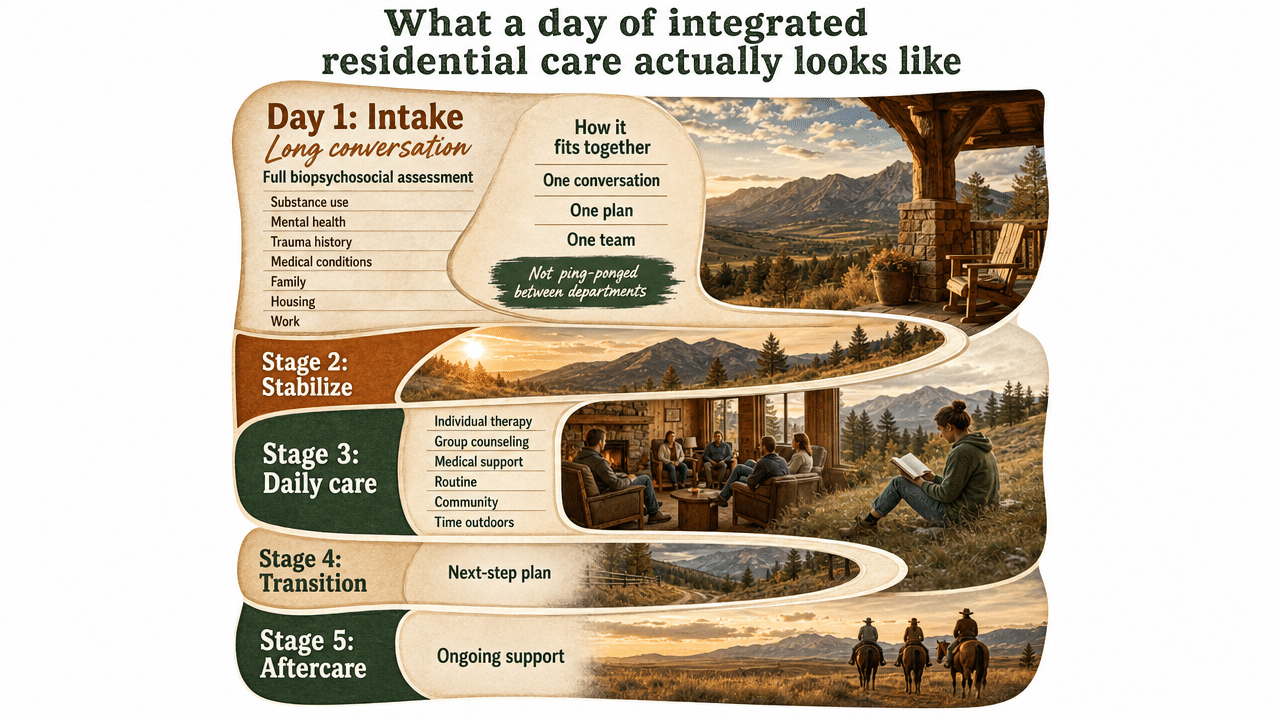
The first day isn’t therapy. It’s a long conversation. A good program starts with what SAMHSA’s TIP 42 calls a full biopsychosocial assessment — meaning someone sits with you and asks about your drinking or drug use, your mental health history, your trauma history, your medical conditions, your family, your housing, your work, and how all of it hangs together 16. Not a checklist ping-ponged between departments. One conversation, written into one plan, held by one team. If you’ve been through intake before where you had to say the hardest sentence of your life to three different strangers, this part will feel different.
From there, care moves in stages rather than a single flat routine. SAMHSA’s integrated treatment principles describe it as stage-wise: meeting you where you are, then moving with you as readiness grows 8. Early on, that usually means medically monitored detox — nurses checking vitals, medications easing the worst of withdrawal, sleep starting to return. In Montana, licensed residential providers are required to maintain 24-hour staffing patterns sufficient for client safety, so there’s someone awake and watching through the nights that used to be the hardest 17.
Once your body settles, the days start to fill in. A typical weekday might open with a community check-in, then individual counseling with the person who will know your story from the inside out. Group sessions follow — some focused on relapse prevention, some on managing depression or anxiety, some on trauma skills. Afternoons often blend experiential work (movement, nature time, equine sessions, art or music) with education about how the brain, the body, and substances actually interact. Evenings tend to hold 12-step meetings and quieter reflection time.
Family gets pulled in on purpose, not as an afterthought. SAMHSA’s implementation guidance is direct about this: with your permission, integrated programs bring families into education and treatment planning because the people you’re going home to are part of what makes recovery hold 7.
And before you leave, aftercare is already being built — follow-up appointments, continuing care groups, check-ins at 30, 60, 90, 180, and 365 days out. Not a handshake at the door. A plan that keeps a hand on your shoulder for a full year.
The therapies doing the heavy lifting
When you hear “integrated care,” it can sound like one big blurry thing. It isn’t. It’s a small handful of specific therapies, each doing a specific job, woven together so they reinforce each other instead of pulling in different directions.
Cognitive behavioral therapy, or CBT, is usually the workhorse. In plain terms, CBT helps you catch the thoughts that show up right before a drink, a pill, a spiral — and test them. The thought “I can’t get through this meeting without something to take the edge off” gets pulled out, looked at, and slowly replaced with something truer. For someone carrying both addiction and depression or anxiety, that same skill works on both sides of the loop.
Motivational interviewing sits alongside it. Instead of a counselor telling you why you should change, a well-trained clinician asks questions that let you hear your own reasons. SAMHSA’s integrated treatment principles put motivational work at the center of stage-wise care, because readiness isn’t a switch — it’s something built through conversation 8. On a hard morning, this is the therapy that keeps you from walking out the front door.
Then there’s the trauma-focused work covered earlier — Prolonged Exposure, Cognitive Processing Therapy, and integrated protocols like COPE — which VA/DoD guidance names as producing the greatest benefit for co-occurring PTSD and substance use disorders compared with treatment as usual 11. These aren’t done in isolation. They sit inside the same weekly plan as your CBT and your relapse prevention group.
Group counseling carries weight most people underestimate. Sitting in a room with seven other adults who understand exactly what a 3 a.m. craving feels like does something individual therapy can’t quite reach. Twelve-step meetings add another layer — a language for surrender, a community that doesn’t close at 5 p.m., a sponsor who’s been where you are.
One honest note: a large trial of integrated dual diagnosis teams found reduced substance use after implementation but no significant improvements on several other measures, and the authors pointed to clinician skill as part of what shapes results 1. Translation for you: the therapies work, and the people delivering them matter. Ask any program you’re considering who is actually running the CBT, who is trained in trauma-focused protocols, and how often the team meets to compare notes on your care. Those answers tell you whether the heavy lifting is real or just on the brochure.
Where equine therapy fits (and where it doesn’t)
You’ve probably seen the photos. Someone standing next to a horse in a round pen, hand on the animal’s shoulder, looking calm for what might be the first time in years. It’s a real image, and it’s a real thing that happens in good programs. It’s also not the whole story, and any place that treats it like the whole story is selling you something.
Here’s what the research actually says. A scoping review of equine-assisted services in addiction treatment found that people who took part often showed improvements in emotional regulation, anxiety, self-efficacy, and engagement with the rest of their care 12. Working with a large animal that reads your body honestly — one that steps back when you’re clenched and steadies when you’re steady — teaches something a worksheet can’t. For someone whose nervous system has been running on high alert for years, that feedback loop matters.
The same review is honest about the limits. Most of the studies are small. The methods vary. Nobody is claiming equine work treats addiction or depression on its own 12. What it does, when placed alongside CBT, trauma-focused therapy, group counseling, and medically monitored detox, is give you a way to practice being present in your own body without a substance in it. That’s a foundation for the harder therapy work, not a replacement for it. A morning with the horses can loosen something that then shows up in your afternoon session. That’s the fit.
Family involvement and what a licensed Montana program looks like from the inside
The people who love you have been carrying something too. Maybe your mom stopped sleeping. Maybe your husband learned to check your car for bottles. Maybe your daughter stopped asking you to come to things because she couldn’t stand the maybe. Whatever shape it took in your house, the addiction was never happening in a room by itself. Which is why serious dual diagnosis programs don’t treat family as visiting hours. They treat family as part of the work.
SAMHSA’s implementation guidance for integrated treatment is direct: with your permission, programs should bring family or other supporters into education about co-occurring disorders and into planning for what recovery looks like at home 7. In residential settings, this often takes the shape of a structured family week — a few days where the people you’re going home to learn what depression paired with drinking actually does, how trauma responses show up, and what their part is (and isn’t) in what happens next. It’s the difference between your sister guessing why you snapped on Sunday and your sister understanding the panic pattern she just witnessed.
The Montana piece matters here too. A licensed residential program in this state has to maintain 24-hour staffing sufficient for client safety, which is what makes it possible to do the harder therapy work during the day and still have someone awake with you at 3 a.m. when a memory surfaces 17. And the counselors sitting across from you aren’t credentialed on addiction alone — Montana’s rules for Licensed Addiction Counselors require 285 hours of addiction studies, including 15 dedicated hours in co-occurring disorders 18. That’s a small number to state out loud, but it means the person guiding your care has been specifically trained not to treat the depression as background noise. Ask a program to name that training. A good one will.
Leaving residential without losing the ground you gained
The last week of residential care is a strange one. You’ve slept through the night for the first time in years. You’ve said the sentence out loud that you thought would end you. And now the calendar says you’re going home to the same kitchen, the same drive, the same phone that used to hold the same wrong numbers.
This is where a lot of hard-won ground gets lost, and it doesn’t have to be. SAMHSA’s evidence base on integrated treatment is clear that dual diagnosis recovery is long-term and recovery-oriented, not a 30-day event 8. What you need waiting for you on the other side of discharge is a plan, not a hope.
A real aftercare plan usually has a few concrete pieces:
- A named outpatient counselor or psychiatrist who already has your file, so you’re not starting from zero on week one at home.
- A continuing care group that meets weekly, ideally with people who were in residential with you.
- Scheduled check-ins at 30, 60, 90, 180, and 365 days — not because those dates are magic, but because relapse risk moves in waves and someone should be reaching for you when the waves come.
- A 12-step home group in your town, with a sponsor’s phone number already saved.
- And your family, still doing the work they started during family week, not sliding back into the roles that used to hurt everyone.
If you’re weighing programs, Rocky Mountain Treatment Center builds this kind of long tail into the plan from day one. Not because leaving is the finish line. Because the year after leaving is where the healing you did here becomes the life you actually get to live.
Frequently Asked Questions
Do I have to get sober before I can start treating my anxiety, depression, or trauma?
No, and the research now pushes hard against that old sequence. VA/DoD-aligned guidance says people with co-occurring PTSD and substance use disorders should receive evidence-based care for both conditions rather than deferring one 11. SAMHSA’s principles describe stage-wise integrated care, where mental health work begins alongside addiction treatment and deepens as you stabilize 8. If a program tells you the mental health piece has to wait, that program is working from an outdated script.
What’s the difference between integrated dual diagnosis care and going to two separate providers?
With separate providers, you translate your story twice and hope they compare notes. Integrated care means one team treats both conditions at the same time, with a single plan 3. Your counselor knows what your psychiatrist prescribed. Your group leader knows the trauma driving the cravings. A review of integrated versus separate treatment found integrated care consistently outperforms fragmented plans across symptom reduction and adherence 14. The difference you feel is nothing falling through the cracks between two calendars.
Is it safe to do trauma-focused therapy while I’m still detoxing or early in recovery?
Yes, when it’s delivered by trained clinicians inside an integrated program. A JAMA Psychiatry trial in veterans with PTSD and alcohol use disorder found integrated prolonged exposure produced significantly greater PTSD symptom reductions than coping-skills therapy, with comparable drinking outcomes — meaning turning toward the trauma didn’t send people back to the bottle 10. Trauma work usually starts after acute detox, once your body has settled, but it doesn’t wait for months of sobriety before it begins.
Which therapies are typically part of a residential dual diagnosis program?
A well-run program layers a few specific therapies together. Cognitive behavioral therapy helps you catch the thoughts that lead to using. Motivational interviewing builds readiness through conversation, which SAMHSA’s principles place at the center of stage-wise care 8. Trauma-focused work — Prolonged Exposure, Cognitive Processing Therapy, or integrated protocols — shows the greatest benefit for co-occurring PTSD and substance use disorders 11. Group counseling, 12-step meetings, family sessions, and experiential work round out the plan.
Does equine therapy actually treat addiction or mental illness?
Not on its own, and any place claiming otherwise is overstating the evidence. A scoping review of equine-assisted services in addiction treatment found participants often showed improvements in emotional regulation, anxiety, self-efficacy, and engagement — while noting most studies are small and methodologically limited 12. What working with a horse does well is help you practice being present in your own body without a substance. That’s a foundation for the harder therapy work, not a substitute for CBT, trauma-focused care, or medically monitored detox.
How is my family involved, and what happens after I leave residential care?
SAMHSA’s implementation guidance says integrated programs should, with your permission, bring family into education and treatment planning 7. In residential care that often means a structured family week where the people you’re going home to learn what your patterns actually look like. After discharge, a real plan includes a named outpatient counselor, a continuing care group, a 12-step home group, and scheduled check-ins at 30, 60, 90, 180, and 365 days — because relapse risk moves in waves and someone should be reaching for you.
References
- Effectiveness of Integrated Dual Diagnosis Treatment (IDDT) in Severe Mental Illness Outpatients With Substance Use Disorders. https://pubmed.ncbi.nlm.nih.gov/30352668/
- Integrated Dual Disorder Treatment | Center for Evidence‑Based Practices. https://case.edu/socialwork/centerforebp/practices/substance-abuse-mental-illness/integrated-dual-disorder-treatment
- Integrating Treatment for Co‑Occurring Mental Health Conditions. https://pmc.ncbi.nlm.nih.gov/articles/PMC6799972/
- Managing Life with Co‑Occurring Disorders. https://www.samhsa.gov/mental-health/serious-mental-illness/co-occurring-disorders
- Co‑Occurring Disorders and Other Health Conditions. https://www.samhsa.gov/substance-use/treatment/co-occurring-disorders
- Integrated Treatment for Co‑Occurring Disorders: The Evidence. https://library.samhsa.gov/sites/default/files/ebp-kit-the-evidence-10242019.pdf
- Integrated Treatment for Co‑Occurring Disorders: Building Your Program. https://library.samhsa.gov/sites/default/files/ebp-kit-building-your-program-10112019.pdf
- Integrated Treatment for Co‑Occurring Disorders Evidence‑Based Practices (EBP) Kit. https://library.samhsa.gov/product/integrated-treatment-co-occurring-disorders-evidence-based-practices-ebp-kit/sma08-4366
- Concurrent Treatment of Posttraumatic Stress Disorder and Alcohol Use Disorder With Integrated Therapy vs Addiction‑Focused Relapse Prevention: A Randomized Clinical Trial. https://pubmed.ncbi.nlm.nih.gov/40663349/
- Efficacy of Integrated Exposure Therapy vs Integrated Coping Skills Therapy for Comorbid Posttraumatic Stress Disorder and Alcohol Use Disorder: A Randomized Clinical Trial. https://pubmed.ncbi.nlm.nih.gov/31017639/
- Treatment of Co‑Occurring PTSD and Substance Use Disorder in VA. https://www.ptsd.va.gov/professional/treat/cooccurring/tx_sud_va.asp
- Equine‑Assisted Services for Individuals With Substance Use Disorders: A Scoping Review. https://pmc.ncbi.nlm.nih.gov/articles/PMC9749232/
- Integrated vs non-integrated treatment outcomes in dual diagnosis: a systematic review. https://pmc.ncbi.nlm.nih.gov/articles/PMC10157410/
- Integrated Treatment of Substance Use and Psychiatric Disorders. https://pmc.ncbi.nlm.nih.gov/articles/PMC3753025/
- Substance Use Disorder Treatment for People with Co-Occurring Disorders (Companion resource). https://library.samhsa.gov/sites/default/files/pep20-06-04-006.pdf
- TIP 42: Substance Use Disorder Treatment for People With Co-Occurring Disorders. https://library.samhsa.gov/sites/default/files/SAMHSA_Digital_Download/PEP20-02-01_004.pdf
- Montana Summary – State Residential Treatment for Behavioral Health Conditions. https://aspe.hhs.gov/sites/default/files/2021-08/StateBHCond-Montana.pdf
- Mont. Admin. r. 24.219.5006 – LAC Education Requirements. https://www.law.cornell.edu/regulations/montana/Mont-Admin-r-24.219.5006
- Traumatic Events in Dual Disorders: Prevalence and Clinical Features. https://pmc.ncbi.nlm.nih.gov/articles/PMC7466030/