
Key Takeaways
- A treatment center is a health care setting combining counseling, medical support, and peer recovery to help people stop using and rebuild their lives 1.
- Care exists on a continuum from outpatient to intensive inpatient, with residential sitting in the middle as a live-in, 24-hour structured setting 3.
- Residential fits best when withdrawal carries medical risk, home environments fuel use, or lighter levels of care have already been tried without holding 10.
- Length of stay depends on severity, co-occurring conditions, and home stability, with 30, 60, or 90 days offering progressively more runway for change 10.
What people actually mean when they say “treatment center”
If you’ve been hearing the words “treatment center” tossed around by a doctor, a family member, a probation officer, or a worried friend, you’re probably picturing something out of a movie. White hallways. A clipboard. Someone in scrubs asking how you feel on a scale of one to ten.
The real thing is calmer than that, and a lot more human.
In plain terms, a treatment center is a place where people get organized, evidence-based help for substance use or mental health, usually a mix of counseling, medical care when needed, and support from other people in recovery 1. Some you go home from at night. Some you live in for a stretch of weeks. They aren’t hospitals, and they aren’t punishment. They’re health care facilities built around a single job: helping you stop using and figure out how to live without it 4.
The word itself gets used loosely. People say “treatment center” when they mean a once-a-week counseling office, and they say it when they mean a 26-bed house in Montana where you wake up, eat breakfast with the same people every day, and meet with a counselor before lunch. Both can be accurate. The difference is how much structure you get, how much medical support is on hand, and whether you sleep there 2.
That’s what the rest of this guide will sort out for you, gently, one piece at a time.
The plain-language definition
Here’s the simplest version you’ll find anywhere.
A treatment center is a health care setting where trained staff help you stop using alcohol or drugs and start putting your life back together. Some are buildings you visit a few times a week. Some are houses or campuses where you live for a stretch of time. What makes them all “treatment centers” is the mix inside: counseling, medical care when your body needs it, group support, and a plan that’s built around you instead of handed to you off a shelf 1.
That last part matters. Real treatment isn’t one thing. It’s behavioral therapy, sometimes FDA-approved medications, and recovery supports like 12-step meetings, woven together based on what you’re dealing with 5. A good center doesn’t pick a single tool and call it a day. It offers options and helps you find the combination that actually works for your situation 8.
So when someone says “go to a treatment center,” they’re not saying go somewhere to be fixed or punished. They’re pointing you toward a place built to give you medical support, honest conversation, and people who’ve been where you are.
The four levels of care, from least to most intensive
Where residential sits on the continuum
Treatment isn’t one size. The American Society of Addiction Medicine sorts care into four basic levels, and the NIAAA lays them out in a way that’s easy to follow 3. Knowing where you fit on this ladder is the difference between guessing and choosing.
At the lowest intensity sits outpatient care. You live at home and meet with a counselor maybe once or twice a week. Your job, your school, your apartment, your dog — all of it stays in place. This works when use is mild, withdrawal isn’t a medical risk, and home is reasonably safe and stable 3.
A step up is intensive outpatient and partial hospitalization. You still sleep at home, but you spend several hours a day, multiple days a week, at the treatment center. Think of it as a part-time or near full-time schedule of group therapy, counseling, and skill-building 3. It’s a bigger commitment than weekly counseling, but you keep most of your life intact.
Third is residential treatment. This is the 24-hour, live-in setting. You move into a structured environment — sometimes a small home-like house, sometimes a larger campus — and you stay for weeks. Staff are there around the clock. Your days have a shape: counseling, groups, meals, meetings, sleep. The NIAAA describes residential as low- or high-intensity programs in 24-hour treatment settings, used when someone needs more structure and support than outpatient can give 3. The NCBI continuum-of-care chapter confirms the same ordering, with residential sitting just below the most intensive medical setting 2.
At the top is intensive inpatient care, usually inside a hospital. This is for medical stabilization — severe withdrawal, dangerous co-occurring conditions, anything that needs doctors and nurses on hand minute by minute 3.
A residential treatment center, like the kind you’re probably picturing when you hear that phrase, sits in the third tier. Not as light as outpatient. Not as medical as a hospital. A live-in middle ground built for people who need real distance from their daily triggers but don’t need an ICU 4.
How to tell which level fits your situation
There’s no clean checklist that spits out the right answer, but a few honest questions will get you close.
Start with safety. Is your body going to be okay if you stop using on your own? Alcohol and benzodiazepine withdrawal can be medically dangerous. If detox is on the table, you need a setting with medical eyes on you, not a weekly counseling appointment 4.
Then look at home. Is the place you live a place you can heal? If the people you live with use, if your neighborhood is full of cues, if you’ve tried to cut back at home and watched it fall apart inside a week — that’s a signal that residential care may give you what outpatient can’t: distance 4. The residential evidence review puts this plainly. Live-in programs tend to be most useful for people with higher-severity substance use, co-occurring mental health conditions, or unstable home environments 10.
Finally, look at what you’ve already tried. Counseling once a week that didn’t stick isn’t a failure on your part. It may simply mean the level of care was too light for what you’re carrying 8.
If you’re nodding at any of those, residential is worth a real conversation. If your situation is milder and home is steady, a less intensive option may serve you just as well. Either way, you’re not picking a label. You’re picking the amount of support that matches the weight of what you’re dealing with.
A real day inside a residential program
If you’ve never stayed in a treatment center, the unknown is half the fear. So here’s what a regular weekday actually looks like inside a small residential program. Not a brochure version. The real shape of the hours 2.
- 7:00 a.m. — Morning check-in.
- You’re up, you’ve had coffee, and the group gathers for a short check-in. How did you sleep? What’s on your mind? It’s quiet, not performative. Some people talk. Some just listen.
- 8:00 a.m. — Breakfast.
- Eggs, toast, the same table you sat at yesterday. Eating with the same handful of people every day is its own kind of medicine. Nobody is performing recovery. You’re just having breakfast.
- 9:30 a.m. — Individual counseling.
- One hour, one-on-one, with a counselor who knows your name and your story. This is where the harder work happens — what you’re using to cope, what you’re scared of, what you actually want your life to look like 5.
- 11:00 a.m. — Group therapy.
- Eight or ten people, one clinician, a topic. Shame. Cravings. Family. You don’t have to say much your first few days. Most people don’t.
- 12:30 p.m. — Lunch and downtime.
- A real break. Walk outside. Sit on the porch. Look at the sky.
- 2:00 p.m. — Experiential block.
- This is where the day breathes a little. Some afternoons it’s equine therapy — working with a horse in a corral. Other afternoons it’s a hike, the gym, recreation, or a hands-on activity. The point is to learn something about yourself with your body, not just your head.
- 4:00 p.m. — 12-step or mutual-support meeting.
- A meeting on-site, often led by people in recovery from the surrounding community. You hear stories that sound a lot like yours 5.
- 5:30 p.m. — Dinner, then the family contact window.
- A scheduled time to call home. Ten minutes with your mom. A check-in with your partner. For a lot of people, this is the hardest and best part of the day.
- 7:00 p.m. — Evening group or reflection.
- A lighter group, sometimes a reading, sometimes journaling. The day winds down.
- 10:00 p.m. — Lights out.
That shape — structured, around-the-clock, the same people, the same rhythm — is what residential care actually means 2. It’s not exciting. It’s not supposed to be. It’s a container steady enough to let you start feeling things again.
What residential includes that outpatient doesn’t
The clearest way to understand a residential treatment center is to put it next to its lighter cousin and look at what each one gives you.
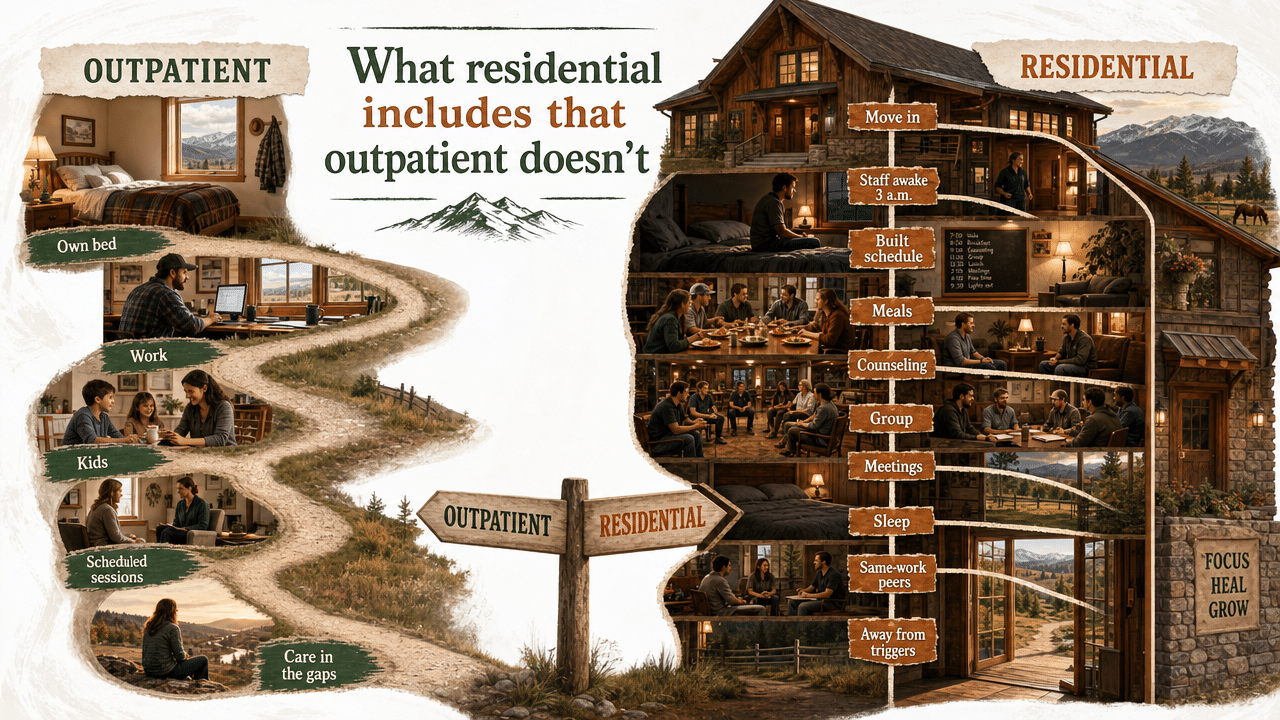
Outpatient care lets you keep your life. You sleep in your own bed, go to work, see your kids, and head to the treatment center for scheduled sessions — a counselor on Tuesday, a group on Thursday 1. That’s the whole shape of it. Real care happens, but it happens in the gaps between everything else you’re already doing.
Residential is the opposite arrangement. You move in. Staff are awake at 3 a.m. if you need them. Your schedule is built for you: meals, counseling, group, meetings, sleep, repeat 1. The people around you are doing the same work you are. And the place itself — a house, a small campus — is physically separate from the bar you used to stop at, the friend who used to bring something over, the parking lot where you used to sit in your car 4.
Here’s the side-by-side, plain:
Residential includes 24-hour staff support, a structured daily schedule, distance from the people and places tied to your use, an on-site peer community eating and sleeping under the same roof, and medical eyes on you during the hardest early days 1.
Outpatient includes scheduled counseling and group sessions, the ability to keep your job and home routine, and a treatment relationship you visit rather than live inside 1.
Neither one is better in the abstract. They’re answers to different questions. If your home is steady and your use is mild, outpatient may be exactly enough. If you’ve tried that and it didn’t hold — or if home itself is part of what’s pulling you under — residential gives you something outpatient can’t manufacture: a few weeks where the only job in front of you is getting well 4.
Why staff in recovery change the experience
Walk into most health care settings and the people helping you have read about your problem. Walk into a good treatment center and a lot of the people helping you have lived it.
That shift matters more than it sounds.
When the counselor across from you has been through their own recovery, the conversation starts in a different place. You don’t have to explain what a craving feels like at 2 a.m. You don’t have to translate the shame of lying to someone you love. They already know the shape of it, and they’re still here, doing fine, sitting in a chair across from you. That alone tells you something the textbooks can’t.
Stigma is one of the biggest reasons people don’t reach out for help in the first place 9. A room full of staff who’ve been where you are quietly dismantles that. Nobody is looking down at you. Nobody is surprised by your story.
Lived experience doesn’t replace clinical training — you want both, and good centers hire for both 8. But when the person guiding you through the hardest weeks of your life has walked the same road, the work gets honest faster. And honest is where recovery actually starts.
Equine therapy: what it is and what the evidence actually says
Of all the things that happen inside a residential program, equine therapy is the one most people raise an eyebrow at. Horses? For addiction? It sounds like a brochure photo.
Here’s what it actually is. You spend time with a horse, usually in a corral or arena, guided by a trained facilitator and often a mental health professional. You’re not riding. You’re grooming, leading, learning to read the animal, learning to let the animal read you. Horses are unusually responsive to body language and emotional state. If you walk in tight and angry, the horse knows. If you soften, the horse softens. That feedback loop, in real time, is the whole point.
For someone who has spent years numbing feelings, an animal that reflects them back without judgment can be the first honest mirror in a long time. You notice what’s going on inside you because the horse just noticed it first.
Now, the evidence. A peer-reviewed review of equine-assisted services for substance use disorders found that available data suggest a potential positive effect on treatment retention, completion, and participants’ mental health 7. That’s encouraging. It’s also important to be straight with you about what that means. The studies in that review had small sample sizes and methodological limits, and researchers have called for larger, more rigorous trials before equine therapy can be recommended as a standalone treatment 7.
So here’s the honest version. Equine therapy isn’t the thing that gets you sober. Counseling, medical support, group work, and a real recovery community do that 5. But as a complement to those, working with a horse can open doors that words alone struggle to open. It’s one piece of a fuller picture, and a piece worth taking seriously without overselling it.
The fears no one says out loud
“Will I lose my job or my family?”
This is usually the first fear, and it makes sense. You’ve built things. You don’t want to walk away from them.
Here’s the honest part. The Family and Medical Leave Act covers a lot of people seeking treatment, which means your job can often be protected while you’re away. Insurance frequently covers a meaningful chunk of residential care. None of that is guaranteed for every situation, but it’s worth a phone call before you assume the worst.
As for family — most residential programs are built around the idea that recovery isn’t a solo project. Family sessions, scheduled calls, and dedicated family programming are part of the schedule, not an afterthought 5. You’re not disappearing. You’re stepping back so you can come home different.
“What if I’ve never done this before?”
Almost everyone walking through the door for the first time is thinking exactly this. You’re not behind. You’re not the only one who doesn’t know the lingo or what a group is supposed to feel like.
Good centers expect first-timers and build for them. Staff explain things twice if you need it. You don’t have to share in your first group. You don’t have to know what step you’re on or what you believe about a higher power. You just have to show up.
The research is clear that good treatment offers multiple paths — behavioral therapy, medications when appropriate, mutual-support groups — and a good counselor helps you find the mix that fits you, not the other way around 8. Not knowing is a starting point, not a problem.
“What if people judge me?”
This one is heavy, and it’s the reason a lot of people wait years longer than they should. Shame keeps people sick. The CDC has been blunt about it — stigma is one of the biggest barriers to people getting help in the first place, and the language we use around substance use either opens a door or slams it 9.
Inside a treatment center, the math flips. The people around you are doing the same work. The staff, in many cases, have walked the same road. Nobody is impressed by your worst story, and nobody is going to flinch.
That doesn’t make the outside world disappear. But it does mean for the weeks you’re inside, you get to put down something you’ve been carrying alone for a long time. That alone is worth a lot.
How to tell if 30, 60, or 90 days makes sense for you
The length question is almost always the second one people ask. The first is whether to go at all. Once you’re past that, the next worry is how long you’ll be away from your regular life.
There’s no formula, but there are honest patterns.
30 days is often the right starting point if this is your first time in treatment, your use hasn’t been severe for long, and you have a steady place to come home to. A month is long enough to get through the hardest early weeks, build a foundation, and learn the tools you’ll keep using once you’re out. It’s also long enough that your body and head start to clear, which is when the real work becomes possible 1.
60 days tends to fit when use has been heavier or longer, when there’s a co-occurring mental health condition in the mix, or when 30 days has come and gone before without holding. The extra month gives you time to settle into new patterns instead of just learning about them. Research on residential care suggests that people with higher severity or co-occurring conditions often benefit from longer stays in structured settings 10.
90 days is the deeper option. It’s for people who have tried shorter stays, people whose home environment needs serious repair before they walk back into it, or people whose recovery is going to require rebuilding most of a life from the studs up. Three months isn’t a punishment. It’s a runway long enough to actually change how you live 10.
You don’t have to pick the right answer alone. A good admissions conversation will walk through your history, your home, and what you’ve already tried, and help you land on a length that fits. And if you start with 30 and need more, that conversation can happen too. The point isn’t the number. It’s giving yourself enough time for this to stick.
Taking the next small step
Reading this far is already something. You didn’t have to. The fact that you’re still here, trying to understand what a treatment center actually is, means part of you is already moving toward help 9.
You don’t have to decide everything tonight. You don’t have to pack a bag, tell your boss, or figure out insurance by morning. The next step is smaller than that. It’s a phone call, or letting someone who loves you make one with you. It’s asking a few questions and listening to the answers.
If a 30, 60, or 90-day residential program in Great Falls sounds like it might fit what you’re carrying, Rocky Mountain Treatment Center has people ready to talk it through — no pressure, no script. One conversation. That’s all the next step has to be.
Frequently Asked Questions
Is a treatment center the same as a hospital or rehab?
Not quite. A hospital handles medical emergencies and acute care. A treatment center is a health care setting focused specifically on substance use or mental health, mixing counseling, medical support when needed, and peer recovery in one place 1. “Rehab” is just an everyday word people use for the same idea. So a residential treatment center is one kind of rehab, but it’s not a hospital stay.
Do I have to live at a treatment center, or can I go home each night?
Both options exist. Outpatient programs let you sleep at home and come in for scheduled counseling or groups. Residential programs are live-in, with 24-hour staff support and a structured daily schedule 3. Which one fits depends on the severity of your use, whether withdrawal is medically risky, and how steady your home environment is right now 10. Neither setting is better in the abstract.
What actually happens during a typical day at a residential treatment center?
A typical weekday has a steady rhythm: morning check-in, breakfast with the same small group, one-on-one counseling, a group session, lunch, an afternoon experiential block like equine therapy or recreation, a 12-step or mutual-support meeting, a scheduled family contact window, dinner, and an evening reflection 2, 5. The structure isn’t there to fill time. It’s there to give your body and head a predictable container while you heal.
How do I know if I need 30, 60, or 90 days?
Thirty days is a common starting point for first-time treatment when home is stable. Sixty or 90 days tend to fit better when use has been long or severe, when there’s a co-occurring mental health condition, or when shorter stays haven’t held 10. You don’t have to figure this out alone — an honest admissions conversation walks through your history and helps you land on a length.
Will my family be involved while I’m in treatment?
Yes, in most good programs family is part of the plan, not an afterthought. That usually includes scheduled phone calls, family counseling sessions, and dedicated family programming where loved ones learn about addiction and how to support recovery 5. You’re not disappearing from their lives. You’re stepping back briefly so the relationships have room to repair while you do your own work.
What if I’ve never been to any kind of treatment before?
First-timers are the rule, not the exception. You don’t need to know the language, the steps, or what you believe about a higher power before walking in. Good centers expect that and build for it, offering several evidence-based paths — counseling, medications when appropriate, mutual-support groups — and helping you find the mix that fits 8. Showing up not knowing is a fine place to start 9.
References
- Treatment Types for Mental Health, Drugs and Alcohol. https://www.samhsa.gov/find-support/learn-about-treatment/types-of-treatment
- Chapter 5—Specialized Substance Abuse Treatment Programs. https://www.ncbi.nlm.nih.gov/books/NBK64815/
- What Types of Alcohol Treatment Are Available?. https://alcoholtreatment.niaaa.nih.gov/what-to-know/types-of-alcohol-treatment
- Understanding Addiction to Support Recovery. https://www.cdc.gov/stop-overdose/stigma-reduction/understanding-addiction.html
- Substance Use Disorders Treatment Options. https://www.samhsa.gov/blog/substance-use-disorders-treatment-options
- Center for Substance Abuse Treatment (CSAT). https://www.samhsa.gov/about/offices-centers/csat
- Equine-assisted services for individuals with substance use disorders. https://pmc.ncbi.nlm.nih.gov/articles/PMC9749232/
- Recommend Evidence-Based Treatment: Know the Options. https://www.niaaa.nih.gov/health-professionals-communities/core-resource-on-alcohol/recommend-evidence-based-treatment-know-options
- Stigma Reduction to Support Recovery. https://www.cdc.gov/stop-overdose/stigma-reduction/index.html
- Residential treatment for substance use disorders: A review of the evidence. https://www.ncbi.nlm.nih.gov/pmc/articles/PMC6761824/