Key Takeaways
- Horses respond to body language rather than words, giving men who shut down in traditional therapy an honest, judgment-free mirror for what’s happening in their nervous system.
- Retention is where equine work shows its clearest impact — one Norwegian cohort saw a 56% completion rate with horse work versus 14% without it.3
- Horse work belongs alongside medically monitored detox, individual and group counseling, and 12-step meetings, not in place of them, according to the 2022 systematic review.1
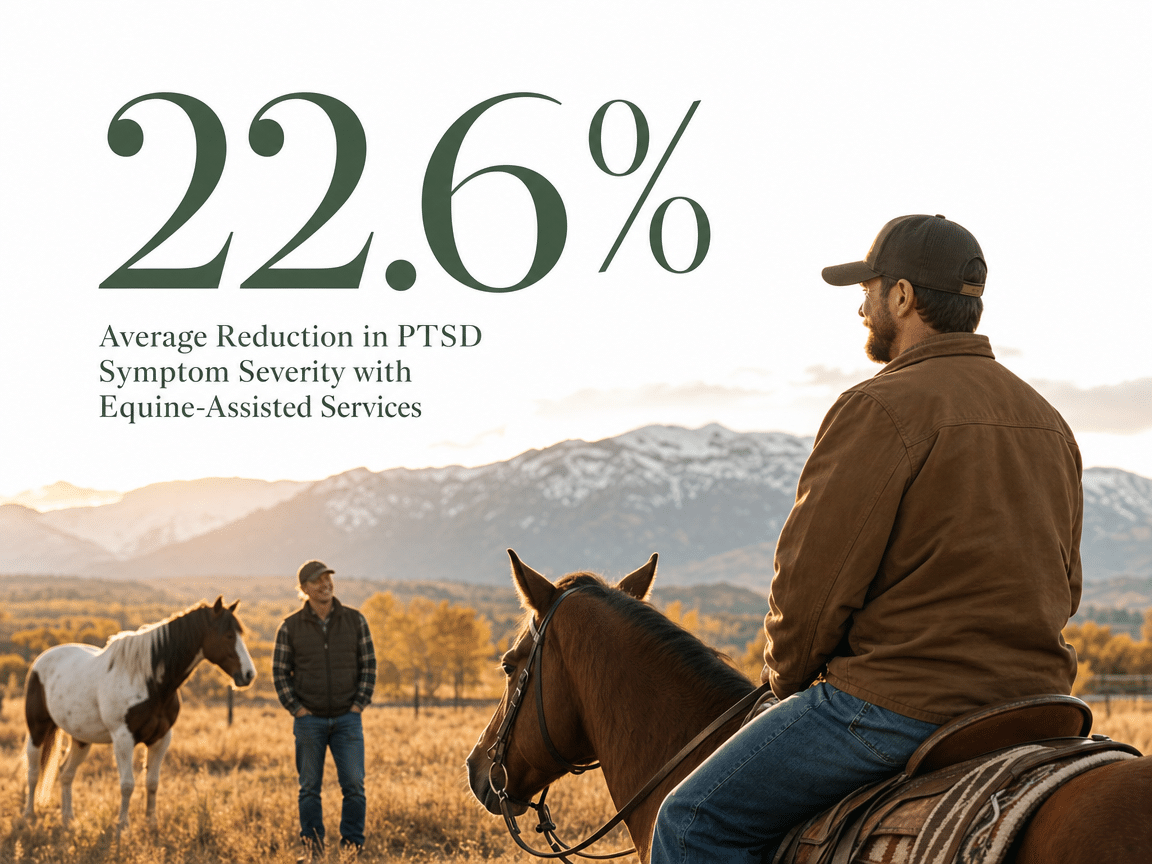
- For veterans and first responders carrying trauma, meta-analysis data shows an average 22.6% reduction in PTSD symptom severity, making the barn a viable entry point when clinical settings haven’t landed.8
Why a 1,200-Pound Animal Reaches Men Who Won’t Talk
You’ve probably sat through a talk about feelings and felt your jaw lock up. Maybe you nodded along, said what you thought the counselor wanted to hear, and walked out no closer to getting sober. If that sounds familiar, you’re not broken. You’re a man who was raised to handle things on your own, and sitting in a circle describing your childhood feels about as natural as wearing a suit to muck a stall.
Here’s what’s different about a horse. A 1,200-pound animal doesn’t care what you say. It cares what your body is doing. If your chest is tight, your shoulders are up around your ears, or your breath is short from last night’s craving, the horse feels it before you’ve said a word. It steps away. It pins its ears. It refuses to follow you across the pen. That honest feedback, without judgment or a clipboard, is why horse work reaches men who shut down in traditional therapy.
Researchers have started calling this an emotional support and a positive self-construct — a fancy way of saying men in horse programs describe feeling capable again, not sick. That matters when shame has been running the show for years.4
At Rocky Mountain Treatment Center in Great Falls, Montana, equine therapy for men in recovery isn’t a photo op. It sits alongside medically monitored detox, individual counseling, and 12-step work, taught by staff where more than 80% have been sober themselves. You still do the hard talking. You just get to do some of it with a lead rope in your hand and mountains on the horizon, which is a language a lot of men actually speak.
What Actually Happens in the Round Pen
A Typical Session, Start to Finish
Let’s walk you through it, because not knowing is half the fear. You show up to the barn in whatever you can move in — jeans, boots, a jacket if the Montana wind is honest that morning. Nobody hands you a workbook. Nobody asks you to share your feelings in front of strangers.
The first ten minutes are quiet. You stand outside the pen. The counselor points out the horse you’ll be working with, tells you its name, maybe a little about its personality. You breathe. If your hands are shaking from early sobriety or your head is loud, that’s noted, not judged. Patients in these programs consistently describe this arrival phase as the moment their shoulders drop for the first time all day.3
Then comes the groundwork. Not riding. Groundwork means you’re on your feet, on the ground, working with the horse from the outside. You’ll learn to approach without spooking it. You’ll halter it — sliding a nylon strap over its nose and behind its ears without getting your fingers pinched. You’ll lead it in a slow circle. You’ll pick up a brush and work down its shoulder, its back, its flank. Simple tasks. Real tasks. The kind that require you to be present or the animal notices.
The middle stretch of the session is where the work gets honest. The counselor might ask you to lead the horse across the pen to a cone. Sounds easy. It isn’t, not when the horse can feel that you’re rattled or angry or ashamed. When the horse plants its feet, you get to try again. And again. That’s the therapy — not the destination, but the noticing.
The last piece is reflection. You sit down, usually right there in the barn or just outside it, and talk with the counselor about what happened. What the horse did. What you did. What came up. Men in these programs report increased comfort and confidence during exactly this arc — arrival, hands-on task, then reflection — because the talking follows the doing instead of leading it.3
By the time you’re back in the truck heading to the main facility at Rocky Mountain, you’ve worked. Not just physically. Something in your chest has shifted, and you didn’t have to force it.
The Horse as a Mirror for Your Nervous System
Here’s the part that surprises most men. The horse isn’t reading your mind. It’s reading your body.
Horses are prey animals. For thousands of years, their survival depended on catching the smallest signal that a predator was near — a change in breathing, a tightening of muscles, a shift in how something walked. That wiring is still in them. When you step into the pen with a clenched jaw and a racing heart, the horse feels it before you’ve said hello. It might back up. It might refuse to move. It might swing its head away.
You’ll want to blame the horse. Most guys do at first.
Then the counselor asks a simple question: what’s happening in your body right now? And you notice your shoulders are up. Your breath is shallow. Your hands are in fists. You slow your breathing. You drop your shoulders. You try again. The horse walks with you.
That’s biofeedback in its oldest, plainest form. No wires, no screens, no clinician telling you what your numbers mean. Just an animal telling the truth about the state you’re actually in versus the one you’re pretending to be in. For men who have spent years using alcohol or drugs to muffle that inner signal, this is often the first time in a long time they’ve felt their own nervous system without numbing it.
Researchers looking at equine work in addiction treatment describe measurable gains in emotion regulation — the ability to notice a feeling, name it, and steady yourself instead of reaching for a drink. The horse isn’t a magic healer. It’s an honest mirror. And once you’ve practiced staying calm enough for a 1,200-pound animal to trust you, staying calm enough to sit through a craving starts to feel possible too.6
What the Research Actually Says (and Doesn’t)
Staying in Treatment Long Enough for It to Work
Here’s the ugly truth about addiction treatment: a lot of guys walk out early. They white-knuckle detox, sit through a few groups, decide they’ve got it handled, and leave before the work has a chance to stick. Then they relapse in a week. If you’ve done that before, you already know.
So the first thing researchers looked at wasn’t whether horses cure anything. It was whether men stay long enough to give sobriety a real shot.
One of the most-cited numbers in this field comes from a Norwegian cohort of young adults in inpatient SUD treatment. The group whose program was supplemented with equine interaction had a 56% completion rate. The group without it completed at 14%. That’s a wide gap, and it’s worth naming the scope: these were young adults in a specific inpatient setting, not every man in every rehab. But the direction is hard to ignore.3
A separate cohort study of horse-assisted therapy in inpatient SUD treatment found patients in the horse group were significantly more likely to complete treatment and stay 90 days or longer than those in usual care. That matters at Rocky Mountain Treatment Center, where the 30, 60, and 90-day tracks are built around the idea that longer stays give your brain and body a real chance to reset.10
You’re not going to hear anyone at the barn tell you a horse will keep you sober. What the research suggests is simpler: guys who work with horses tend to show up the next day. And the day after that. Retention isn’t a cure, but it’s the ground everything else gets built on.
Emotion Regulation, Self-Efficacy, and Anger
Staying is one thing. Changing what happens inside you is another.
Most men who end up in treatment have been managing feelings with a bottle or a pill for years. Anger, shame, boredom, grief — all of it got the same answer. When you take the substance away, those feelings don’t disappear. They come back louder. And if you don’t have another way to steady yourself, you drink again.
A 2023 study looked at whether equine-assisted therapy could move the needle on three specific things men in recovery often struggle with: emotion regulation, general self-efficacy, and self-esteem. Researchers found measurable improvements in all three after equine work was added as a complementary treatment. In plain terms, patients got better at catching a feeling before it hijacked them, they felt more capable of handling hard situations, and they thought a little better of themselves.6
Anger and aggression show up in that research too. A study of equine-facilitated psychotherapy in SUD patients found the domain that improved most significantly was behavioral problems — the category that covers aggression, impulsivity, and difficulty with substance use itself. The same study documented a statistically significant improvement in patient mood after each session.5
You’ll notice these aren’t dramatic claims. Nobody’s saying a horse rewrote a man’s personality. What the data suggests is that hours spent working with a large animal that requires patience and calm gradually build the internal skills a man needs to sit with a craving instead of feeding it. That’s the work. That’s what the counselors at Rocky Mountain are watching for when you leave the barn — not whether you led the horse perfectly, but whether you can name what came up in you while you tried.
The Honest Limits of the Evidence
You deserve straight talk here, because you’ve probably been sold snake oil before.
The 2022 systematic review of equine-assisted services for SUD is careful about what the data can and can’t say. Quantitative results suggest a positive effect on retention, completion, and mental health, but most studies had small sample sizes and inconsistent methods. A randomized controlled trial testing complementary horse-assisted therapy against usual care found 44% of the horse group completed treatment versus 32% of the usual-care group. The direction favored horses, but the difference did not reach statistical significance in that sample.1,2
What that means for you: equine therapy is promising, not proven the way a medication trial gets proven. The men who show up to the barn aren’t guinea pigs in a lab. They’re getting a real experience, and the research so far says the experience helps more than it hurts. It just hasn’t been studied on the scale that antidepressants or 12-step programs have.If somebody tells you a horse will fix you, walk away. If somebody tells you working with one might help you stay in treatment and learn to steady yourself, they’re closer to the truth.
For Veterans and First Responders Carrying Combat or Trauma
A lot of men who end up drinking too hard aren’t just drinking because they liked the taste. They’re drinking because something happened. A tour. A shift. A wreck. A call they can’t unhear. If you’re a veteran, a cop, a firefighter, a medic, or a corrections officer, you already know what it costs to carry that home and try to sleep on top of it.
Horses seem to reach that particular kind of injury in a way a folding chair and a clipboard often can’t.
A 2024 systematic review and meta-analysis of equine-assisted services for military veterans with PTSD pulled together data across multiple studies and found an average 22.6% reduction in PTSD symptom severity, with a mean severity score reduction of 12.46 across pooled trials. Veterans in that same body of research reported very positive perceived benefits, and every veteran surveyed in the qualitative arm said the work helped them build new or improved self-regulation skills. An earlier study of therapeutic horseback riding for veterans measured a 6-point improvement in PTSD symptoms at three weeks and a 13-point improvement by six weeks.7,8
Read those numbers with clear eyes. The samples are smaller than what you’d see in a big pharmaceutical trial, and follow-up windows are short. Nobody’s saying six weeks with a horse fixes a decade of combat memory. What the data does suggest is that hours spent around a large, watchful animal give trauma-hardened men a place to slow their breathing, feel their body without panicking, and practice trusting something again.
Part of why this lands with military and first-responder guys is the frame. Nobody asks you to sit in a circle and cry. You have a task. You have an animal that outweighs you and expects you to lead. It looks and feels more like a mission than a therapy session, which is exactly why men who’ve dismissed clinical work for years will sometimes give it a real try.
At Rocky Mountain Treatment Center, that matters. Great Falls has deep military roots, and many of the men who come through the 30, 60, and 90-day programs are carrying both addiction and trauma from service or a career of running toward what everyone else ran from. Working with horses becomes one more tool alongside detox, dual diagnosis counseling for co-occurring PTSD, and 12-step meetings — not a replacement for any of them, but a way in when the door has been shut for a long time.
Why Horse Work Lands Differently for Men
Sit a man down in a folding chair and ask him to talk about his father, and watch his shoulders climb. Hand him a lead rope and ask him to walk a horse to a fence post, and something else happens. His hands have a job. His eyes have somewhere to go. The conversation, when it comes, comes sideways.
That sideways angle is why horse work reaches guys who bounce off traditional therapy. You’re not the patient in the room. You’re the guy with the halter. The horse doesn’t know you drank yourself out of a marriage. It doesn’t know you’ve been to two other rehabs. It only knows what you’re doing right now, in your body, in this pen. For a man who has been carrying shame like a second job, that clean slate is medicine on its own.
Qualitative research backs this up in a way that reads true. Men in horse-assisted therapy describe the animal as a facilitator of a positive self-construct — meaning they walk out of the barn feeling capable, not sick. Nobody put that label on them. They earned it by catching a horse that didn’t want to be caught.4
There’s also the setting to reckon with. At Rocky Mountain Treatment Center, the barn sits under Montana sky. Boots, dust, weather that has opinions. For a rancher, a tradesman, a veteran, a mechanic — for the kind of man who’s spent his life outside — that setting doesn’t feel like a hospital. It feels like a place where real work gets done. And when the work is real, a man is more likely to stay long enough to let it change him.
How Equine Therapy Fits Into a Real Recovery Program
Detox, Counseling, and 12-Step Work Come First
Let’s be straight with you. Horses don’t detox you. If you’ve been drinking a fifth a day or running opioids, your body has to come off the substance safely before any barn work makes sense. That’s what medically monitored detox is for — nurses, medication when it’s needed, and eyes on you around the clock while the shakes and the sweats do what they do.
Once your body is stable, the real architecture of recovery kicks in. At Rocky Mountain Treatment Center, that means individual counseling with someone who has probably been sober themselves — more than 80% of the staff are in recovery, so the person across from you knows what a craving actually feels like at 3 a.m. It means group counseling, where you sit with other men who are figuring out the same thing you are. And it means 12-step meetings, where the language of sponsorship, honesty, and one day at a time gets built into your bones.
Equine therapy sits alongside all of that, not in place of it. The 2022 systematic review of equine-assisted services for SUD is clear that horses work as a complement to standard treatment, not a substitute for it. You do the counseling. You work the steps. You show up to detox appointments. And then, once or twice a week, you go to the barn and practice being the calm, steady man the horse needs you to be — the same man the rest of your life is asking you to become.1
Continuing Care, Family Week, and Life After Discharge
Thirty days is a start. Sixty is better. Ninety gives your brain the runway it actually needs to build new habits. Whichever track you land on at Rocky Mountain, discharge day isn’t the finish line — it’s when the harder part begins.
Family Week is part of that. For three days, the people who love you sit down with counselors and learn what addiction has cost, what recovery asks, and how to be part of your life without walking on eggshells or covering for you. If you’ve been to the barn during your stay, some of what you learned there — patience, honest signals, letting the other party set their own pace — travels straight into those family conversations.
After you go home, continuing care keeps the line open. Weekly Zoom groups. Check-ins at 30, 60, 90, 180, and 365 days. A counselor who remembers your name and knows what horse gave you trouble in week two. That kind of long tail matters because the internal skills equine work helps build — emotion regulation, self-efficacy, a steadier sense of who you are — take time to settle in, and research on those exact gains in SUD patients suggests they need reinforcement to hold.6
The horses stay in Great Falls. What you learned around them goes wherever you go next.
Frequently Asked Questions
Do I have to know anything about horses to do equine therapy?
No experience needed. Most guys who walk into the barn at Rocky Mountain have never touched a horse. The counselors and equine staff teach you everything as you go — how to approach, how to halter, how to lead. If you can hold a rope and follow simple direction, you can do this work. Being green is actually an advantage. You bring no bad habits and no ego about what you already know.
Is equine therapy a replacement for detox, counseling, or 12-step work?
What if I’m nervous or intimidated around a 1,200-pound animal?
Does equine therapy help with PTSD and combat trauma too?
Do you have to ride the horse, or is it all groundwork?
How strong is the research behind equine therapy for addiction?
References
- Equine-assisted services for individuals with substance use disorder: A mixed methods systematic review. https://pmc.ncbi.nlm.nih.gov/articles/PMC9749232/
- Complementary horse-assisted therapy for substance use disorders: a randomized controlled trial. https://pmc.ncbi.nlm.nih.gov/articles/PMC7001193/
- Cognitive and physiological impacts of psychotherapy incorporating equine interaction in substance use disorder treatment. https://pmc.ncbi.nlm.nih.gov/articles/PMC12497412/
- More Than Just a Break from Treatment: How Substance Use Disorder Patients Experience Horse-Assisted Therapy. https://pmc.ncbi.nlm.nih.gov/articles/PMC5054942/
- An evaluation of the effect of equine-facilitated psychotherapy on patients with substance use disorders (clinical outcomes version). https://pmc.ncbi.nlm.nih.gov/articles/PMC10306210/
- Equine-assisted therapy effectiveness in improving emotion regulation, self-efficacy, and self-esteem in patients with substance use disorders. https://pubmed.ncbi.nlm.nih.gov/37833688/
- Effects of therapeutic horseback riding on post-traumatic stress disorder in military veterans. https://pmc.ncbi.nlm.nih.gov/articles/PMC5774121/
- Are equine-assisted services beneficial for military veterans with PTSD? A systematic review and meta-analysis. https://pmc.ncbi.nlm.nih.gov/articles/PMC11293092/
- Equine-assisted psychotherapy for adolescents with substance use disorder: A quasi-experimental study. https://pubmed.ncbi.nlm.nih.gov/27104514/
- Horse-assisted therapy in inpatient treatment of substance use disorders: A naturalistic prospective cohort study. https://pubmed.ncbi.nlm.nih.gov/31843662/