
Key Takeaways
- Redefine ” drug detox near me” as reachable within a day, medically supervised around the clock, and connected to ongoing care, because proximity alone does not equal safety.
- A complete detox includes evaluation, stabilization, and preparation for continued treatment; missing any of these three parts is considered incomplete care.1
- Match the level of care to the substance and severity, since alcohol and benzodiazepine withdrawal can turn dangerous and require inpatient monitoring.3,4
- Verify six things before saying yes: state licensing, third-party accreditation, 24-hour medical staff, pre-medication evaluation, FDA-approved medications, and a booked next step.5
- In Montana, confirm DPHHS licensing, state-approved status, and Licensed Addiction Counselor credentials to make sure the facility legally meets clinical standards.10,12,14
- Expect the first 72 hours to include a thorough medical evaluation, scheduled vitals checks, adjusted medications, and early conversations about what comes after detox.1
- Plan the handoff into residential, outpatient, or medication-assisted treatment before discharge, because detox alone does not address why substance use started.1,2
- Without insurance, call the SAMHSA National Helpline at 1-800-662-HELP or use FindTreatment.gov to reach licensed, state-funded, or sliding-scale programs.15,8
What “near me” really needs to mean tonight
If you are reading this at 2 a.m. with a phone in your hand, take a breath. You are already doing the hard part. Looking is a real step, and it counts.
When you type “near me” into a search bar, your brain hears reachable today. While proximity feels safer, it’s not the same as medical safety. A detox facility two blocks away without a doctor on site is not safer than a licensed program a short drive away with nurses awake all night.
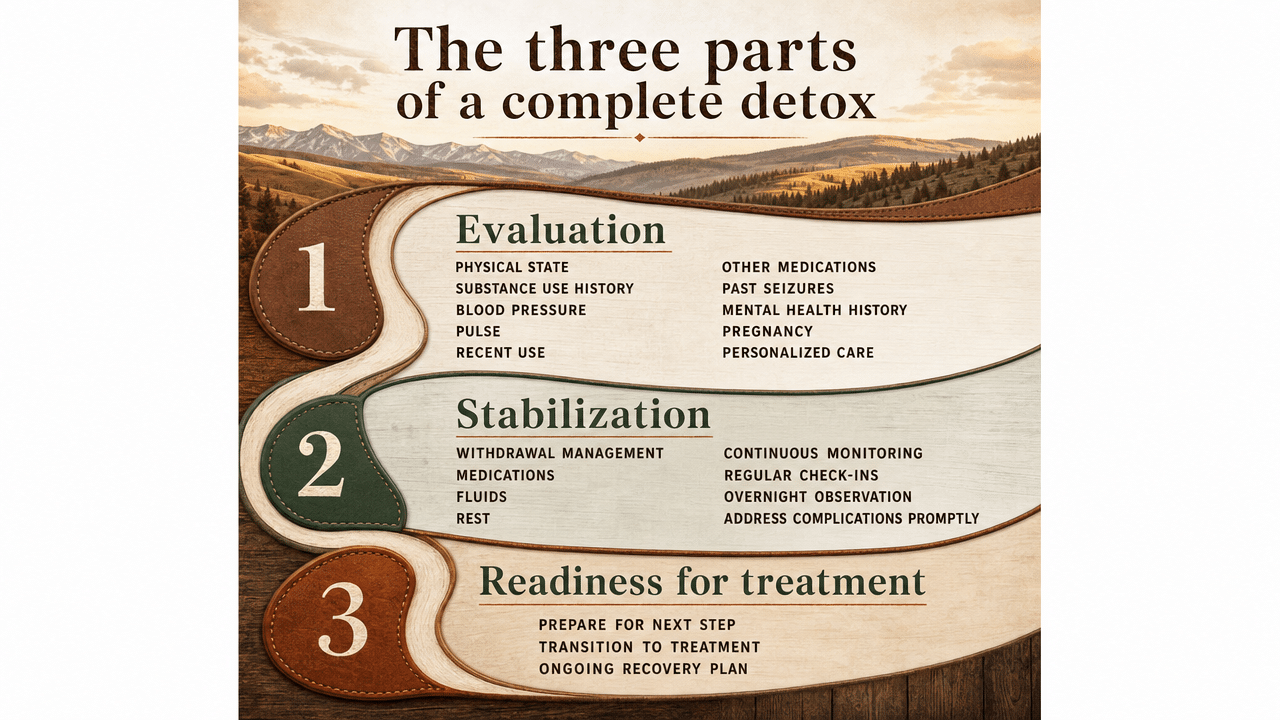
A safe detox is not a single event where you sweat it out and go home. National clinical guidance describes detoxification as three linked steps: evaluation, stabilization, and getting you ready for ongoing treatment. A program that skips any of the three is considered incomplete care.1
The next few sections provide a straightforward way to check for these critical components. You will not need a medical degree. You will need about ten minutes and a willingness to ask a few direct questions.
What makes a detox medically safe (not just close)
The three parts of a complete detox
When a detox is described as “safe,” it typically refers to three specific, interconnected parts, as outlined by federal clinical guidelines that reputable programs follow.
Here is what those parts entail:
- Evaluation.
- Before any treatment begins, a nurse or doctor assesses your physical state and substance use history. This includes checking blood pressure, pulse, recent substance use, other medications, past seizures, mental health history, and any pregnancy. This personalized assessment ensures you receive appropriate care.
- Stabilization.
- This is the medical management of withdrawal symptoms. It involves medications, fluids, rest, and continuous monitoring. Medical staff should check on you regularly, especially through the night, to address any complications promptly.
- Fostering readiness for treatment.
- A complete detox program prepares you for the next phase of recovery, whether that is residential care, outpatient services, or specialized treatment for opioid or alcohol use disorder. This step is integral to the definition of adequate care.1
Federal clinical guidance emphasizes that a detox process lacking any of these three components is considered incomplete and inadequate. Detox alone addresses the physical clearing of substances but does not, on its own, tackle the underlying reasons for substance use.1,2
If a program focuses only on symptom management, it is important to ask more questions about their comprehensive approach.
Why level of care matters more than distance
The appropriate setting for withdrawal varies depending on the individual and the substance. For instance, alcohol withdrawal can range from mild to severe. National guidelines from the American Society of Addiction Medicine recommend different levels of care based on the severity of anticipated withdrawal. Mild cases might be managed in an outpatient setting, while moderate to severe cases require inpatient monitoring due to risks like seizures and delirium tremens. Opioid withdrawal, though rarely fatal, is intensely uncomfortable, and proper management is crucial to prevent individuals from leaving treatment prematurely.3,4
Therefore, the critical question is not “how close is it?” but “can they provide the appropriate level of care for my specific withdrawal needs?”
A reputable program will inquire about your substance use history before admission. If a facility offers a bed without any medical questions, it is a red flag. Conversely, if they recommend a hospital setting because your condition requires it, that indicates a responsible approach.
A safe, medically supervised detox two hours away, with continuous nursing care and physician oversight, is a far better option than a nearby facility that cannot confirm medical staffing at all hours.
Your 10-minute verification checklist
Six things to confirm before you say yes
You do not need to become an expert tonight. You need to confirm six things. If a program can answer these questions clearly on the phone, you are probably looking at a safe detox. If they dodge, get vague, or push you to commit before answering, that is data too.
Here is your list. Screenshot it if it helps.1,5
- State licensing. Is this program licensed by the state as a substance use disorder facility? Not “registered.” Not “certified” by some private group you have never heard of. Licensed. This is the baseline federal guidance names first.
- Third-party accreditation. Are they accredited by an outside body such as The Joint Commission or CARF? Accreditation means someone from outside the building has looked at their clinical practices and said they meet a national standard.
- Medical staff on site around the clock. Ask directly: “Who is physically at the facility at 3 a.m.?” You want to hear “a nurse” or “a nurse and an on-call physician,” not “staff.”
- Medical evaluation before any medication. A safe program evaluates you first and then decides what, if anything, to give you. If they promise you a specific medication before they have asked a single question about your health, that is a red flag.
- FDA-approved medications available when appropriate. For alcohol and opioid withdrawal, there are medications with real evidence behind them. A quality program uses them.
- A booked path into treatment on day one. Not a pamphlet. An actual plan for what happens when detox ends.
Safe detox vs. unsafe detox: a side-by-side
Sometimes it is easier to see the difference than to describe it. Here is what the two look like sitting next to each other.
| What to check | Safe, medically monitored detox | Unsafe or custodial detox |
|---|---|---|
| Licensing | Currently licensed by the state as a substance use disorder facility | No verifiable state license, or vague claims of being “registered” |
| Accreditation | Accredited by The Joint Commission, CARF, or a similar body | No third-party accreditation, or credentials you cannot look up |
| Medical evaluation | Nurse and/or physician assessment before any medication is given | Beds offered before anyone asks about your health history |
| Around-the-clock monitoring | Nursing coverage every shift, with a physician directing care | Overnight coverage by non-medical staff, or unclear who is on site |
| Medications | FDA-approved medications used when clinically appropriate | Herbal-only, “rapid,” or one-size-fits-all protocols |
| Transition to treatment | A booked next step in care before you are discharged | Discharge with a phone number and a wish of good luck |
That last row is the one families miss most often. National clinical guidance is blunt about it: a detox process that does not include getting you ready for, and connected to, ongoing treatment is considered incomplete and inadequate care. Clearing your body of a substance is not the same as treating why you were using it.1
If you are looking at a program and cannot fill in the left-hand column for all six rows, keep calling.
The phone script: what to say when you call intake
If you are the family member reading this, this part is for you. Making the first call is hard. Your voice will shake. That is fine. The people who answer these phones hear shaky voices all day, and the good ones will slow down with you.
You do not need a speech. You need three sentences and a short list of questions. Try this:
“Hi. I’m calling about my [husband/daughter/brother]. He’s been using [alcohol/opioids/etc.] and I think he needs medical detox. Can you tell me if you can help, and how soon?”
Then, once they respond, work through these:6
- Are you licensed by the state and accredited by an outside body?
- Is there a nurse on site 24 hours a day, and a physician directing care?
- Will someone medically evaluate him before any medications are given?
- How soon can you admit him? (If the answer is more than 48 hours, ask what to do in the meantime.)
- What is the plan for treatment after detox ends?
- Do you take our insurance, and what will we owe?
Write down the answers. If a question gets deflected, ask it again. You are not being difficult. You are being the person your loved one needs right now.
If you are in Montana: a local verification layer
If the program you are considering is in Montana, you get an extra layer of verification that most national articles skip. The state keeps public records of who is licensed to do this work, and you can use them.
Montana licenses substance use disorder facilities through the Department of Public Health and Human Services (DPHHS). There are four categories: outpatient, inpatient, residential, and partial-hospitalization. A safe drug detox will fall into the inpatient or residential category, and the facility has to meet real requirements to hold that license, including approved floor plans, State Fire Marshal certification, water and sewer safety, and written policies and procedures. A license is not a formality. It is time-limited, it is tied to a specific building, and a facility cannot legally operate without one.10,11
There is a second Montana-specific piece worth knowing. To be reimbursed for facility-based treatment through the state, a program has to be state approved in addition to being licensed, and DPHHS inspects those facilities at least every two years. So when you are on the phone, you can ask two clean questions: Are you licensed by DPHHS as an inpatient or residential SUD facility? Are you a state-approved program?12
Then ask about the people. Montana credentials its addiction clinicians through the state Board of Behavioral Health. The one to listen for is Licensed Addiction Counselor, or LAC. You can also ask whether their staffing meets the state’s SUD facility standards, which spell out the clinical roles that must be in place.13,14
Four questions. That is the whole Montana check.
What the first 72 hours actually feel like
Arrival and evaluation: the first few hours
Picture this so it feels less like a black box. You walk in, or someone walks in with you. Someone takes your bag. There is paperwork, but not as much as you fear, and someone will sit with you while you do it.
The first real thing that happens is a medical evaluation. A nurse checks your blood pressure, your pulse, your temperature. They ask what you have been using, how much, and how long since the last time. They ask about other medications, past withdrawal, seizures, pregnancy, mental health history, any pain you are in right now. It is not a test. There are no wrong answers. Tell them the truth, even the parts you have not said out loud before. It changes what they can safely give you.1
You may get fluids. You may get a first dose of medication once the picture is clear. You will get a bed, a blanket, and a quiet room. Someone will explain what to expect over the next few hours in plain language.
If you are the family member who brought them in, this is usually where you get to breathe. You did your part. Now people whose whole job is this are taking the next shift.
Stabilization: days one through three
The next two to three days are the part most people are scared of. Here is what actually fills them.
Vital signs get checked on a schedule, often every few hours at first, then less often as your body settles. Medications are adjusted based on how you are doing, not based on a rigid script. If you are withdrawing from alcohol or benzodiazepines, the team is watching specifically for the things that can turn dangerous, because those are the withdrawals where inpatient monitoring earns its keep. If it is opioids, they are managing the misery so you do not leave against advice before your body has a chance to reset.3,4
You will sleep in broken pieces. You may sweat through a shirt or two. Your appetite will be strange. Some hours will drag. A nurse will come in at 3 a.m. to check on you, and that is a good thing, not a bother. That is what “medically monitored” means when you strip the words down.
By day two or three, most people start to feel human again. Not fixed. Human. You will be eating something. You will be talking to a counselor about what happens next, because a good program starts that conversation before you walk out the door, not after. That handoff into ongoing treatment is where the next section picks up.1,2
What comes after detox (and why detox alone is not treatment)
Here is the part a lot of programs skim over, and the part that matters most for whether this actually holds.
Detox clears the substance out of your body. That is a real accomplishment. It is also a starting line, not a finish line. The reasons you were using, the habits your days are built around, the people you drink or use with, the trauma you have been outrunning, the sleep you have not had in years, the anxiety underneath it all—none of that leaves your body when the withdrawal does. Federal clinical guidance is plain about this: detoxification by itself is not sufficient treatment for substance dependence.1,2
So a safe program plans for what comes next while you are still in the bed. That plan usually looks like one of a few things: residential care for 30, 60, or 90 days; a partial-hospitalization or day-treatment program; outpatient counseling several times a week; or, for opioid or alcohol use disorder specifically, ongoing medication paired with therapy. The right next step depends on your situation, but there should be one, and it should be booked before you walk out the door.7
Ask the intake team directly: What happens on the day I finish detox? A good answer names a place, a date, and a person. A vague answer—”we’ll figure that out later”—means the handoff is not really built in.
If you can, keep going where you started. Staying under the same roof for detox and treatment means no gap, no second intake, no lost momentum. That continuity is the quiet reason residential programs with in-house detox tend to hold.2
If you have no insurance or nowhere to start
If you are reading this and thinking none of this applies to me because I have no way to pay for it, stay with me for a minute. There are two doors that are open to you tonight, and both are free to walk through.
The first is the SAMHSA National Helpline at 1-800-662-HELP (4357). It is answered 24 hours a day, it is confidential, it costs nothing, and the person on the other end can point you toward licensed detox and treatment options in your area, including state-funded programs. They speak English and Spanish. You do not have to have your story ready. You can just say you need help.15
The second is FindTreatment.gov. It is a federal directory of state-licensed providers, and you can filter by location, payment accepted, and level of care. Every program listed is a licensed provider, which means you are not gambling on who shows up first in a search result.8
Call the intake teams anyway. Many programs will help you check your insurance benefits over the phone, and some accept sliding-scale payment or can connect you to state funding. Not having a card in your wallet is not the end of the road. It is the reason those two numbers exist.
One phone call from here
You made it through a long article about a hard subject. That counts. Reading this at all means part of you is already reaching for a different next day, and that part is worth listening to.
Here is the concrete move. Pick one number. Call the SAMHSA National Helpline at 1-800-662-HELP (4357), or call a state-licensed, accredited program directly and work the checklist from earlier. Ask the six questions. Write down what you hear.15
If you are looking in Montana, Rocky Mountain Treatment Center in Great Falls offers medically monitored detox that transitions straight into residential care, so there is no gap between clearing your body and starting the real work.
You do not have to know what to say. You just have to dial. The people on the other end will take it from there.
Frequently Asked Questions
Is it safer to go to a detox close to home or one farther away?
Safer means medically monitored, licensed, and accredited. Distance is secondary. A program 90 minutes away with nurses on every shift and a physician directing care is a safer choice than one down the street that cannot tell you who is on site overnight. Give yourself permission to travel if the closer option cannot meet the basics.5
How do I know if a detox program is actually licensed and accredited?
Ask directly on the phone, then verify. State licensing is public record through your state’s health department. Third-party accreditation from The Joint Commission or CARF can be looked up on their websites. In Montana, DPHHS licenses substance use disorder facilities and inspects them at least every two years. If a program hesitates when you ask, that is your answer.10,12
What happens if a program cannot see me for several days?
Keep calling other programs. Federal consumer guidance suggests being cautious with any program that cannot admit you within 48 hours. If nothing is available quickly, call the SAMHSA National Helpline at 1-800-662-HELP for a same-night referral, or go to a hospital emergency department if withdrawal symptoms are severe.6,15
Can I just detox at home instead of going to a facility?
For some substances and some people, outpatient detox with medical supervision is appropriate. For others, it is dangerous. Alcohol and benzodiazepine withdrawal can cause seizures and a condition called delirium tremens that turns life-threatening quickly, and moderate to severe cases need inpatient monitoring. Do not guess. A quick phone evaluation with a licensed program can tell you which category you are in.3,4
What if I don’t have insurance or money for detox?
Call the SAMHSA National Helpline at 1-800-662-HELP (4357). It is free, confidential, and open 24 hours, and the people who answer can point you toward state-funded and sliding-scale programs in your area. You can also search FindTreatment.gov, which lists only state-licensed providers and lets you filter by payment options. Lack of insurance is not a closed door.8,15
Why isn’t detox by itself considered full treatment?
Detox clears the substance from your body. It does not change the reasons you were using, the habits built around it, or the mental health issues underneath. Federal clinical guidance is direct: detoxification alone is not sufficient treatment for substance dependence, and a detox that does not connect you into ongoing care is considered incomplete. Real recovery starts after the withdrawal ends.1,2
References
- Quick Guide For Clinicians Based on TIP 45—Detoxification and Substance Abuse Treatment. https://nida.nih.gov/sites/default/files/samhsa_detoxification_and_substance_abuse_treatment.pdf
- Detoxification and Substance Abuse Treatment (TIP 45). https://www.ncbi.nlm.nih.gov/books/NBK64115/
- The ASAM Clinical Practice Guideline on Alcohol Withdrawal Management. https://pubmed.ncbi.nlm.nih.gov/32511109/
- Executive Summary of the American Society of Addiction Medicine Clinical Practice Guideline on Alcohol Withdrawal Management. https://pubmed.ncbi.nlm.nih.gov/32909985/
- Quality Treatment for Mental Health, Drugs and Alcohol. https://www.samhsa.gov/find-support/learn-about-treatment/finding-quality-treatment
- Struggling with Addiction? Tips on Finding Quality Treatment. https://www.samhsa.gov/blog/struggling-addiction-tips-finding-quality-treatment
- Treatment Options for Substance Use Disorder. https://www.samhsa.gov/substance-use/treatment/options
- Find Substance Use Disorder Treatment. https://www.samhsa.gov/substance-use/treatment/find-treatment
- A Quick Guide to Finding Effective Alcohol and Drug Addiction Treatment. https://www.michigan.gov/-/media/Project/Websites/mdhhs/Folder2/Folder62/Folder1/Folder162/SAMHSA_Quick_Guide_Find_Treatment.pdf?rev=c45fcb5f2d3a4803adf85828f150a252
- Substance Use Disorder Facility – Montana DPHHS Office of Inspector General. https://dphhs.mt.gov/oig/licensure/healthcarefacilitylicensure/lbfacilityapplications/lbsubstanceusedisorderfacility
- Rules for Substance Use Disorder Facility – Montana DPHHS. https://dphhs.mt.gov/assets/oig/Rules_for_Substance_use_Disorder_Facility.pdf
- Mont. Admin. r. 37.27.106 – State Approved Programs, Substance Use Disorder Facilities. https://www.law.cornell.edu/regulations/montana/Mont-Admin-r-37.27.106
- Mont. Admin. r. 37.106.1468 – Outpatient Substance Use Disorder Facility Standards. https://www.law.cornell.edu/regulations/montana/Mont-Admin-r-37.106.1468
- License Information – Montana Behavioral Health Professional Boards. https://boards.bsd.dli.mt.gov/behavioral-health/certified-behavioral-health-peer-support-specialist
- National Helpline for Mental Health, Drug, Alcohol Issues. https://www.samhsa.gov/find-help/helplines/national-helpline