
Key Takeaways
- Four FDA-approved medications treat alcohol use disorder: acamprosate for abstinence, oral naltrexone for cutting heavy drinking, monthly injectable naltrexone when daily pills falter, and disulfiram as a deterrent wall.
- None of these medications are habit-forming, sedating, or a cure — they quiet cravings and post-withdrawal noise so counseling, community, and daily life can do the deeper work 14.
- Choice hinges on your goal, your body, and your life: acamprosate leans toward full sobriety while naltrexone leans toward fewer heavy nights, and you can change course later 15.
- Medication works better inside a structured program with psychosocial support, and it should continue after discharge through a prescriber handoff and continuing care check-ins 12, 17.
The questions you’re actually asking at 11pm
You didn’t come here for a lecture on brain chemistry. You came here because something is wrong, and you’ve been turning it over for a while, and tonight the tab you finally opened has the word medication in it.
So let’s answer what you’re actually asking.
Is this a crutch? No. It’s a tool. The medications used for alcohol use disorder aren’t habit-forming, and they don’t get you high. They quiet the noise so the rest of the work has a chance to land 14.
Will I still feel like me? Yes. These aren’t sedatives. Most people describe it as the volume on cravings turning down, not their personality turning off 16.
Does taking a pill mean I’m not really doing recovery? No. Every major clinical guideline treats medication as one part of a bigger picture that includes counseling, community, and support. The pill isn’t the plan. It’s something that helps the plan work 2, 12.
Are there really options? Four, actually, all FDA-approved, and each one fits a different goal. Some help you stay fully sober. One helps you drink less on the days you slip. One puts a hard wall between you and the next drink 14.
You don’t have to decide anything tonight. Reading this counts. Sitting with the question counts. The next honest step is smaller than you think, and it starts with knowing what’s actually on the table.
Here’s what’s on the table.
What medication is really doing (and what it isn’t)
Here’s the honest version of what these medications do: they change how your brain and body respond to alcohol, or to the absence of it. That’s the whole trick. None of them make you a different person, and none of them do the deeper work of figuring out why drinking became the thing you reached for.
Think of it this way. If cravings are a loud room, medication can turn the volume down. It doesn’t empty the room. It doesn’t put new furniture in. It just gives you enough quiet to hear the other voices in your life again — a counselor, a sponsor, your kid on the phone, yourself.
What they aren’t: they aren’t sedatives, they aren’t uppers, and they aren’t habit-forming. The four FDA-approved options for alcohol use disorder have no abuse potential, which means your body doesn’t start craving them the way it craves a drink 14. You won’t feel high. You won’t feel numb. Most people say they just feel a little more like themselves on a normal Tuesday.
And here’s the part most people don’t hear enough: any healthcare provider can prescribe these. You don’t need to find a specialist first to have the conversation 14. You can start where you already are.
Four FDA-approved medications, matched to what you want
If your goal is staying fully sober: acamprosate
Some people know, deep down, that moderation isn’t the road for them. If that’s you — if the goal is a clean line, no drinks at all — acamprosate is worth knowing about.
Here’s what it actually does. After you stop drinking, your brain doesn’t just snap back to normal. The chemistry that got used to alcohol keeps sending out static for weeks or months. Restlessness. Sleep that won’t come. A low hum of anxiety that makes a drink sound reasonable at 4pm on a Wednesday. Acamprosate helps quiet that static. It eases the post-withdrawal discomfort that so often pulls people back 16.
It’s typically taken as two tablets, three times a day. That sounds like a lot, and it is — this is a medication that asks you to remember it with breakfast, lunch, and dinner. For some people, that rhythm actually helps. It becomes a small daily practice, like making the bed. For others, the pill count is the hard part.
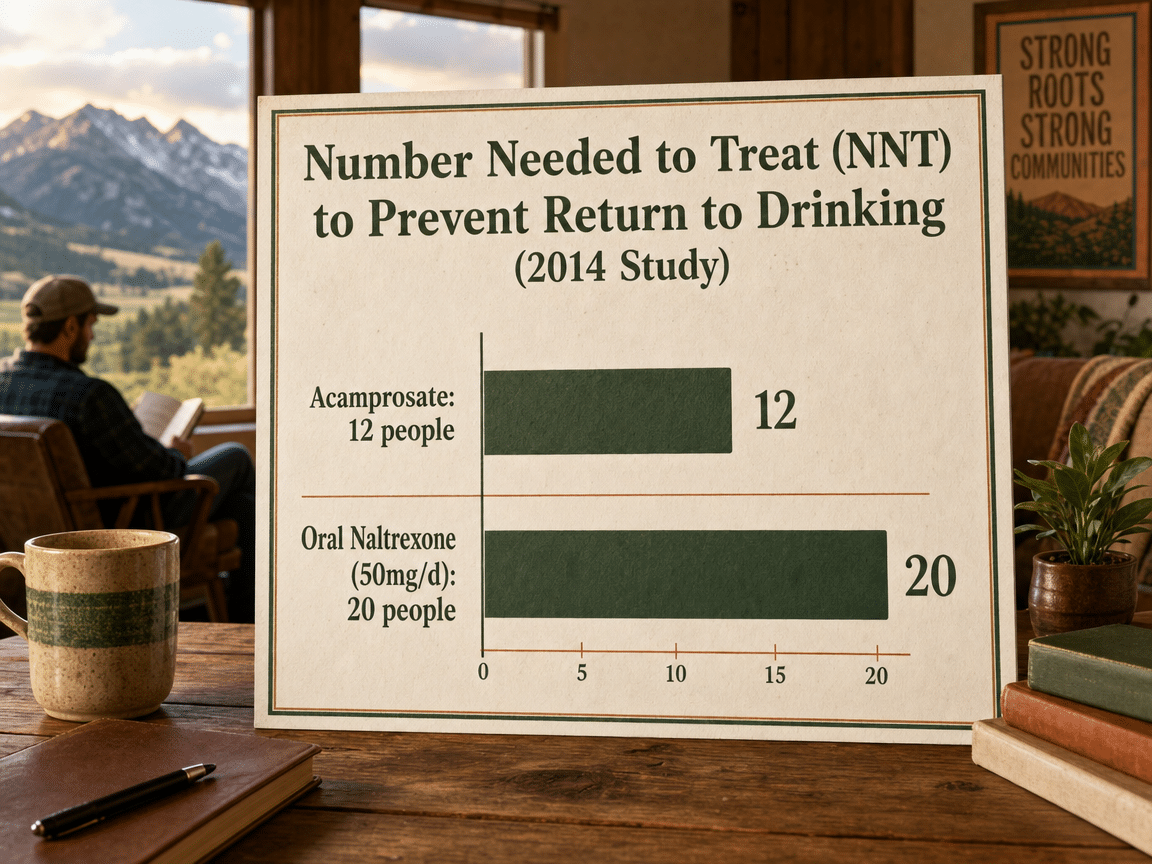
The evidence behind it is real. In the 2023 JAMA meta-analysis of 118 trials, researchers reported a number needed to treat of 11 for acamprosate to prevent one person from returning to any drinking, compared with 18 for oral naltrexone at 50 mg/day 5. Number needed to treat is a plain idea dressed in stiff clothes: out of every 11 people who take acamprosate, one person stays sober who otherwise wouldn’t have. That’s not everyone. But it’s someone real, and it might be you.
One safety note worth naming: acamprosate is cleared through your kidneys, so if you have kidney issues, your care team will check your labs and may adjust the dose 13. That’s routine, not scary.
If your goal is cutting the heavy drinking: oral naltrexone
Maybe abstinence feels like too big a jump right now. Or maybe you’ve stopped before, and the drinks that undo you aren’t the first one — they’re the fourth, the sixth, the one where the night tips over. If the heavy drinking is the piece you most want to change, oral naltrexone is often where care teams start.
Naltrexone works differently than acamprosate. When you drink, your brain releases chemicals that make alcohol feel rewarding — that warm rush, that softening of the edges. Naltrexone blocks the receptors that carry that reward signal. So the drink still goes down, but the payoff you were chasing doesn’t fully arrive 16. Over time, that dulled reward can loosen alcohol’s grip. You may find yourself stopping at two drinks instead of six, or not reaching for the second bottle.
Two large systematic reviews name oral naltrexone at 50 mg/day, alongside acamprosate, as a first-line medication for alcohol use disorder 5, 8. A separate meta-analysis found that naltrexone is slightly better at cutting down heavy drinking compared to acamprosate 15. Neither one wins. They just do different jobs.
You take it as one pill a day, which is easier to remember than acamprosate’s six. That matters more than it sounds like it should. The medication that fits into your actual life is the one that has a chance to work.
The main safety piece: naltrexone is processed by the liver, so your care team will want baseline labs and may check in on liver function during treatment 13. You also can’t be using opioid pain medication while taking it — that’s a real conversation to have if pain is part of your medical picture.
When a daily pill is the hard part: the monthly naltrexone shot
Let’s be honest about something. Taking a pill every single day for months, when part of you still misses drinking, is hard. Some people forget. Some people forget on purpose. The morning after a rough night, reaching for the medication that helps you not have rough nights can feel like a small betrayal you don’t have language for.
The extended-release version of naltrexone is a monthly shot. Same medication, same mechanism — it blocks the reward signal from alcohol — but you get it once, in a clinic, and then it’s working quietly in the background for about four weeks 14. No morning decision. No bottle on the counter to look at.
The evidence supports it. A meta-analysis of randomized placebo-controlled trials found that people on the monthly injection had about two fewer drinking days per month and 1.2 fewer heavy drinking days per month compared with placebo, with the effect getting stronger the longer people stayed on it 7. Those numbers aren’t fireworks. They’re the sound of a slow shift — fewer nights that go sideways, more mornings you’re proud of.
The shot works especially well for people leaving a structured setting, when the daily rhythm of a program ends and normal life comes rushing back with all its noise. Having something already in your system, quietly doing its job, can be the buffer that gets you through the first hard month.
One note: like the oral version, injectable naltrexone is processed by the liver, and your care team will monitor for that 13. You’ll also need to be off opioids and past acute withdrawal before starting.
When you need a hard wall between you and the next drink: disulfiram
Some people don’t want a nudge. They want a wall.
Disulfiram is that wall. Take it in the morning, and if alcohol enters your system that day, your body reacts hard — flushing, nausea, a pounding head, a racing heart. It’s genuinely unpleasant, and that’s the whole point. The medication doesn’t reduce cravings the way naltrexone does. It doesn’t quiet post-withdrawal static the way acamprosate does. It just makes drinking a physically miserable choice, so the decision gets made once in the morning instead of a hundred times through the day 3.
For some people, that’s exactly the structure they need. If your pattern is impulsive — a drink out of nowhere, before your thinking mind catches up — disulfiram converts that impulse into an actual pause. It’s often chosen by people who want an external commitment, sometimes taken with a partner or family member watching, as a kind of daily promise made visible.
Here’s the honest part. The controlled-trial evidence for disulfiram is more limited than it is for naltrexone or acamprosate — some reviews note it hasn’t consistently shown benefit in blinded trials where people didn’t know they were taking it 11. What seems to help most is when both the person and their support system know it’s there. The deterrent works because you know it works.
Safety is real with this one. Disulfiram isn’t right for people with certain heart conditions, some psychiatric conditions, or during pregnancy, and even things like alcohol in cough syrup or mouthwash can trigger a reaction 13. This is one where a careful conversation with a doctor matters more than usual.
How you and a care team actually choose
Here’s the part where a lot of articles get abstract. Let’s stay concrete instead. Choosing a medication for alcohol use disorder isn’t really about which one is “best” — it’s about which one fits the shape of your actual life and what you’re trying to change.
Good care teams start with a few honest questions:
- What do you want? Total abstinence, or fewer heavy nights?
- Can you take a pill every day, or is a monthly shot more realistic once life speeds back up?
- What does your body already carry — liver issues, kidney concerns, pregnancy, heart conditions, opioid pain medication you can’t stop?
- What have you tried before, and what got in the way?
The evidence lands in a helpful place here. Acamprosate tends to be slightly better at helping people stay fully abstinent, while naltrexone tends to be slightly better at cutting down heavy drinking 15. That’s not a tiebreaker — it’s a hinge. If your goal is a clean line, acamprosate is the natural starting point. If your goal is fewer nights that spiral, naltrexone leads. If daily pills won’t survive real life, the monthly naltrexone shot is the same medication with a different delivery. If you need a firm external wall and you and a doctor have talked through the safety piece carefully, disulfiram is on the table 3.
The APA practice guideline and other major reviews all land in the same place on how the decision gets made: collaboratively, between you and a clinician who knows your history, with your preferences carrying real weight 11, 17. You’re not being handed a prescription. You’re building a plan together.
One thing worth saying out loud. You can change your mind. If the first medication doesn’t fit — the side effects are too much, the schedule doesn’t work, the goal itself shifts — that isn’t failure. That’s information. Care teams expect this. The first choice is a starting point, not a verdict.
Why medication works better inside a real program
Here’s something worth saying plainly: a prescription by itself is a thin thread. It can hold, especially at the start. But it holds better when it’s woven into something bigger.
The research keeps landing on the same conclusion. Every major systematic review of medications for alcohol use disorder — the 2023 JAMA meta-analysis, the AHRQ evidence summary, the SAMHSA guidance — frames these medications as effective in conjunction with psychosocial interventions, not as standalones 8, 12. That’s not a soft caveat. That’s the finding. The pill quiets the craving. The counseling, the group, the family conversation — that’s what teaches you what to do with the quiet.
Inside a residential setting, that combination gets easier, not harder. Detox is medically monitored, so the wobbly first days don’t happen alone in an apartment where the wine is still in the fridge. Medication decisions get made in real conversations with a clinician who’s watching how you actually respond — not over a fifteen-minute appointment three weeks apart. If acamprosate makes your stomach unhappy or the daily pill count feels impossible, someone notices by dinner, not by month three 8.
Then there’s the rest of the day. Individual counseling. Group work with people who won’t be shocked by anything you say. Equine sessions where a thousand-pound animal reflects back your own nervous system without saying a word. Family week, where the people who love you learn a shared language for what happened. The mhGAP intervention guide names it directly: no single therapy is clearly superior, and care works best when it’s adapted to the person in front of you 10. A structured program builds that layered picture on purpose.
Medication also lands differently when you’re not carrying every decision alone. The APA practice guideline is built around shared decision-making — you and a clinician choosing together, with your preferences carrying real weight 17. That conversation is harder to have when you’re exhausted, isolated, and trying to research options between shifts. It’s easier when the person prescribing knows your story because they’ve been sitting with you for two weeks.
The pill isn’t doing less inside a program. It’s doing exactly what it’s designed to do, with more of the surrounding conditions actually in place.
What happens with your medication after you leave
Here’s the question most articles skip. You finish 30 or 60 or 90 days. The rhythm that held you steady — the meals at the same times, the counselor down the hall, the group at 10am — starts to fade behind you. What happens to the medication you were taking?
The short answer: it keeps going, if it’s working. FDA-approved medications for alcohol use disorder aren’t detox drugs. They’re not something you take for two weeks and stop. Every major guideline treats them as ongoing supports, continued for months or longer depending on how you’re doing and what you and your clinician decide together 17. There’s no fixed finish line. There’s a conversation you keep having.
The handoff is the piece that matters. Before you leave a residential program, someone on your care team should be helping you line up the next prescriber — a primary care doctor, an outpatient addiction clinician, a psychiatrist. Any healthcare provider can prescribe these medications 14, so the network is wider than people think. The monthly naltrexone shot works especially well through this transition, because the next dose is already scheduled and you’re not making a daily decision alone 7.
Continuing care is where the medication and the rest of the work stay married. Weekly check-ins, alumni groups, family follow-ups at 30, 60, 90, 180, and 365 days — that’s the scaffolding around the prescription. The medication doesn’t do more when it’s inside a program. It does exactly what it’s designed to do, wherever you are.
A next honest step
You made it to the end of a long page about a hard topic. That counts for something. Reading this at 11pm, or after a rough morning, or in a parked car outside somewhere you weren’t ready to go inside — that’s not nothing. That’s a person deciding to look at the thing.
Here’s what the next honest step actually looks like. It isn’t picking a medication. It’s picking up the phone, or opening a message, and saying some version of: I think I need help, and I want to know what my options are. The medication conversation happens after that, with someone who knows your story, your health history, and what you’re hoping to build. You don’t have to have it figured out first.
If a structured setting sounds like it might be what you need — medically monitored detox, counseling that goes deeper than a fifteen-minute appointment, a care team that can start medication in real time and keep watching how it lands — that’s what places like Rocky Mountain Treatment Center are built for. The pill is one piece. The rest of the picture is where healing actually happens.
You’re allowed to ask.
Frequently Asked Questions
Are these medications addictive or habit-forming?
No. The four FDA-approved medications for alcohol use disorder — acamprosate, disulfiram, oral naltrexone, and the monthly naltrexone injection — have no abuse potential 14. Your body doesn’t build a craving for them the way it does for alcohol. You won’t feel high, you won’t feel numb, and stopping them (with your care team) doesn’t cause the kind of withdrawal drinking does. They’re tools, not new dependencies.
Do I have to be fully sober before starting medication?
It depends on which one. Oral and injectable naltrexone are typically started after you’ve moved through acute withdrawal and can abstain from alcohol at the start of treatment 13. Acamprosate is generally started after drinking stops, once detox is complete. Disulfiram also requires you to be alcohol-free before your first dose. Inside a residential program, the timing gets managed for you — one less decision to carry alone.
Will taking medication mean I’m not really doing the work of recovery?
That worry shows up a lot, and it deserves an honest answer. No. Every major clinical guideline treats medication as one part of recovery, alongside counseling, group support, and family healing 2, 12. The pill doesn’t do the emotional work — you still do that. It just makes the ground steadier while you do it. Using a tool that helps isn’t cheating. It’s paying attention to what actually works.
How long will I need to stay on medication for alcohol use disorder?
There’s no fixed answer, and that’s the honest part. These aren’t short-course medications. Guidelines treat them as ongoing supports, continued for months or longer based on how you’re doing and what you decide with your clinician 17. Some people stay on for a year. Some longer. The conversation about stopping happens later, when your life has enough scaffolding under it — not on a calendar someone else drew.
What are the most common side effects I should know about?
Acamprosate and naltrexone most often cause stomach upset — nausea, diarrhea, or headache, especially in the first weeks 8. Naltrexone is processed by the liver, so your team will check labs 13. Acamprosate is cleared by the kidneys, which may mean dose adjustments if you have kidney issues 13. Disulfiram causes the intentional reaction with alcohol and has cautions for heart, psychiatric, and pregnancy concerns 13. Most side effects ease with time.
Can my regular doctor prescribe these, or do I need a specialist?
Your regular doctor can prescribe them. Any healthcare provider can write prescriptions for the four FDA-approved medications for alcohol use disorder — no special waiver or addiction specialty required 14. That said, having someone who knows addiction medicine (a residential care team, an outpatient addiction clinician, a psychiatrist) helps with the harder questions: which fits your goals, how to time it around detox, what to watch for. You can start where you already are.
References
- Treatment of Alcohol Use Disorder. https://www.ncbi.nlm.nih.gov/books/NBK561234/
- Alcohol Use Disorder (AUD) Treatment. https://medlineplus.gov/alcoholusedisorderaudtreatment.html
- Medications for the Treatment of Alcohol Use Disorder. https://oasas.ny.gov/providers/medications-treatment-alcohol-use-disorder
- Pharmacotherapy for Alcohol Use Disorders: A Systematic Review and Network Meta-Analysis. https://pmc.ncbi.nlm.nih.gov/articles/PMC10010623/
- Pharmacotherapy for Alcohol Use Disorder: A Systematic Review and Meta-Analysis. https://pubmed.ncbi.nlm.nih.gov/37934220/
- Pharmacotherapy for Adults With Alcohol Use Disorders in Outpatient Settings: A Systematic Review and Meta-analysis. https://pubmed.ncbi.nlm.nih.gov/24825644/
- Effect of Extended-Release Naltrexone on Alcohol Consumption. https://pubmed.ncbi.nlm.nih.gov/34033183/
- Pharmacotherapy for Alcohol Use Disorder: A Systematic Review and Meta-Analysis (Open Access Article). https://pmc.ncbi.nlm.nih.gov/articles/PMC10630900/
- Acamprosate and Naltrexone: Similar Efficacy for Reducing Return to Drinking. https://www.bu.edu/aodhealth/2014/07/01/acamprosate-and-naltrexone-similar-efficacy-for-reducing-return-to-drinking/
- Recommendations – Mental Health Gap Action Programme (mhGAP) Intervention Guide (Alcohol Use Disorders Section). https://www.ncbi.nlm.nih.gov/books/NBK598420/
- Updated Systematic Review Examines Pharmacotherapy for Adults With Alcohol Use Disorders. https://www.ahrq.gov/news/newsroom/press-releases/alcohol-use-disorders.html
- Treatment Options for Substance Use Disorder. https://www.samhsa.gov/substance-use/treatment/options
- Medication for the Treatment of Alcohol Use Disorder. https://library.samhsa.gov/sites/default/files/sma15-4907pocketguid.pdf
- Prescribing Pharmacotherapies for Patients with Alcohol Use Disorder. https://library.samhsa.gov/sites/default/files/PEP20-02-02-015.pdf
- Meta-analysis of Naltrexone and Acamprosate for Treating Alcohol Use Disorders. https://pmc.ncbi.nlm.nih.gov/articles/PMC3970823/
- Medication Options for Alcohol Use Disorder. https://www.ohsu.edu/sites/default/files/2022-04/Medication_Options_for_Alcohol_Use_Disorder_Handout.pdf
- The American Psychiatric Association Practice Guideline for the Pharmacological Treatment of Patients With Alcohol Use Disorder. https://pubmed.ncbi.nlm.nih.gov/29301420/