
Key Takeaways
- A non-religious 12-Step approach means working the Steps without adopting any specific faith, using the phrase ‘as we understood Him’ as space for personal interpretation.
- Recovery in 12-Step programs is driven by self-efficacy, sober social networks, coping skills, and service to others, not by adherence to any particular theology.
- Consistent attendance and active involvement predict success more than belief content, with sponsors, step work, and service linked to better abstinence outcomes.3
- Secular alternatives like SMART Recovery, LifeRing, and Women for Sobriety produce equivalent benefits to AA, making them parallel valid paths rather than lesser options.1
Addressing Concerns About “God Language” in 12-Step Programs
Many individuals seeking sobriety are drawn to the proven effectiveness of 12-Step programs but find themselves hesitant due to the “God as we understood Him” language. This tension is a common and valid concern, reflecting diverse personal beliefs and experiences.
It’s important to understand that while the Steps use spiritual language, the core mechanisms driving recovery are behavioral and relational, not doctrinal. Research indicates that factors like self-efficacy, genuine social connection, and developing new coping skills are key to successful recovery, outcomes achievable regardless of one’s spiritual or religious beliefs. At Rocky Mountain Treatment Center, we recognize and respect this distinction, ensuring our program supports your journey without imposing a specific belief system.
This article will explore what “non-religious” truly means within the context of the Steps, how a higher power can be defined personally, and what a spiritually flexible day in residential care at a place like Rocky Mountain Treatment Center looks like, free from prescriptive beliefs.
Understanding “Non-Religious” in the 12 Steps
The term “non-religious” encompasses a wide spectrum of beliefs, including atheism, agnosticism, spiritual but not affiliated, or those with complex histories with organized religion. All these perspectives are welcome and can find a path within the 12 Steps.
The spiritual language of the Steps does not mandate adherence to any particular religion or theology. The phrase “as we understood Him” was intentionally included by the founders to provide space for individual interpretation of a higher power, or even to choose not to use the term “God” at all. This distinction is crucial: religion often involves specific texts, practices, and a shared community of beliefs, whereas spirituality, as defined by the NIH, is a broader “search for meaning, purpose, and connection” that can exist independently of religious institutions. This broad definition allows for diverse interpretations, from traditional prayer to finding meaning in nature or human connection.9
When Rocky Mountain Treatment Center states it is 12-Step based, it signifies a commitment to the underlying principles of honesty, connection, service, and personal growth, not religious conversion. Our approach ensures that your recovery journey is about your personal transformation, not about adopting a specific faith.
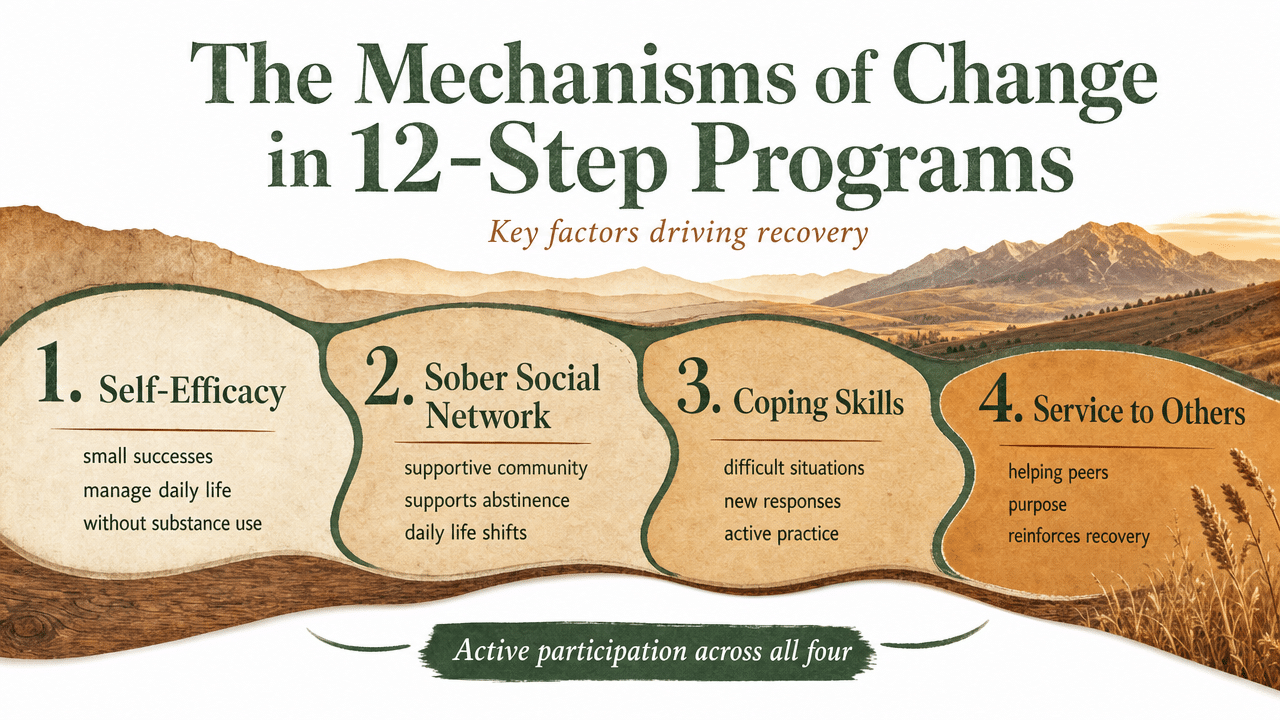
The Mechanisms of Change in 12-Step Programs
Key Factors Driving Recovery
If specific religious belief isn’t the primary driver, what truly facilitates recovery in 12-Step programs? Researchers have identified four key mechanisms that are effective regardless of theological stance, all requiring active participation.
- The first is self-efficacy, which is the growing confidence in one’s ability to manage daily life and difficult situations without substance use. This is built through consistent, small successes, such as attending meetings or reaching out for support instead of resorting to old habits.
- The second is developing a social network that supports abstinence. Shifting one’s social circle to include individuals also committed to sobriety fundamentally alters the dynamics of daily life. This isn’t about shared ideology, but about building a supportive community where individuals can rely on each other.
- The third mechanism involves acquiring effective coping skills. Through observation and shared experiences, individuals learn practical strategies for managing cravings, resolving resentments, and seeking help proactively. These are tangible tools shared within the community.
- Finally, service to others plays a significant role. Engaging in acts of service, such as sponsoring newcomers or contributing to meetings, is a powerful way to reinforce one’s own recovery. Helping others often proves to be one of the most effective ways to help oneself.
Research consistently shows that 12-Step involvement leads to improved social functioning, increased self-efficacy, and reduced healthcare utilization. These outcomes are directly linked to active participation and behavioral changes, not to specific beliefs. At Rocky Mountain Treatment Center, we focus on fostering these actionable elements of recovery.7
The Power of Attendance and Active Involvement
A surprising finding in recovery research is that the most significant predictor of success in mutual-help groups isn’t philosophical alignment, but consistent attendance and active involvement. A 2025 meta-analysis of eight studies, including both 12-Step and secular programs like SMART Recovery, found a strong correlation between greater attendance and decreased addiction symptoms, reduced cravings, lower relapse rates, and higher rates of complete abstinence. This highlights that showing up and engaging are more critical than achieving immediate comfort with specific terminology.2
This insight can alleviate pressure for those grappling with the spiritual language. Often, individuals initially resistant to the language find connection and resonance with others’ experiences, leading to gradual engagement. A randomized trial on 12-Step Facilitation further demonstrated that active involvement—getting a sponsor, working the steps, and performing service—yielded better abstinence rates and social functioning compared to passive attendance alone.3
Therefore, if you are still exploring your beliefs, this is not an impediment to recovery. The emphasis is on actionable steps: attending meetings, connecting with others, and participating in the community. These consistent, small actions foster change, allowing personal beliefs to evolve naturally throughout the recovery process.
Defining a Higher Power on Your Own Terms
The concept of a “higher power” in 12-Step programs is intentionally flexible, serving as anything that helps an individual relinquish sole control over their life. This functional definition is often more practical than a theological one. The core idea is to acknowledge that self-reliance alone has been insufficient and to lean on something greater than one’s individual thinking.
For some, this “something” might be a traditional God. For many others, it is the collective wisdom and support of the group itself—the shared experience and strength found in a community of peers. The acronym G.O.D. has been playfully reinterpreted by some members as “Group Of Drunks,” a testament to the program’s adaptability. Others find their higher power in nature, appreciating its consistent and powerful presence. Some envision their future sober self, or draw strength from abstract concepts like love, truth, or the guidance of a sponsor. The process of working the Steps itself can also be seen as a higher power, trusting that adherence to the program will bring about change.
The NIH’s definition of spirituality as a “search for meaning, purpose, and connection” perfectly encapsulates this broad approach. There is no pressure to arrive with a definitive answer. The journey involves exploring what resonates with you, allowing your understanding to evolve. The crucial step is the willingness to seek support beyond your own isolated thoughts, and the specific label can emerge over time.9
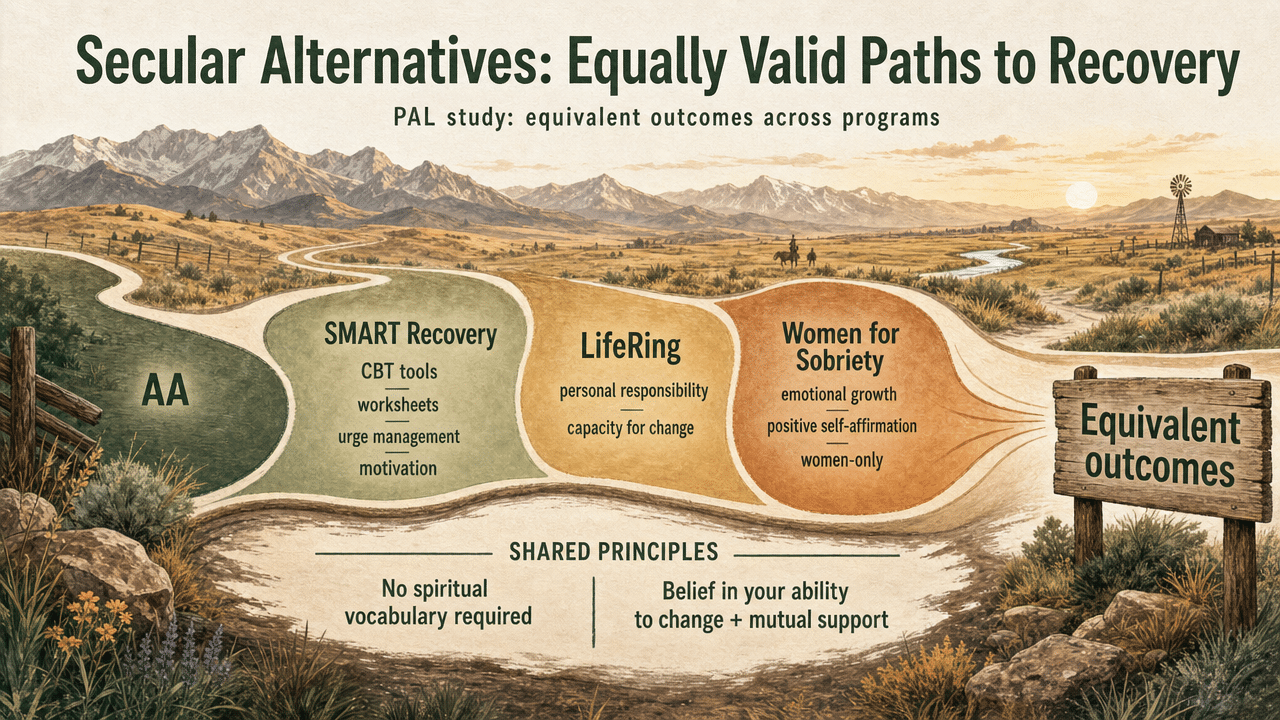
Secular Alternatives: Equally Valid Paths to Recovery
For those who find the spiritual language of 12-Step programs persistently uncomfortable, secular alternatives offer equally effective paths to recovery. These groups are built without any spiritual vocabulary and focus on different methodologies.
- SMART Recovery utilizes cognitive-behavioral tools, including worksheets, urge-management techniques, and motivational exercises.
- LifeRing emphasizes personal responsibility and the individual’s inherent capacity for change.
- Women for Sobriety focuses on emotional growth and positive self-affirmation within a women-only environment.
None of these programs require belief in anything beyond one’s own ability to change and the value of mutual support.
A significant finding from the Peer Alternatives in Addiction (PAL) study revealed that participants in AA, SMART Recovery, LifeRing, and Women for Sobriety experienced equivalent benefits in reducing substance use and related problems, regardless of the program chosen. This research underscores that the framework is less important than active engagement. Secular groups are not secondary options but parallel, equally valid pathways to recovery.1
Navigating Past Religious Harm in Recovery
For some, discomfort with 12-Step language stems from past negative experiences with religious environments. This can manifest as a visceral reaction to certain phrases or practices. It’s crucial to understand that such reactions are not personal failings but understandable responses to genuine harm. Researchers acknowledge that individuals hurt by religious environments may prefer explicitly secular approaches, and this preference deserves respect.10
If this resonates with you, several strategies can help. Seek out 12-Step groups that explicitly identify as agnostic or secular, often found in larger cities or online, which use plainer language while still following the Steps. Alternatively, secular programs like SMART Recovery and LifeRing provide peer support without any spiritual vocabulary that might trigger past trauma.
It is vital to communicate your history to your care providers. A compassionate counselor, such as those at Rocky Mountain Treatment Center, will not pressure you into environments that cause distress. Instead, they will help you find a supportive setting that aligns with your needs. In residential settings, “optional” programming, such as Bible study, truly means optional; you are empowered to decline without judgment or impact on your clinical care.
Allow yourself time and space for healing. Some individuals may eventually redefine spiritual language on their own terms, while others achieve lasting sobriety without ever engaging with such concepts. Both paths are valid and equally deserving of respect.
A Spiritually Flexible Day at Rocky Mountain Treatment Center
Imagine a typical day at Rocky Mountain Treatment Center, designed to be spiritually flexible and supportive of diverse beliefs. Your day begins in a peaceful environment, followed by breakfast with peers, fostering early connections.
Mornings often include group counseling, a space where authentic sharing and personal growth occur. The focus is on honesty and self-reflection, not on affirming any particular creed. Mid-morning might involve individual counseling, providing a confidential setting to discuss personal histories, including any complex experiences with religion. Our counselors are trained to listen without judgment and tailor your care accordingly.
Afternoons offer varied therapeutic activities. This could range from equine therapy, which teaches presence and boundaries through interaction with horses, to group hikes or recreational activities that leverage the natural beauty of Montana. These experiences align with the broader understanding of spirituality as a “search for meaning, purpose, and connection” that can be found outside traditional religious contexts.9
Evenings typically include a 12-Step meeting, either on-site or nearby. Participation is encouraged, but there’s no pressure to speak. The goal is to listen and find resonance with others’ stories. Optional programming, such as Bible study or meditation, is available for those interested, but it is never mandatory. Your clinical program progresses regardless of your participation in these optional activities.
This structure provides support without coercion, community without a script, and ample room to explore your beliefs—or lack thereof—while the essential work of recovery continues around you.
Your Next Step: Respecting Your Individual Journey
You don’t need to have all your beliefs sorted out before entering treatment. Questions about spirituality and a higher power can evolve throughout your recovery journey, remaining open as you progress. What is essential is finding a treatment environment that respects these questions and provides genuine support.
When seeking residential care, look for programs that integrate 12-Step meetings while also acknowledging and offering secular alternatives. Ensure that individual counseling sessions provide a safe space to discuss your religious history without judgment, and that any “optional” programming is truly optional. Don’t hesitate to ask direct questions about these aspects; a reputable program will provide clear and honest answers.
Rocky Mountain Treatment Center in Great Falls, Montana, embodies this approach. We offer 12-Step-based care with optional Bible study, comprehensive individual and group counseling, and unique therapies like equine therapy. Our staff, many of whom are in recovery themselves, are experienced in addressing the diverse spiritual and philosophical questions individuals bring to treatment.
Wherever you choose to seek help, the most important step is to reach out, ask the questions that truly concern you, and take the next honest step toward your recovery.
Frequently Asked Questions
Do I have to believe in God to work the 12 Steps?
No. The Steps use spiritual language, but they do not require belief in any specific God or religion. The phrase “as we understood Him” is deliberate — it leaves the definition to you. Atheist, agnostic, and spiritually undecided people have worked the Steps successfully for decades. What matters is your willingness to be honest, connect with others, and keep showing up. Belief content is not the active ingredient.
What can I use as a higher power if I’m not religious?
Anything larger than your own self-will that helps you stop running the show alone. Common choices include the group itself, nature, love, truth, your future sober self, or the recovery process. Some members joke that G-O-D stands for Group Of Drunks — and no one corrects them. You can try one, revise it, or hold the question loosely. The willingness to look outside your own head is the move.
Are secular alternatives like SMART Recovery as effective as AA?
The research says yes, they are peers. In the PAL longitudinal study comparing AA, SMART Recovery, LifeRing, and Women for Sobriety, the four groups produced equivalent benefits in substance use and related problems regardless of which one a person chose. The engagement mattered more than the framework. So if 12-Step language doesn’t fit, you are not choosing a lesser path. You are choosing a different room with the same underlying work.1
What if I was hurt by a religious environment in the past?
Your reaction is reasonable, not a defect. Tell your counselor what happened so they can route you toward meetings that use plainer language — many 12-Step groups describe themselves as agnostic or secular. SMART Recovery and LifeRing offer peer support without any spiritual vocabulary at all. Anything labeled optional in residential care actually is optional. You are allowed to say no, and a good program will help you find rooms that don’t hurt.
Can I skip the Bible study or prayer parts of residential treatment?
In a program that offers Bible study as optional programming, yes — you can skip it entirely without affecting your clinical care. Optional means optional. The required work is the clinical work: individual counseling, group counseling, and the daily structure of recovery. Faith-based add-ons sit alongside that work for people who want them. If a program treats spiritual content as mandatory or grades you on participation, that is worth asking about before you admit.
What actually predicts success in a 12-Step program?
Active involvement, not correct belief. A randomized trial of 12-Step Facilitation found that people who got a sponsor, worked steps, and did service had better abstinence and social functioning than those who only attended meetings. Show up, get a phone number, call it when you said you would, help set up chairs. Those small repeatable moves build self-efficacy and a sober network. Your beliefs can keep evolving while the actions are already working.3
References
- A Longitudinal Study of the Comparative Efficacy of Women for Sobriety, LifeRing, SMART Recovery, and 12‑step Groups for Those with AUD. https://pmc.ncbi.nlm.nih.gov/articles/PMC5884451/
- Effectiveness of Mutual Help Groups for Illicit Drug Use Disorders. https://pmc.ncbi.nlm.nih.gov/articles/PMC12360454/
- A Combined Group and Individual 12-Step Facilitative Intervention: A Randomized Clinical Trial. https://pmc.ncbi.nlm.nih.gov/articles/PMC3408890/
- Influence of Religiosity on 12-Step Participation and Treatment Response Among Substance Abuse Patients. https://pmc.ncbi.nlm.nih.gov/articles/PMC3211954/
- Belief, Behavior, and Belonging: How Faith is Indispensable in Preventing and Recovering from Substance Abuse. https://pmc.ncbi.nlm.nih.gov/articles/PMC6759672/
- Supplementary material – Peer Alternatives in Addiction (PAL) study. https://pmc.ncbi.nlm.nih.gov/articles/PMC5884451/pdf/nihms943367.pdf
- Mechanisms of Behavior Change in 12-Step Programs. https://pmc.ncbi.nlm.nih.gov/articles/PMC3408889/
- Mutual-help groups for alcohol and drug use disorders: a review of the evidence. https://pmc.ncbi.nlm.nih.gov/articles/PMC4010223/
- Spirituality, Religiousness, and Alcohol/Other Drug Use. https://pmc.ncbi.nlm.nih.gov/articles/PMC4018646/
- Religious and Spiritual Aspects of Alcohol Use, Abuse, and Recovery. https://pmc.ncbi.nlm.nih.gov/articles/PMC3318428/