
Key Takeaways
- Searching at a hard hour already signals something important, and not knowing where to start is one of the most common reasons people who need treatment never get it.13
- Inpatient becomes the right level of care when outpatient hasn’t held, withdrawal turns physical, mental health is tangled in, or home keeps pulling you back toward the bottle.
- Filtering only by ‘near me’ can sideline fit; ask whether a program matches your medical, mental health, and family picture before measuring the drive.
- A credible program runs medically monitored detox into real treatment without a discharge gap, evaluates every patient for medications like naltrexone, and treats co-occurring conditions in the same building.3,7
- Length of stay shapes what’s possible: 30 days interrupts the cycle, 60 deepens the work, and 90 lets sober living start to feel like a life, with longer stays linked to better outcomes.12
- Family week matters because relatives have been adjusting around the drinking for years, and supportive family involvement improves engagement, retention, and recovery outcomes.5
- Aftercare should be planned before discharge, with scheduled check-ins at 30, 60, 90, 180, and 365 days, plus named mutual-help meetings — not a wave goodbye at the parking lot.9,11
- Before saying yes, confirm state licensure, ask who runs detox medically and what the counselor ratio is, and verify insurance coverage and what’s actually included in the cost.6
If you’re searching at a hard hour, start here
If you’re reading this late at night, or in the quiet after another rough morning, that already says something. You’re looking. That counts.
Maybe you typed “inpatient alcohol rehab near me” because you’ve tried to stop on your own and it hasn’t held. Maybe a doctor or a partner said the word “rehab” out loud and you didn’t argue this time. Maybe you’re the spouse, the parent, the grown kid searching while someone you love sleeps it off in the next room. Whoever you are, you don’t need to have this figured out before you keep reading.
Here’s something worth knowing: not knowing where to start is one of the most common reasons people who need help don’t get it. About one in five adults who recognized they needed substance use treatment but didn’t receive it said a reason was simply not knowing where to get it. You’re not behind. You’re not failing at this. The information just isn’t where it should be.13
This guide walks you through how to tell if inpatient is the right level of care, what a real program should include, what 30, 60, and 90 days actually look like, and what should happen after you come home. Take it one section at a time.
Signs inpatient is the right level of care for you
When drinking has outgrown outpatient help
Outpatient care can do a lot. Weekly counseling, a support group, maybe a medication from your doctor — for some people, that’s enough scaffolding to stop drinking and stay stopped. If you’ve tried that and it’s working, keep going.
What often pushes someone toward inpatient is the quiet realization that the scaffolding isn’t holding. You make it to Friday and then lose the weekend. You promise yourself one drink and wake up at 3 a.m. counting empties. The morning shakes start earlier. You hide bottles in places you swore you never would. You’ve been to a counselor and still couldn’t stay sober between sessions.
Clinical guidelines describe alcohol use disorder on a spectrum — mild, moderate, severe — and recommend matching the level of care to where you actually are, not where you wish you were. When drinking is moderate to severe, when withdrawal is physical, when outpatient hasn’t held after honest tries, residential care is the level that was built for this.2
That’s not a failure on your part. It’s information. The level of help has to match the size of the problem.
Why 24-hour structure changes the odds
One of the hardest parts of trying to quit at home is that the rest of life keeps happening. The phone rings. The liquor store is on the way home. The argument with your partner doesn’t pause while you white-knuckle through a craving. Outpatient asks you to do recovery in the same environment that taught you to drink.
Inpatient changes that math. You sleep, eat, and do the work in one place, with people who are doing the same work next to you and staff who know what early recovery actually looks like at 11 p.m. on a Tuesday.
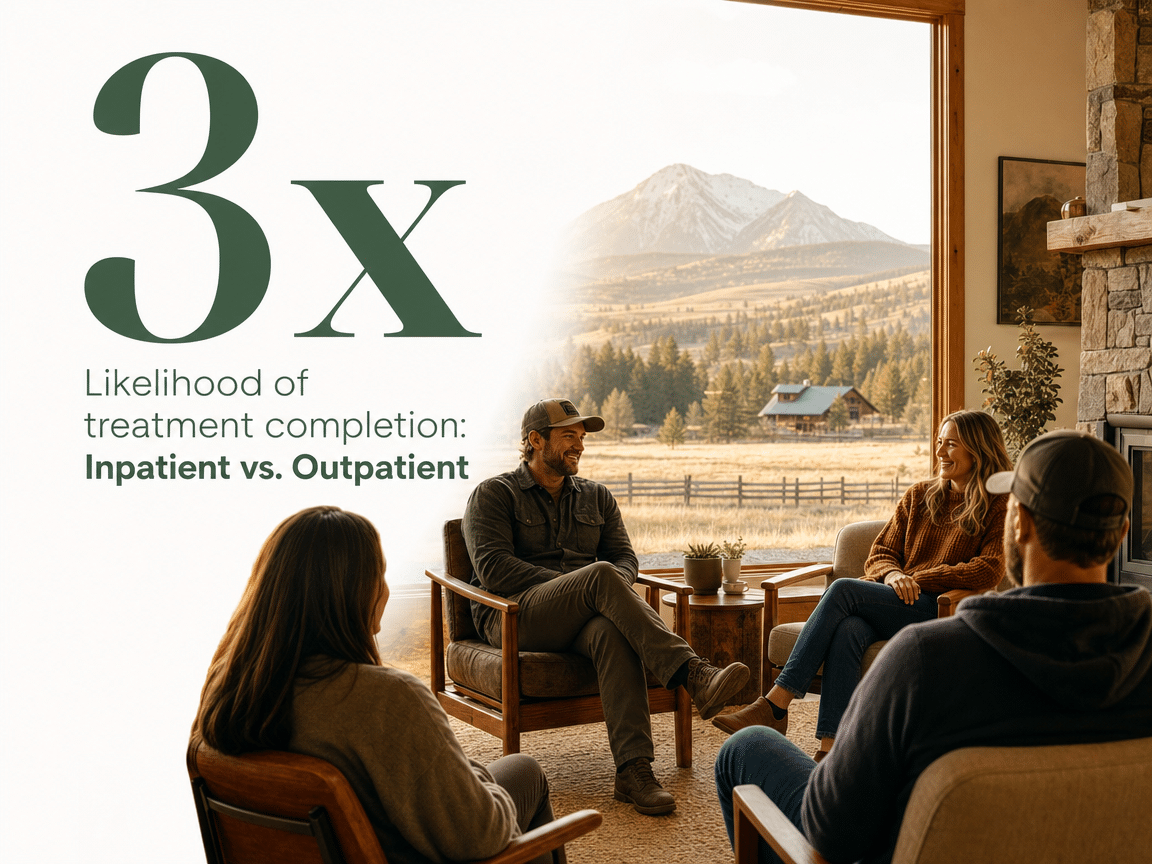
The numbers reflect this. A CADTH evidence review comparing residential and outpatient treatment for substance use disorders — including alcohol — found that people in inpatient programs were about three times more likely to complete treatment than those in outpatient programs, particularly among people with more severe addiction. Completion isn’t the same as cure. But finishing what you started is the foundation everything else gets built on, and it’s hard to finish anything when the environment that fed the problem still has full access to you.1
Medical risk, mental health, and home environment
Three other things should push the inpatient conversation to the front.
The first is medical risk. Alcohol withdrawal isn’t like quitting other substances — for someone drinking heavily every day, stopping cold can trigger seizures, dangerous blood pressure swings, or delirium tremens. Medically supervised detox exists because of that risk, and the people who need it most are usually the ones most tempted to try quitting alone. If you’ve ever had withdrawal shakes, sweats, or hallucinations, that’s a medical reason to be somewhere staffed around the clock.7
The second is what’s going on alongside the drinking. Depression, anxiety, trauma, bipolar — these travel with alcohol use disorder more often than not, and treating one without the other tends to leave the door open for relapse. Integrated care that addresses both at once is associated with better outcomes than treating them in separate buildings on separate schedules.10
The third is your home. If the people you live with drink, if your house is where the relapses happened, if you don’t feel safe — inpatient gives you a different room to wake up in while you figure out what comes next.
Why ‘near me’ is the wrong filter to start with
Proximity feels like the safest filter when you’re scared. The closer the building, the faster the rescue. That’s the logic, anyway.
But “near me” can quietly become the only filter, and that’s where it stops serving you. A program twenty minutes from your front door isn’t automatically the right one for your medical picture, your mental health, or the home situation you’re trying to step away from for a while. Sometimes the closest option is exactly right. Sometimes the right place is a few hours up the highway in a smaller setting where you can actually exhale.
If you live in rural Montana, the math is different than it is for someone in a city. Driving to Great Falls from a ranch outside Glasgow or a town near the Idaho line might feel far on a map. In recovery terms, it’s often closer to right than a bed that happens to be in your county.
What a credible inpatient program actually offers
Medically monitored detox, then real treatment
If you’ve been drinking heavily for a while, the first 72 to 96 hours after your last drink are the riskiest. That’s the window for seizures, dangerous blood pressure spikes, and in some cases delirium tremens. A credible inpatient program starts with medically monitored detox, which means a nurse or doctor checks vitals around the clock, withdrawal symptoms are tracked on a scale, and medications are available to keep you safe and comfortable while your body adjusts.
Here’s the part that often gets missed: detox is not treatment. The clinical guidance is direct about this — detoxification on its own is not in itself treatment
, it’s the first step that has to be followed by actual substance abuse treatment to do any lasting good. A hospital can dry you out in five days. That’s not the same as helping you stay sober for the next five years.7
What you want is a program where detox flows straight into rehab under the same roof, with the same staff watching the handoff. No discharge between the two. No going home for a week to “recover” before counseling starts. The bridge from medical stabilization to real psychological work is where a lot of people fall through, and a credible facility has built that bridge into the schedule.
Counseling that goes past intake paperwork
Ask any program how often you’ll meet one-on-one with a counselor. Not how often groups happen — those should be daily — but how often you sit across from one person whose job is to know your story.
In a strong residential program, individual counseling happens at least weekly, often more, and your counselor is someone you can knock on the door of between sessions. Group therapy fills the rest of the schedule: process groups where people talk about what’s actually going on, education groups about how alcohol changed your brain and body, relapse-prevention groups where you build a plan for the cravings that will come.
Something else to ask about: who’s running the groups. Programs where a meaningful share of staff are in recovery themselves tend to feel less like a clinic and more like a room of people who’ve been where you are. That doesn’t replace clinical training, but it changes the temperature. You can tell pretty fast in a first phone call whether the person on the other end has lived any of this.
Medication evaluation for alcohol use disorder
There are FDA-approved medications for alcohol use disorder. Most people have never heard of them.
Naltrexone, acamprosate, and disulfiram all have evidence behind them — they can reduce heavy drinking, cut cravings, and increase the odds of staying abstinent when paired with counseling. They’re not magic, and they don’t replace the work. But for a lot of people, they make the work possible.8
And almost no one gets them. A NIAAA analysis found that only about 1.6% of adults with a past-year alcohol use disorder were prescribed any of these medications. That’s not because the drugs don’t work. It’s because stigma and old habits in the treatment world have kept them buried, and because many programs were built around an abstinence-only model that didn’t make room for medication.3
When you’re calling around, ask this directly: does a medical provider evaluate every patient for medications for alcohol use disorder? Not “do you offer it if someone asks for it.” Not “we can refer out.” Do you evaluate. A credible program treats medication as one tool in the kit, alongside counseling and peer support, and at least puts the option on the table for every person who walks in.3
Dual diagnosis and the mental health piece
For a lot of people who drink the way you might be drinking, there’s something underneath it. Depression that started long before the bottle. Anxiety that quiets down for an hour after the first drink and roars back at 4 a.m. Trauma you’ve never talked about with anyone sober. Bipolar that hasn’t been diagnosed because the drinking muddied the picture.
Treating the alcohol without treating what’s underneath tends to leave a trap door open. Integrated care — where one team addresses both the substance use and the mental health condition at the same time, in the same building — is associated with better outcomes than handing you off between two systems that don’t talk to each other.10
When you ask a program about dual diagnosis, listen for specifics:
- Is there a psychiatrist or psychiatric nurse practitioner on staff or readily available?
- Are mental health medications managed during your stay?
- Are trauma-informed approaches part of the counseling, not just a phrase on the website?
Those details separate a program that says it treats co-occurring conditions from one that actually does.
Experiential work: what equine therapy actually does
The first time you walk into a barn as part of treatment, it feels a little strange. You’re here to stop drinking. What does a horse have to do with anything?
More than you’d think. Horses don’t care about your story. They respond to what you’re actually feeling in the moment — the tension in your shoulders, the breath you’re holding, the anger you’ve been swallowing for years. People who’ve spent a long time numbing emotions with alcohol often discover, standing next to a thousand-pound animal that won’t move until they settle down, that they have feelings they didn’t know how to find anymore.
A small randomized trial of horse-assisted therapy added to standard residential treatment found that patients in the equine-assisted group had greater reductions in psychological distress than those receiving usual care alone. It’s an early study with a small sample, not a guarantee. But it lines up with what counselors who use this work see: experiential therapy reaches places that talk therapy alone sometimes can’t.4
What 30, 60, and 90 days actually change
The number of days isn’t a price tag. It’s a shape — what you’ll actually have time to do while you’re there.
In a 30-day stay, the first week or so usually belongs to detox and stabilization. You’re sleeping again. Your body is figuring out what “normal” feels like without alcohol in it. The remaining three weeks are where the core work starts: individual counseling that begins to find the why under the drinking, daily groups, a first pass at a relapse-prevention plan, and the early skills you’ll need for the cravings that show up after discharge. Thirty days is enough to interrupt the cycle and walk out with a plan. For some people, it’s enough.
Sixty days gives you a second month past the fog. That’s when a lot of people say the real work actually begins — when the early shame has loosened a little and you can talk about what you’ve been carrying without flinching. Trauma work, family sessions, deeper relapse-prevention planning, and rebuilding daily routines all fit better in this window.
Ninety days adds depth and rehearsal. You’re practicing sober living long enough that it starts to feel like a life, not a hold-your-breath exercise. There’s time to address co-occurring conditions thoroughly, work through harder material, and step into pre-discharge planning without rushing.
Research on length of stay backs the general direction: longer residential stays are linked with better post-treatment abstinence and functioning, though the relationship isn’t strictly linear and varies by the person. More days isn’t automatically more recovery. But for people with severe drinking, significant mental health needs, or unstable homes to return to, the longer windows tend to give the work room to land.12
If you can only do 30, do 30. If you have the option for 60 or 90, take it seriously. You can always step down. It’s much harder to come back.
Family week and the people who came with you
Addiction is rarely a solo event. The people who live with you have been adjusting their lives around your drinking for a long time — walking on eggshells, covering for you, lying awake. They need their own version of recovery, and a good program builds time in for that.
Most strong residential centers run a structured family week — usually two to three days when partners, parents, and adult children come on-site for education about how alcohol use disorder actually works, facilitated sessions with you and a counselor in the room, and time with other families going through the same thing. It’s not a courtroom. Nobody’s there to assign blame. The point is to start rebuilding honest conversation in a setting where a trained person can help when things get hard.
The evidence backs this up. A review of family involvement in substance use treatment found that supportive family participation can improve engagement, retention, and outcomes, and that relatives are powerful resources for recovery when they’re brought into the work rather than left outside it.5
If your family is fractured, if there’s no one safe to invite, that’s worth telling the admissions counselor on the first call. A good program adapts.
What aftercare should look like on day 31 and day 365
Discharge day is not the finish line. It’s the part of recovery where the real test starts — your old kitchen, your old commute, the people who don’t know what to say to you yet.
A serious program plans for this before you leave, not after. Continuing care research is clear that ongoing support after intensive treatment — telephone check-ins, virtual groups, periodic counseling, alumni meetings — produces small but clinically meaningful improvements in staying sober over the long haul. The format matters less than the fact that someone keeps showing up in your week.9
Ask any program you’re considering what specifically happens on day 31. Is there a scheduled follow-up call? A weekly Zoom group you’re expected at? A counselor checking in at 60 days, 90 days, six months, a year? Programs that run structured follow-ups at 30, 60, 90, 180, and 365 days post-discharge are building a year-long safety net rather than waving goodbye at the parking lot.
Mutual-help meetings belong in this plan too. Twelve-step participation, when combined with formal treatment, is associated with improved abstinence rates over time. A good aftercare plan names the meetings, the home group, the sponsor conversation — not just “go find AA.”11
If a program can’t tell you what your year after discharge looks like, that’s your answer.
Questions to ask before you say yes to a program
Licensure, staffing, and Montana-specific standards
Before you commit to a bed, ask if the facility is licensed by the state it operates in. In Montana, that means meeting the rules the Department of Public Health and Human Services sets for substance use disorder facilities — required services like individual and group counseling, family therapy, medication management, and standards for staffing and quality. A program that can’t answer the licensing question quickly is one to keep walking past.6
Then ask about accreditation. Joint Commission accreditation is a separate, voluntary standard that signals the facility has been audited against national quality benchmarks. It’s not required, but it’s a meaningful extra layer.
On staffing, ask three things:
- Who runs detox medically — a physician, a nurse practitioner, an RN on every shift?
- What’s the counselor-to-client ratio?
- How many of the people on staff are in recovery themselves?
That last question isn’t about credentials. It’s about whether the person sitting across from you at 7 a.m. has any idea what your first morning sober actually felt like.
Insurance, cost conversations, and what to confirm
Call your insurance company before you call the rehab, or ask the rehab to verify your benefits for you — most will do it the same day. You want to know three things:
- Whether residential treatment is covered
- What your out-of-pocket cost looks like (deductible, coinsurance, daily copay)
- How many days the plan will authorize before a review
Then ask the program directly: do you work with my insurance? Many quality residential centers work with most major commercial insurers but do not accept Medicaid or Medicare — confirm that on the first call so you’re not surprised on intake day.
If you’re underinsured, ask about payment plans, scholarships, or sliding-scale options before assuming you can’t afford care. And ask what’s included — detox medications, family week travel logistics, continuing care after discharge — so you’re comparing real totals, not sticker prices.
Making the call
The hardest part is usually picking up the phone. Once you do, the rest gets easier than you’d expect.
You don’t need a speech ready. “I think I need help with my drinking” is enough. A good admissions counselor will take it from there — asking about how much you drink, what withdrawal has looked like, what’s going on at home, what your insurance is. Same-day or next-day admission is often possible when safety is a concern.
If you’re looking at Montana and want a smaller, family-oriented setting, Rocky Mountain Treatment Center in Great Falls is one place worth calling. Whoever you call first, call someone today.
Frequently Asked Questions
How do I know if I need inpatient rehab instead of outpatient?
Should I choose a 30, 60, or 90-day program?
Is detox by itself enough to treat alcohol use disorder?
Does it matter if the rehab is close to home?
What should I ask about medications for alcohol use disorder?
What happens after I leave inpatient treatment?
References
- Inpatient and Outpatient Treatment Programs for Substance Use Disorder: A Review of Clinical Effectiveness and Cost-Effectiveness. https://www.ncbi.nlm.nih.gov/books/NBK507689/
- Treatment of Alcohol Use Disorder. https://www.ncbi.nlm.nih.gov/books/NBK561234/
- Recommend Evidence-Based Treatment: Know the Options. https://www.niaaa.nih.gov/health-professionals-communities/core-resource-on-alcohol/recommend-evidence-based-treatment-know-options
- Complementary horse-assisted therapy for substance use disorders: A randomized controlled trial. https://pmc.ncbi.nlm.nih.gov/articles/PMC7001193/
- Family Involvement in Treatment and Recovery for Substance Use Disorders: What Do We Know and Where Do We Go From Here?. https://pmc.ncbi.nlm.nih.gov/articles/PMC8380649/
- Rules for Substance Use Disorder Facility – Montana Department of Public Health and Human Services. https://dphhs.mt.gov/assets/oig/Rules_for_Substance_use_Disorder_Facility.pdf
- Detoxification and Substance Abuse Treatment. https://www.ncbi.nlm.nih.gov/books/NBK424859/
- Medications for Alcohol Use Disorder. https://www.ncbi.nlm.nih.gov/books/NBK553166/
- The Role of Continuing Care in Substance Use Disorder Treatment. https://pmc.ncbi.nlm.nih.gov/articles/PMC8061325/
- Treating Co-Occurring Disorders in Substance Use Treatment Settings. https://pmc.ncbi.nlm.nih.gov/articles/PMC4533264/
- Effectiveness of 12-Step Facilitation in Addiction Treatment. https://pmc.ncbi.nlm.nih.gov/articles/PMC4442597/
- Length of Stay in Residential Treatment and Outcomes in Alcohol Dependence. https://pmc.ncbi.nlm.nih.gov/articles/PMC539821/
- Barriers to Treatment and Treatment Dropout in Substance Use Disorders. https://pmc.ncbi.nlm.nih.gov/articles/PMC3835646/