Key Takeaways
- Montana’s recovery landscape splits between seven hub cities with dense in-person schedules and rural areas where virtual meetings and phone contact carry most of the weight.2
- Five parallel meeting paths exist side by side — AA/NA, SMART Recovery, peer-led groups, family-focused meetings like Al-Anon, and culturally grounded circles near the Flathead Reservation.3,9
- Where you live shapes your blueprint: hub residents can anchor on a physical home group, while rural Montanans should stack one reachable in-person meeting with two virtual ones.
- A workable first-month rhythm is four weekly touchpoints — one in-person meeting, one virtual meeting, one sponsor or peer call, and one alumni check-in with your treatment program.
The week after you come home
The drive back from Great Falls feels different than the drive in. You’ve spent 30, 60, or 90 days in a place where someone knocked on your door for breakfast, where group started at the same time every morning, where the people around you understood exactly what you were carrying. Now you’re walking into your own kitchen, and the house is quiet. This is often when support meetings MT become an important part of staying connected and maintaining momentum in recovery.
That quiet is the thing nobody warns you about. The structure you leaned on is gone. The counselors who knew your story are 200 miles away. And the meetings you joined in treatment? They were already built into the day. You just had to show up.
This is where a lot of good recovery work gets tested. Not because you’ve forgotten what you learned, but because the rhythm goes missing. Mutual-help groups and peer recovery services are recognized parts of long-term recovery, not nice-to-haves you add when you feel like it. They’re the next layer of what you’ve already been doing.11
The good news: you don’t have to figure this out from scratch, and you don’t have to do it alone. Montana has more meeting options than most people realize, in more formats than just the church-basement folding chairs you might be picturing. The next sections walk you through where they are, what kinds you can pick from, and how to build a week that actually holds.
Montana’s geography splits recovery into two realities
Here’s the thing about staying connected to support in this state: where you live changes almost everything about what’s available to you on a Tuesday night.
Montana has three metro core areas — Billings, Missoula, and Great Falls — and four micro core areas in Kalispell, Bozeman, Helena, and Butte. Those seven towns are where in-person meetings cluster. If you live in one of them, or within a reasonable drive, you can probably find an AA meeting tonight, an NA meeting tomorrow morning, and a SMART Recovery group later in the week. The schedule exists. You just have to walk in.2
If you live anywhere else — and a lot of Montanans do — your reality looks different. Maybe the nearest in-person meeting is 40 miles away over a pass that gets ugly in February. Maybe your county seat has one meeting a week, and it conflicts with your shift. Maybe you’re on a ranch where the closest town has a post office and a bar and not much else. That’s not a moral failure on your part. That’s geography.
This split matters because it changes how you build your week. In the hubs, your home group can be a physical room with the same faces every Thursday. In ranch country, your home group might be a Zoom call you join from the kitchen table after the kids go to bed, with a SMART Recovery meeting on Sunday and a phone call with your sponsor on Wednesday filling in the rest.
Neither version is the lesser one. The research backs this up — mutual-help groups and peer recovery services are recognized recovery supports whether they happen in a church basement in Butte or on a screen in Jordan. What matters is that the rhythm holds.11
The sections ahead are organized around this reality. First, the kinds of meetings you can pick from — five real options, not a ladder where 12-step sits on top. Then a closer look at how those options actually map to the hubs and the spaces between them. If you’ve been worrying that the meeting scene around you looks thinner than what you had in treatment, you’re not wrong to notice. You just need a different blueprint than someone in downtown Missoula. Both blueprints work.
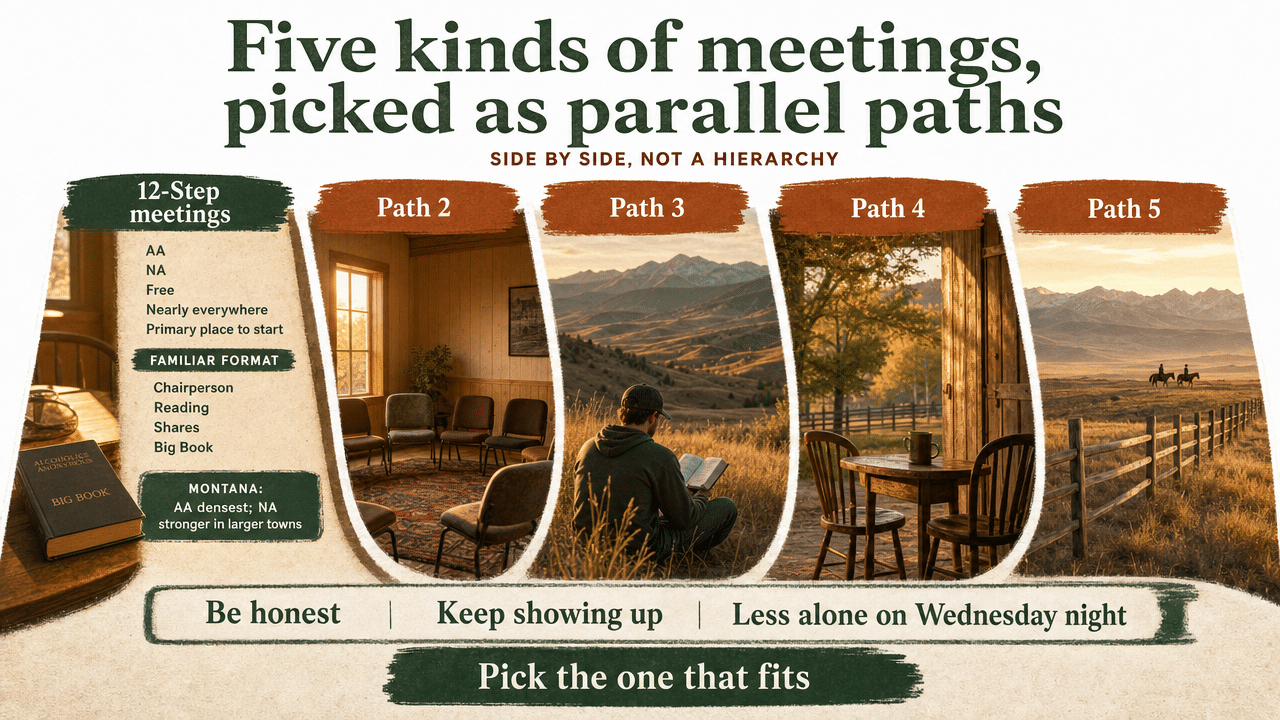
Five kinds of meetings, picked as parallel paths
You have more than one road back to community, and none of them is the right one by default. The five kinds of meetings below sit side by side. Pick the one where you can be honest, keep showing up, and feel less alone on a Wednesday night. That’s the test.
12-Step meetings: AA and NA
Alcoholics Anonymous and Narcotics Anonymous are the meetings most people picture first, and there’s a reason for that. They’re free, they’re nearly everywhere, and SAMHSA still lists them as primary places to start when you’re looking for ongoing support. In Montana, AA tends to have the densest schedule, with NA filling in strong in the larger towns.3
If you worked the steps during your residential stay, walking into a meeting at home is less of a leap. The format will feel familiar — a chairperson, a reading, shares around the room, maybe a Big Book study on certain nights. You don’t have to talk on day one. Sitting in the back, drinking bad coffee, and listening counts. So does grabbing a phone list before you leave.
The piece worth being honest about: 12-step has a spiritual frame. For some folks that’s the part that finally clicked. For others, it’s friction. If the God language is a wall for you, keep reading — there are other rooms.
SMART Recovery: skills-based and secular
SMART Recovery is the option a lot of people wish someone had told them about sooner. It’s secular, skills-based, and built around tools you can practice between meetings — things like managing urges, checking your thinking, and setting goals you’ll actually hit. SAMHSA lists it alongside AA and NA as a recognized support group network.3
The vibe in a SMART meeting is closer to a workshop than a confessional. A trained facilitator runs the hour. You bring a current situation, and the group helps you work through it using a worksheet or a tool from the handbook. There’s no higher power, no sponsor system, no chips for time. If you came out of treatment with a notebook full of cognitive-behavioral tools, SMART picks up exactly where that left off.
In Montana, SMART runs strong online and shows up in the bigger towns and a handful of tribal college and community settings. The virtual meetings are well-attended and easy to join from anywhere with a signal.
Peer-led recovery groups
Peer-led groups are the ones facilitated by someone who’s been where you are. Not a clinician, not a counselor — a person in recovery themselves, often with formal training behind it. SAMHSA describes peer support workers as people who use shared experience and mutual empowerment to help others stay engaged in recovery and reduce relapse risk.1
What that looks like in practice: a group where the leader has lived through detox, residential, the messy first month home, the long middle stretch. They’ve raised their hand in the same kind of room you’re sitting in. That changes what gets said and how it gets said. Shame has a harder time surviving in there.
Montana has been actively building this workforce. The state has a five-week Peer Support Specialist certification course for residents with lived experience, training them in trauma-informed care, hope, and connection. The people you meet at a peer-led recovery group or a recovery community center may well be graduates of that program — which means the person across the table is trained, not just well-meaning.7
Family-focused groups
Recovery isn’t a solo project, and the people who love you have been carrying their own version of this whole time. Family-focused groups give them a room of their own. Al-Anon and Nar-Anon are the longest-running options, built for spouses, parents, adult kids, and close friends of someone with a substance use disorder. NAMI offers family groups when mental health sits alongside the substance use piece.3
If your Family Week was the first time your people heard about boundaries, codependency, and what their own healing might look like, these meetings are where that work continues. Your partner doesn’t have to drive you to your meeting and then sit in the car. They can be in their own meeting across town, or on their own Zoom call from the next room.
Montana is also building paraprofessional family-support roles through a state workforce program, expanding the people trained to walk alongside families. That infrastructure is quietly growing.6
Culturally grounded circles on and near the Flathead Reservation
For Native folks heading home to western Montana, and for non-Native neighbors welcomed into those spaces, the meetings on and near the Flathead Reservation show what parallel paths actually look like in one place. Salish Kootenai College in Pablo runs a weekly schedule that puts SMART Recovery, a Life Skills Group, Narcotics Anonymous, Alcoholics Anonymous, and talking circles side by side — not as a hierarchy, but as different doors into the same week.9
That mix matters. A talking circle is not a translation of a 12-step meeting into a different vocabulary. It’s its own thing, with its own protocol and its own role in community life. Sitting in one is different from sitting in an AA meeting in a church basement, and that difference is the point.
What’s worth noticing is the everyday quality of the schedule — a 9 a.m. SMART Recovery session, an evening NA meeting, an AA meeting later in the week. You can layer them. You can try one this week and another next week. If you came out of treatment unsure whether you’d find a recovery community that fit your background and your beliefs in the same room, the Flathead is one place where the answer is yes, and the schedule is already built.9
Hubs vs. ranch country: where each kind of meeting actually lives
The five paths in the last section aren’t spread evenly across the map. Knowing what actually shows up in your zip code saves you a lot of frustration before you start.
In the metro cores — Billings, Missoula, Great Falls — and the four micro cores of Kalispell, Bozeman, Helena, and Butte, all five paths exist in person on a regular schedule. AA and NA carry the densest in-person calendars, with morning, lunch, and evening options most days. SMART Recovery shows up in person in the bigger towns and reliably online. Peer-led groups and recovery community spaces cluster where the workforce has been trained, which lines up with these same hubs. Family meetings like Al-Anon and Nar-Anon run in person in the cores and online statewide. Culturally grounded circles concentrate near the Flathead Reservation and other tribal communities.2,3,7,9
Outside those seven towns, the math changes. One in-person AA meeting a week is common. NA may be thinner. SMART Recovery, family groups, and peer-led options often live online, which is not a downgrade — it’s the format that actually fits a 60-mile drive and a long winter.3
A first 30 days home weekly template
The first month back is where the rhythm either takes hold or slips. You don’t need a perfect plan. You need a repeatable one — something you can pull up on your phone Sunday night and know exactly where you’re going Tuesday at 7 p.m.
Here’s a template that has worked for a lot of folks coming out of residential care. Steal it, edit it, make it yours.3
- One home-group meeting in person. Pick a single AA, NA, SMART Recovery, or peer-led group near you and commit to the same night every week. This is the room where people will start to learn your name. AA, NA, NAMI, and SMART Recovery are all listed by SAMHSA as primary networks you can search by zip code. One of them, every week, same time.
- One virtual meeting. Add a second meeting in a format you can join from your kitchen — online AA, an NA video meeting, or a SMART Recovery session. This one carries you through the weeks when weather, work, or a kid’s fever makes the in-person meeting impossible.
- One family or peer call. Schedule a standing 20-minute call with your sponsor, your peer support contact, or a sober friend you trust. Same day, same time. If a family member is doing their own Al-Anon or Nar-Anon work, this is also where you check in with each other on what you’re both learning.
- One alumni or aftercare check-in. If your treatment program offers a weekly Zoom group or scheduled follow-ups at 30, 60, and 90 days, put those on the calendar before you do anything else. Those calls connect you back to the people who already know your story.
Four touchpoints. That’s it. If you can hold four a week for thirty days, you’ll have built something close to what you had in residential — a rhythm of contact, accountability, and people who get it. Print this. Tape it to the fridge. Cross things off in pen. The week you actually do all four is the week you get to feel proud of yourself, and you should.
Meetings as one piece of a wider Montana recovery ecosystem
A meeting is one room, one hour, one week. The rest of your life has to hold the other 167 hours. That’s why it helps to see what’s been built around the meetings — the quieter pieces of Montana’s recovery scene that most people don’t hear about until they need them.
Start with where you sleep. The Montana Recovery Residence Registry maintained by DPHHS lists certified sober housing across the state, with locations, contact numbers, and the organizations that certified them. These aren’t dorms or halfway houses in the old sense — they’re structured homes where attending meetings is part of how the household runs. If you’re heading back into a living situation that isn’t sober, or you just need a stretch of time in a place built for recovery, the registry is the first phone call.8
If housing itself is the wobble, Montana launched Medicaid-funded Housing Support Services in 2025 under its HEART program. The service helps eligible members find housing, work with landlords, and cover security deposits and application fees. One important limit: it does not pay rent or utilities. So it’s a tenancy bridge, not an income replacement. Worth knowing before you build a plan around it.4
The people running peer-led groups and recovery community spaces aren’t winging it, either. Montana State University’s five-week Peer Support Specialist certification trains residents with lived experience in trauma-informed care, hope, and connection. The state is also building out paraprofessional family-support roles through a separate workforce program. All of this sits inside Montana’s broader continuum, where the DPHHS Treatment Bureau coordinates evidence-based substance use services statewide.5,6,7
What this means for you: the meeting on Tuesday night isn’t a solo act. There’s housing behind it, trained peers inside it, and a state framework around it. You’re plugging into something real.
If you can’t find a meeting tonight
Some nights the schedule doesn’t line up. The Tuesday group got canceled. You’re in a motel in Glendive. The roads are bad and you’re already tired. None of that means you have to white-knuckle the evening alone.
Pick up the phone first. SAMHSA’s National Helpline is free, confidential, and runs 24 hours a day, 365 days a year — staffed by people trained to connect you to local meetings, treatment providers, and crisis support. Call 1-800-662-HELP (4357). They will not pressure you. They’ll listen and point you somewhere useful.10
If you’re steady enough to do a little searching yourself, AA, NA, NAMI, and SMART Recovery all run online meetings most hours of the day — SAMHSA lists each of them as a place to start. Open a laptop, type the name plus “online meeting,” and pick the next one starting within the hour.3
Then text someone. Your sponsor, a peer support contact, a friend from the program you just finished. One sentence — “rough night, can you talk” — is enough. You already know how to do this. You did it for weeks in treatment. Tonight you’re doing it from home.
Keeping the rhythm you built
You already know how to do this work. You sat in groups every day. You learned what it feels like to be honest with people who weren’t going to flinch. The job now is smaller than starting over — it’s keeping the rhythm you built, in a new room, with new faces, on your own schedule.
Some weeks that will feel easy. Some weeks one meeting will be all you can manage, and one meeting is still a win. The point isn’t perfect attendance. The point is that the people in the rooms — your home group in Great Falls or Billings, the SMART Recovery facilitator on Sunday night, the peer specialist who answers your text — start to know you, and you start to know them. That’s recovery community. It builds slowly and then it holds.
If you’re still putting the pieces together, your aftercare counselor at Rocky Mountain Treatment Center can help you map your first month meeting by meeting. Every step forward counts. Even this one — reading to the end of an article about meetings — is you showing up for the next version of your life.
Frequently Asked Questions
How do I find a support meeting near me in Montana?
Start with SAMHSA’s list of national networks — AA, NA, NAMI, and SMART Recovery — and search each one by your zip code. If that turns up thin results, call SAMHSA’s free, confidential helpline at 1-800-662-HELP (4357), which runs 24/7 and connects you to local options. Your aftercare counselor can also tell you which meetings in your county are currently active.3,10
What’s the difference between AA, NA, and SMART Recovery?
AA focuses on alcohol, NA on drugs, and both use a 12-step framework with sponsors, readings, and a spiritual element. SMART Recovery is secular and skills-based — a facilitator walks the group through tools for managing urges, thoughts, and goals. SAMHSA lists all three as recognized support networks. None is ranked above the others. Pick the room where you can be honest and keep coming back.3
What can I do if I live in rural Montana and can’t get to an in-person meeting?
Build your week around virtual meetings. AA, NA, NAMI, and SMART Recovery all run online sessions you can join from a kitchen table or a truck cab with signal. Add a standing phone call with a sponsor or peer support contact. If your treatment program offers Zoom alumni groups or scheduled follow-ups, put those on the calendar first. Distance changes the format, not the value.3
Are there meetings for family members of someone in recovery?
Yes. Al-Anon and Nar-Anon are built for spouses, parents, adult children, and close friends. NAMI offers family groups when mental health sits alongside substance use. Most run both in person in Montana’s larger towns and online statewide. Montana is also growing its family-support paraprofessional workforce through a state program, so the people walking alongside families are increasingly trained, not just well-intentioned.3,6
Are there culturally grounded recovery options on or near the Flathead Reservation?
Yes. Salish Kootenai College in Pablo runs a weekly schedule that puts SMART Recovery, a Life Skills Group, Narcotics Anonymous, Alcoholics Anonymous, and talking circles side by side. A talking circle isn’t a 12-step meeting in different words — it’s its own practice with its own protocol. You can layer options across the week, and Native and non-Native community members are welcomed into the spaces designated for that.9
How often should I attend meetings after leaving residential treatment?
A workable starting rhythm is four touchpoints a week: one in-person home group, one virtual meeting, one call with a sponsor or peer contact, and one alumni or aftercare check-in. SAMHSA treats mutual-help groups and peer recovery services as core parts of long-term recovery, not extras. Some weeks you’ll hit all four. Some weeks one meeting is the win. Consistency over time matters more than any single week.11
References
- Peer Support Workers for Those in Recovery – SAMHSA. https://www.samhsa.gov/substance-use/recovery/peer-support-workers
- Montana: One State with Three Changing Regions (Part 2 of 3). https://www.umt.edu/this-is-montana/columns/stories/montana_regions_2of3.php
- Find a support group for mental health, drugs, alcohol – SAMHSA. https://www.samhsa.gov/find-support/health-care-or-support/support-group-or-local-program
- Governor Gianforte, DPHHS Launch Housing Support Services for Montanans with Behavioral Health Needs. https://dphhs.mt.gov/News/2025/June/HousingSupportServices
- Substance Use Disorder Services and Resources – Montana DPHHS. https://dphhs.mt.gov/BHDD/SubstanceAbuse/
- Montana Family Support Program. https://healthinfo.montana.edu/bhwet/mfs.html
- Peer Support Specialist – Montana State University. https://healthinfo.montana.edu/bhwet/ccc/pss.html
- Montana Recovery Residence Registry – DPHHS. https://dphhs.mt.gov/BHDD/MontanaRecoveryResidenceRegistry
- Addiction Services & Support – Salish Kootenai College. https://prevention.skc.edu/addictionservicessupport/
- National Helpline for Mental Health, Drug, Alcohol Issues – SAMHSA. https://www.samhsa.gov/find-help/helplines/national-helpline
- Recovery and Support | SAMHSA. https://www.samhsa.gov/substance-use/recovery