
Key Takeaways
- When searching at 2 a.m., trust the instinct that something has to change and look for a 24/7 medically monitored program that bridges into real treatment.1,3
- Know the withdrawal timeline: alcohol seizures and delirium tremens can emerge within 48 to 72 hours, so round-the-clock medical eyes matter more than quiet check-ins.9
- Opioids, benzodiazepines, and stimulants each carry distinct withdrawal risks, and benzo or opioid detox in particular requires supervised medical management rather than willpower.10
- Use four plain questions to evaluate any center: Safety, Continuity, Fit, and Dignity — they turn a frantic search into answerable calls.
- For safety, confirm a nurse is physically on the floor overnight and a doctor can order withdrawal medications fast when symptoms escalate.1,9
- Ask about overdose readiness: naloxone stocked on-site, trained staff, and monitoring after a reversal, since the medication can wear off before the danger does.5,6
- Verify licensing through your state health department, because not every facility calling itself a detox is licensed for medically managed withdrawal.12
- Demand a clear day-five plan into residential, PHP, or IOP care, since the post-detox cliff is when overdose risk and relapse hit hardest.1,3
If you’re reading this at 2 a.m., start here
Take a breath. If you’re scrolling through search results at 2 a.m. looking for a place that can help someone you love — or yourself — you’re already doing the hard part. The fact that you’re here, awake, looking, means you know something has to change tonight or tomorrow morning. That instinct is right. Trust it. Finding reliable drug detox centers near me Montana is the first critical step toward safely stabilizing the body and beginning the deeper work of emotional and behavioral healing.
Here’s what you need to know before you start making calls. A good detox center is not just a place to ride out the worst of withdrawal. It’s a 24/7 medically monitored bridge — doctors and nurses on-site around the clock — that keeps someone safe through symptoms that can turn dangerous fast, then hands them off into real treatment that addresses why the drinking or using started in the first place.1,3
That second piece matters more than most articles will tell you. Detox by itself is not the finish line. It’s the first step, and choosing a center that treats it that way could be the difference between a fresh start and a heartbreaking phone call a week from now.3
Let’s walk through what to look for, together.
What withdrawal actually feels like — and when it turns dangerous
The first 72 hours of alcohol withdrawal
If your person has been drinking heavily for months or years, the first three days without alcohol are the ones to watch. Symptoms can start within just a few hours of the last drink — sometimes before the bottle is even cold on the counter.8
Here’s the rough shape of what happens, and why it matters when you’re picking a place:
| Time Frame | Symptoms & What Happens |
|---|---|
| Hours 6 to 12 | Shaking hands, sweating, nausea, racing heart, anxiety that feels like it’s crawling under the skin, trouble sleeping. The body begins craving alcohol it has become dependent on. |
| Hours 12 to 48 | Risk window for seizures begins. Some people may experience hallucinations (seeing or hearing things that aren’t there), known as alcohol hallucinosis. Seizures can occur unexpectedly, even in individuals without prior history. |
| Hours 48 to 72+ | Most dangerous stage: delirium tremens (DTs) may occur in severe long-term cases. Symptoms include confusion, high fever, severe agitation, and unstable heart rate. Without medical care, this condition can be fatal. |
You won’t know in advance which category your loved one falls into. That’s the whole point. The first 72 hours are the highest-stakes window, and a detox center earns its name by having doctors and nurses watching for these shifts in real time — not by texting you back in the morning. If a program describes alcohol detox as something you can sleep through in a quiet room with check-ins every few hours, keep calling.
Opioids, benzos, and the drugs where coming off alone is risky
Alcohol is not the only substance where stopping cold can hurt you. Federal clinical guides cover withdrawal across opioids, benzodiazepines, stimulants, inhalants, and nicotine — and each one carries its own pattern of risk.1,10
-
Opioids (heroin, fentanyl, oxycodone, hydrocodone). Withdrawal itself rarely kills a healthy adult, but it is brutally uncomfortable — vomiting, diarrhea, cramps, the kind of bone-deep ache that drives people back to using just to make it stop. The real danger comes after a few clean days: tolerance drops fast, and the same dose someone used last week can stop their breathing this week. That’s why opioid detox needs medical oversight and a plan for what comes next.
-
Benzodiazepines (Xanax, Valium, Klonopin, Ativan). These are the sleeper threat. Stopping a long benzo habit suddenly can trigger seizures, much like alcohol. People often don’t realize their daily anti-anxiety pill has the same kind of physical hold as a bottle of vodka. Benzo withdrawal needs a slow, supervised taper — not willpower.
-
Stimulants (cocaine, methamphetamine). The medical danger is lower, but the emotional crash — exhaustion, deep depression, suicidal thinking — is real and needs people around who know how to keep someone safe.
If you’re not sure which category applies, that’s okay. A good detox center will ask you on the phone.
Why this is medical, not a willpower problem
You may have heard, or even said out loud, some version of: “They just need to want it more.” Set that down for a minute. It isn’t true, and it isn’t helping.
What’s happening in the body during withdrawal is a measurable medical event. The brain and nervous system have adapted to a drug’s presence, and pulling the drug away suddenly creates real, physical danger — seizures, dangerous blood pressure spikes, an unstable heart. Federal health agencies treat substance use as a chronic but treatable medical condition, with evidence-based medications and counseling to manage withdrawal and what comes after.1,11
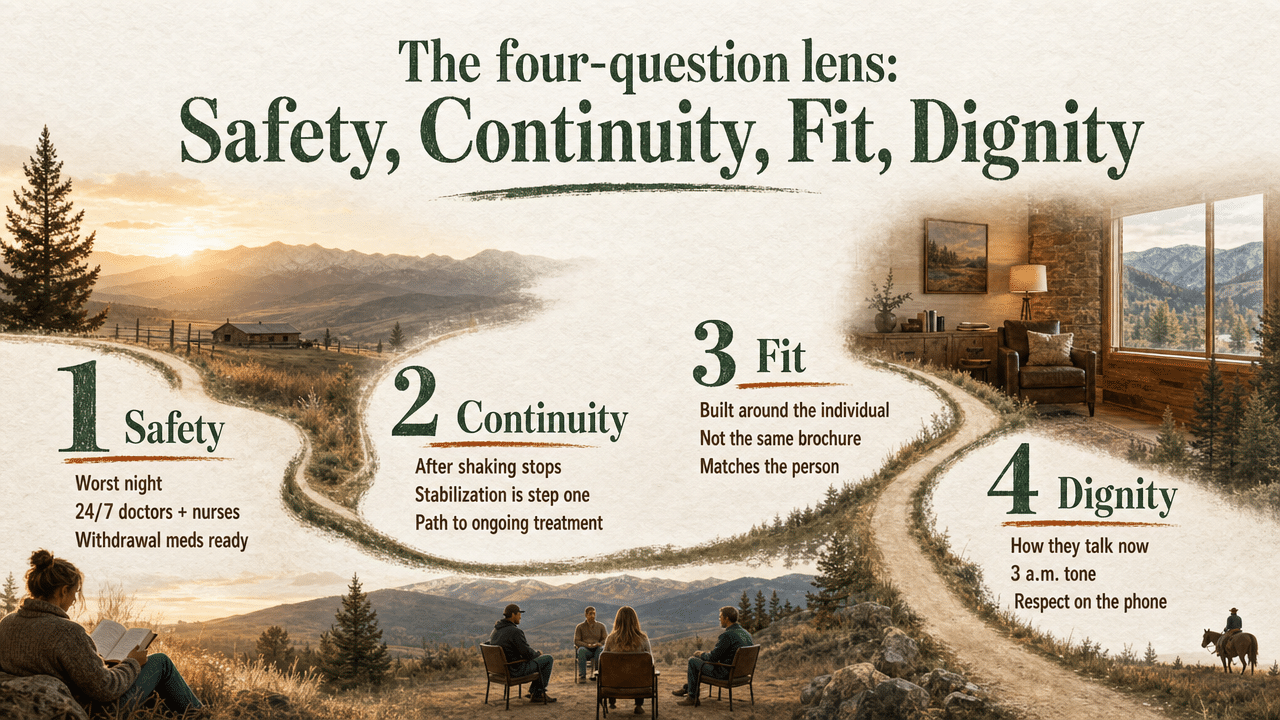
The four-question lens: Safety, Continuity, Fit, Dignity
Before you pick up the phone, give yourself a simple frame to hold onto. You don’t need to memorize a clinical checklist. You need four plain questions, in this order:
| Factor | What to Ask / Look For |
|---|---|
| Safety | Can this place keep my person alive through the worst night? Are there doctors and nurses on-site around the clock, with medications ready for withdrawal symptoms that can turn serious fast? |
| Continuity | What happens after the shaking stops? A good detox center treats stabilization as the first step, not the whole job, and has a clear path into ongoing treatment. |
| Fit | Does the program match the person in front of them, or does every caller get the same brochure? Real treatment is built around the individual. |
| Dignity | How do they talk to you on the phone right now? That tone is the same tone your loved one will hear at 3 a.m. |
Hold these four words in your head as you read on. They turn a scary search into four answerable questions.
Safety: can this place keep someone alive through the worst night?
Doctors and nurses on-site around the clock
When you call a detox center, the first thing to ask is who is actually in the building at 3 a.m. on a Sunday. Not on call. Not reachable by phone. In the building.
You’re looking for two answers. First, a nurse on the floor 24 hours a day, every day. Second, a doctor either on-site or immediately reachable, with the authority to order medications when withdrawal symptoms start climbing. This matters because the most dangerous parts of alcohol or benzo withdrawal — seizures, dangerously high blood pressure, the early signs of delirium — don’t keep business hours. They tend to show up in the middle of the night, and someone has to be there to see them coming.9
Ask directly: “If my husband’s blood pressure spikes at 2 a.m. and he starts seeing things, who is at his bedside, and how fast can they give him medication?” A good program will answer that question in plain language. They’ll tell you about nursing checks, vital sign monitoring, and the medications they use to ease withdrawal safely. If the person on the phone gets vague, that’s your answer.1
Overdose readiness and the naloxone question
If your person has been using opioids — heroin, fentanyl, prescription painkillers — overdose risk doesn’t end the moment they walk through the door. It can spike in the hours before admission, during transport, and again in the days right after detox when tolerance drops. A detox center worth your trust treats overdose readiness as a baseline, not a bonus.
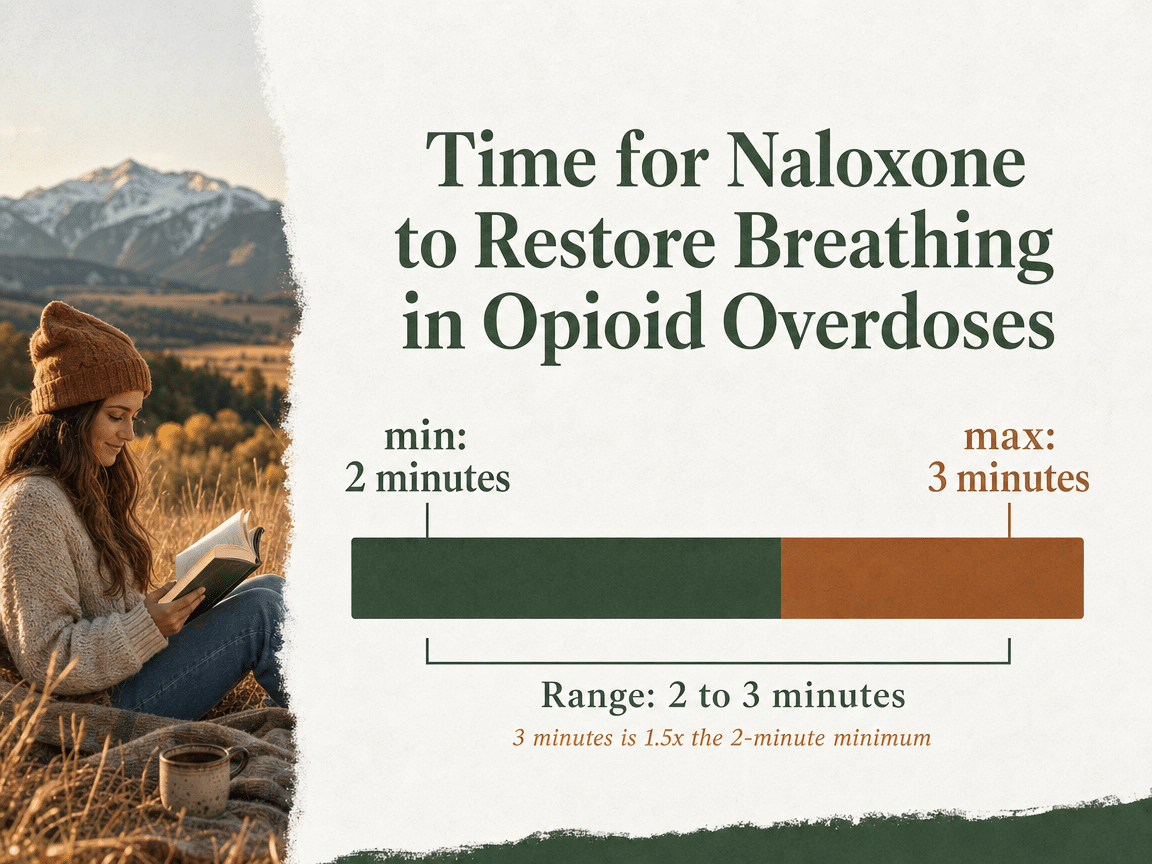
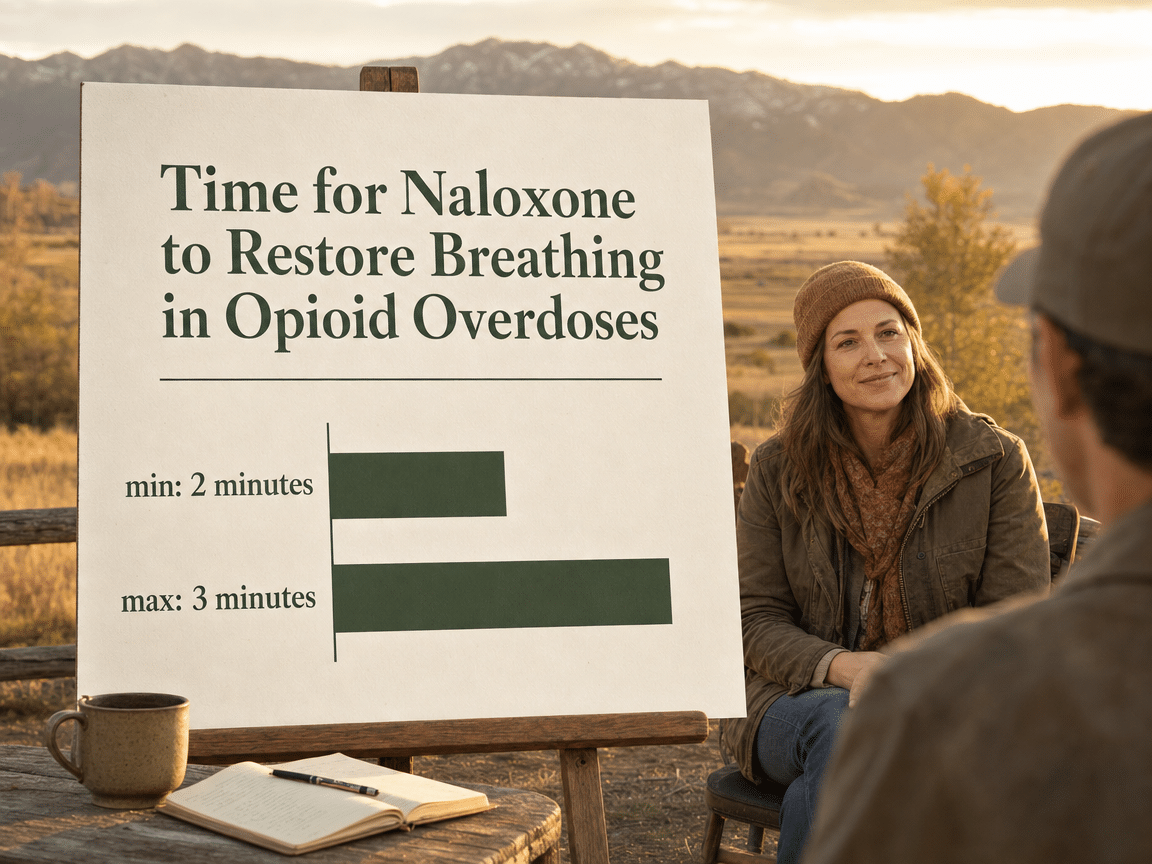
Ask whether naloxone is stocked on-site and whether every clinical staff member is trained to use it. Naloxone is the medication that reverses an opioid overdose by restoring breathing, and the CDC notes it can restore normal breathing within 2 to 3 minutes in some opioid overdoses. That’s the window. Two to three minutes between a stopped breath and a breath coming back — but only if someone trained is in the room with the medication ready. A 911 call from a facility ten minutes from the nearest ambulance is not the same standard of care.6
The FDA approved over-the-counter naloxone nasal spray, which has made it easier for programs and families to keep it on hand. After naloxone is given, monitoring still matters, because the overdose can return as the medication wears off. Any program treating opioid users should be able to walk you through exactly how they handle this, calmly, on the phone.4,5
How to verify licensing in your state (Montana example)
You don’t need to be a regulator to check whether a center is licensed for the kind of care your person needs. You just need to know where to look.
Every state licenses substance use disorder facilities, and the rules spell out exactly what each level of care can and cannot do. In Montana, for example, the Department of Public Health and Human Services publishes rules that distinguish clinically managed residential withdrawal management from other levels of care. Translation: not every facility calling itself a “detox” is licensed to medically manage withdrawal. Some are designed for lower-acuity stabilization. That distinction can matter a lot if your loved one is a heavy drinker or a daily benzo user.12
Two practical steps. One, search your state health department’s website for “substance use disorder facility license” or “withdrawal management” and look up the specific center by name. Two, ask the center directly: “What level of withdrawal management are you licensed for, and where can I verify that?” An honest program will tell you and point you to the right page. If they dodge, that’s information too.
Continuity: what happens on day five matters as much as day one
The post-detox cliff most families don’t see coming
Here’s the part nobody warns you about. Day one through day four, your person is the safest they’ve been in a long time — surrounded by nurses, getting medication, sleeping in a bed where someone is checking on them. Then detox ends. If there’s no plan for day five, that’s when the cliff appears.
For someone coming off opioids, those first days after detox are a high-risk window for overdose. Tolerance drops fast during a clean stretch, so a dose that felt routine two weeks ago can stop their breathing now. For someone coming off alcohol or benzos, the physical symptoms ease, but the cravings, the shame, and the racing thoughts can hit hard — and they hit in a body that no longer has the chemical buffer it built over years. 1
Federal guidance is direct about this: detox is the first step in treatment, not the whole of it. A center that discharges someone after three to five days with a pamphlet and a phone number is not finishing the job. The places worth your trust treat detox as the front door to ongoing care — counseling, medications when appropriate, support that lasts past the parking lot.1,3,11
Questions that reveal whether a center has a real treatment plan
You don’t need clinical training to tell the difference between a place that has a plan and a place that’s hoping you’ll figure it out. You just need to ask three things on the phone.2
-
“What happens on the day detox ends?” A strong answer names the next level of care — residential treatment, a partial hospitalization program, intensive outpatient — and explains how the handoff works on-site or through a trusted partner. A weak answer talks vaguely about “options” or “resources.”
-
“How is the treatment plan built around the person, not the calendar?” Solid programs match care to the individual rather than running everyone through the same week. Ask how they decide what comes next for someone with a 20-year drinking history versus someone with six months of pill use.
-
“What does support look like after discharge?” Listen for specifics: counseling sessions, family involvement, check-ins at 30, 60, 90 days. If the answer is “we’ll give you a list,” keep calling.
Fit and dignity: the questions most articles skip
Matching the program to the person, not the brochure
Two people can walk into the same detox center with the same drug listed on the intake form and need wildly different care. A 58-year-old who has been drinking a fifth of vodka a day for twenty years is not the same patient as a 24-year-old who started using pills after a back surgery last spring. Federal guidance on addiction treatment is clear that care should be matched to the individual, not run on a single template.2
So on the phone, listen for curiosity. A good intake person asks about how much, how long, what else is going on — depression, anxiety, past trauma, other medications, medical conditions like high blood pressure or seizure history. They ask whether your loved one has tried to stop before and what happened. They ask if there are kids at home, a job to protect, a faith background that matters to them.
If the call feels like a form being filled out, that’s a brochure program. If it feels like someone trying to understand a person, you’re in the right place.
How staff talk to you on the first call
Pay attention to tone, because tone travels. The way the admissions person talks to you at 11 p.m. is the same way the night nurse will talk to your loved one at 3 a.m.
What you want to hear: calm, unhurried answers. No shame in their voice when you describe how bad it has gotten. No pressure to put down a deposit before you’ve asked your questions. Real warmth when you say the person’s name. A willingness to say “I don’t know, let me find out” instead of guessing.
What should make you pause: a sales pitch, vague reassurances like “we handle everything,” or any hint that your worry is inconvenient. You are not being dramatic. You are scared because something scary is happening, and the right people on the other end of the line will treat you that way.
Family communication during detox
Detox is not the time for a communication blackout. Your loved one needs to focus on getting through withdrawal, but you need to know they’re safe — and a good center builds that bridge without making you beg for it.
Ask how communication works during the first few days. Some programs limit calls in the first 24 to 48 hours so the patient can rest and stabilize, which is reasonable. What is not reasonable is silence. You should be able to reach a nurse or counselor to ask how your person is doing, especially if there’s a medical concern. Ask whether family updates happen on a set schedule, who you can call, and how they handle emergencies on your end.
Strong programs also pull families in early — family education, counseling sessions, a clear plan for what role you’ll play after discharge. That’s not extra. That’s part of the treatment working.1
Red flags: when to hang up and call somewhere else
Some answers should end the call, gently and quickly. You don’t owe anyone a long conversation when your loved one’s safety is on the line. Trust your gut, and watch for these.1,3,9,12
-
They downplay the medical side. If someone tells you alcohol or benzo withdrawal can be ridden out without a doctor, or that your person just needs rest and fluids, hang up. Severe withdrawal can progress to seizures and delirium tremens.
-
They pressure you to wire money or commit before you’ve asked questions. Real programs answer your questions first. High-pressure sales is a sign the priority is the bed, not the person in it.
-
They promise a cure. Addiction is a chronic, treatable condition — not something a five-day stay fixes. Anyone guaranteeing a permanent fix is selling.
-
They have no plan for after detox. If you ask what happens on day five and the answer is a shrug or a list of phone numbers, that’s the cliff.
-
They won’t name their license or level of care. A legitimate center will tell you exactly what they’re licensed to do and where to verify it.
You’re allowed to say, “Thank you, I’m going to call somewhere else,” and hang up. Then call the next one.
Five things to verify on the phone in under ten minutes
You don’t have all night to interview five places. Here’s a short list you can keep on your phone or read off a sticky note. Ten minutes per call, max.1,3,5,12
- 24/7 medical coverage. Ask who is in the building overnight and whether a nurse is on the floor at all hours. Listen for specifics about vital sign checks and medications for withdrawal.
- Licensing and level of care. Ask what they are licensed to provide and where you can verify it. State rules separate medically managed withdrawal from lower-acuity care.
- Overdose readiness. Naloxone on-site, staff trained, monitoring after a reversal.
- The day-five plan. Ask what happens when detox ends and how they connect people to ongoing treatment.
- Family communication. Ask how and when you’ll hear about your loved one, and who picks up when you call worried.
A note on Rocky Mountain Treatment Center
If you’re searching from Montana or somewhere nearby, one local option worth a call is Rocky Mountain Treatment Center in Great Falls. It’s a small residential program — 26 beds, not an institution — with medically monitored detox built into the front of a 30, 60, or 90-day stay, so the day-five handoff happens under the same roof rather than as a referral. Over 80% of the staff are in recovery themselves, which tends to show up in how they answer the phone. Ask them the five questions above. Then trust what you hear.3
Frequently Asked Questions
How do I know if someone needs medical detox instead of quitting at home?
If your person drinks heavily every day, uses benzodiazepines like Xanax or Klonopin daily, or has had withdrawal symptoms before, quitting at home is not safe. Severe alcohol withdrawal can progress to seizures and delirium tremens. When in doubt, call a detox center and describe the situation. They’ll help you decide.9
How long does detox usually take?
What should I ask a detox center when I call?
What happens after detox is finished?
This is the question that matters most. A strong program moves the person directly into ongoing care — residential treatment, a partial hospitalization program, or intensive outpatient — with counseling and, when appropriate, medication 1. Detox alone is not the full treatment, and the days right after are a high-risk window without a real plan.3
How can I verify a detox center is properly licensed in my state?
Search your state health department’s website for substance use disorder facility licensing. In Montana, for example, DPHHS publishes rules that separate clinically managed residential withdrawal management from lower-acuity care. Then ask the center directly what level they’re licensed for and where to verify it. An honest program will point you to the page.12
Can family members stay in contact during detox?
Yes, though the first 24 to 48 hours may have limited patient calls so your loved one can rest and stabilize. That’s reasonable. What’s not reasonable is silence. You should be able to reach a nurse or counselor for updates, and a good program pulls families into education and counseling early as part of the treatment.1
References
- Treatment | National Institute on Drug Abuse (NIDA) – NIH. https://nida.nih.gov/research-topics/treatment
- Principles of Drug Addiction Treatment: A Research-Based Guide (Third Edition). https://nida.nih.gov/sites/default/files/podat-3rdEd-508.pdf
- Quick Guide For Clinicians Based on TIP 45—Detoxification and Substance Abuse Treatment. https://nida.nih.gov/sites/default/files/samhsa_detoxification_and_substance_abuse_treatment.pdf
- FDA Approves First Over-the-Counter Naloxone Nasal Spray. https://www.fda.gov/news-events/press-announcements/fda-approves-first-over-counter-naloxone-nasal-spray
- Naloxone DrugFacts | National Institute on Drug Abuse (NIDA). https://nida.nih.gov/publications/drugfacts/naloxone
- Lifesaving Naloxone | Stop Overdose – CDC. https://www.cdc.gov/stop-overdose/caring/naloxone.html
- Alcohol Use and Your Health – CDC. https://www.cdc.gov/alcohol/about-alcohol-use/index.html
- Alcohol withdrawal: MedlinePlus Medical Encyclopedia. https://www.medlineplus.gov/ency/article/000764.htm
- Alcohol Withdrawal Syndrome – StatPearls – NCBI Bookshelf – NIH. https://www.ncbi.nlm.nih.gov/books/NBK441882/
- Detoxification and Substance Abuse Treatment – NCBI Bookshelf – NIH. https://www.ncbi.nlm.nih.gov/books/NBK64115/
- Harm Reduction | Overdose Prevention Strategy – HHS.gov. https://www.hhs.gov/overdose-prevention/harm-reduction
- Rules for Substance use Disorder Facility – dphhs. https://dphhs.mt.gov/assets/oig/Rules_for_Substance_use_Disorder_Facility.pdf