
Recognizing the Signs You Need More Support
Warning Signals That Outpatient Isn’t Enough
Let’s start with a practical checklist: Warning signals that outpatient care may not be enough for you or your clients. If multiple items below ring true, it’s time to seriously ask, “when is residential treatment necessary” for sustained recovery.

– Repeated relapses despite active participation in outpatient programs– Increasing medical or psychiatric risks (such as worsening depression, suicidal thoughts, or dangerous withdrawal symptoms)- Substance use escalating even with regular counseling or medication- Lacking a safe, stable home environment that supports sobriety- Ongoing use leads to emergencies or puts others at risk (e.g., driving under the influence, workplace accidents)
The American Society of Addiction Medicine (ASAM) identifies these as key criteria for stepping up care, especially when you see high relapse risk, severe withdrawal, or co-occurring mental health needs that can’t be safely managed outside a 24/7 setting 62. This approach is ideal for professionals helping clients who, despite best outpatient efforts, continue to struggle with daily functioning or safety concerns.
Yes, recognizing these signals is tough—acknowledge that! Every time you notice a pattern, you’re one step closer to a safer path forward. Next, you’ll learn a simple self-check to help clarify your or your client’s current level of need.
A Simple Self-Check You Can Use Today
Here’s a practical tool: a simple self-check you can use—or share with your clients—to quickly assess the urgency of stepping up care. Ask yourself the following:
– Have you experienced two or more relapses in the past six months, even while attending outpatient sessions or support groups?- Are you noticing withdrawal symptoms that feel unsafe or unmanageable at home?- Do you feel your mental health is deteriorating (such as new or worsening depression, anxiety, or suicidal thoughts) alongside substance use?- Is your current living environment making it harder to avoid substances?- Are you missing work, school, or important responsibilities due to substance use, despite efforts to get back on track?
If you answer “yes” to several of these, it’s a clear sign that more structured help may be needed. The American Society of Addiction Medicine (ASAM) uses similar criteria to determine when is residential treatment necessary, especially when safety, stability, or medical monitoring are concerns 62.
Remind yourself: needing a higher level of care isn’t a failure. It’s a step toward real change. Every honest answer here is progress—acknowledge your courage in facing these questions. Next, we’ll look at how industry-wide guidelines like ASAM help professionals match treatment intensity to individual needs.
How ASAM Criteria Guide the Right Level of Care
You’ve probably administered ASAM assessments yourself—maybe dozens of them. You know the six dimensions by heart, understand the clinical logic behind each level of care recommendation, and have guided clients through this exact process. Now you’re the one being evaluated, and that shift changes everything. Sitting across from a colleague as they work through those same dimensions with you can feel surreal. The questions you’ve asked others countless times suddenly land differently when they’re directed at you. Your acute intoxication and withdrawal potential, biomedical conditions, emotional complications, readiness to change, relapse history, recovery environment—all the clinical markers you’ve professionally assessed are now your own lived reality. The cognitive dissonance can be disorienting: you understand exactly why these questions matter, yet answering them honestly requires a vulnerability that your professional identity may have shielded you from experiencing. Here’s what many professionals in crisis discover: knowing the system doesn’t make needing it any easier. You might intellectually recognize that your withdrawal symptoms, co-occurring challenges, or home environment warrant intensive care, yet accepting that recommendation for yourself feels entirely different than making it for someone else. The structured support you’ve confidently prescribed—24/7 medical supervision, removal from triggers, comprehensive daily programming—suddenly becomes personal rather than theoretical. The criteria’s flexibility matters differently when it’s your recovery at stake. You understand clinically that treatment intensity should match current need and adjust over time, but experiencing that progression yourself—starting with the full structure you might require, then stepping down as you stabilize—asks you to trust the same process you’ve trusted for others. That trust can feel harder to extend to yourself. For professionals dealing with physical dependence, unstable circumstances, or previous attempts that didn’t hold, residential programs often provide what ASAM criteria indicate: comprehensive medical oversight during withdrawal, structured days that replace old patterns, peer support from others who understand both addiction and recovery, and distance from the environments and stressors that contributed to crisis. Many programs are staffed significantly by people in recovery themselves—colleagues who’ve sat where you’re sitting and rebuilt their professional lives alongside their personal ones. The assessment process removes some weight from your shoulders. Rather than trying to objectively evaluate your own situation while in crisis, honest conversations about your substance use patterns, physical health, mental wellness, and current environment help identify the level of care that gives you the foundation you need. You’ve helped others accept appropriate treatment recommendations. Now it’s your turn to receive that same standard of care—as both the professional you are and the person who needs support right now.Weighing Your Options: A Decision Framework
Comparing Completion Rates and Outcomes
Begin with a quick comparison tool: Picture two groups—one in residential treatment, one in outpatient care. Which group is likelier to finish their program and see real gains? For many, this is the crossroads where you must weigh, “when is residential treatment necessary” for achieving lasting recovery.
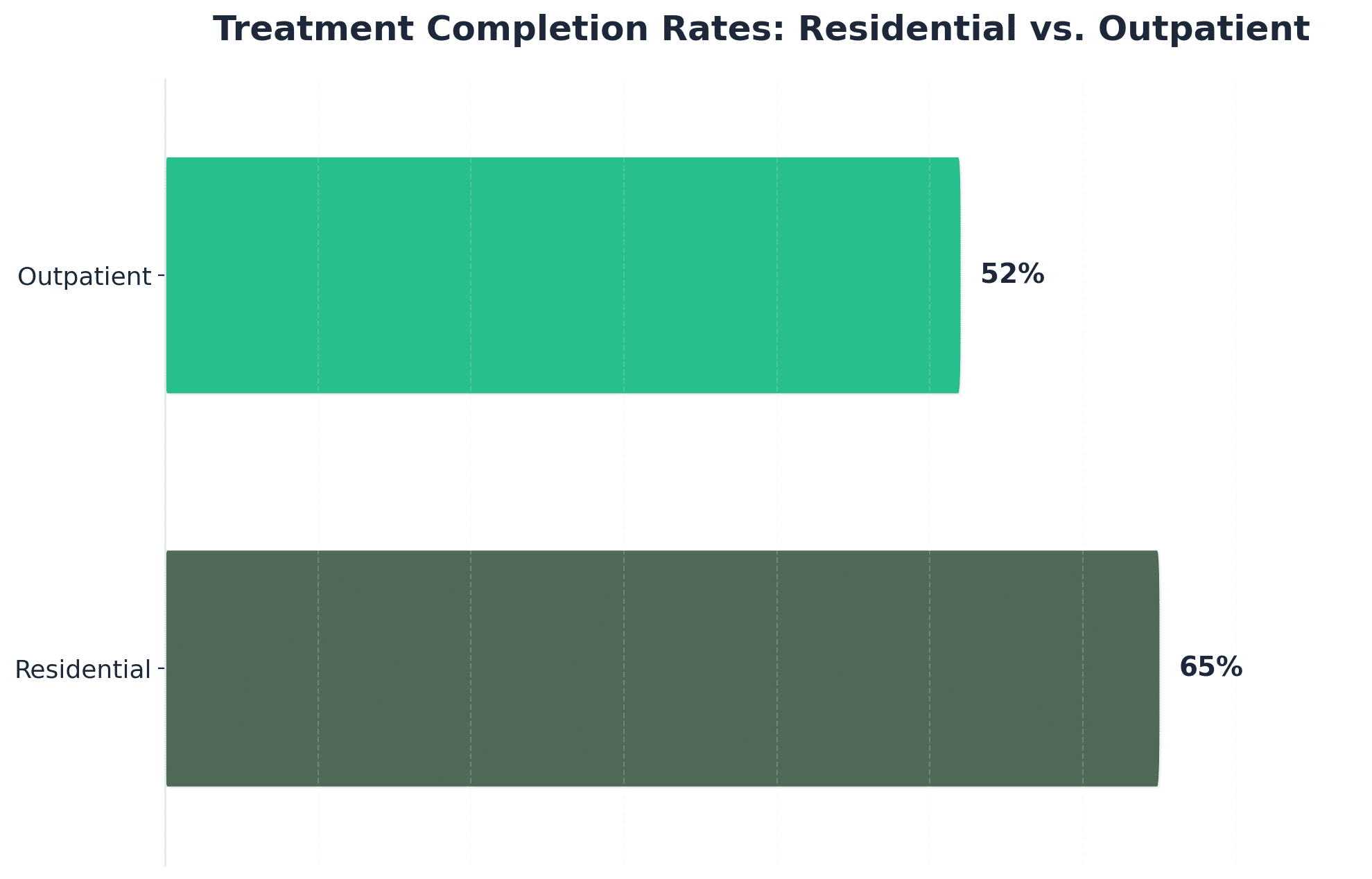
Recent studies show residential programs have a 65% completion rate compared to 52% for outpatient care 5. That’s a significant difference, especially if you’ve seen clients or colleagues cycle through multiple failed attempts. In fact, after adjusting for other factors, people in residential settings are nearly three times as likely to complete treatment as those in outpatient programs 5. Completion is not just a number—it’s often the difference between sustained progress and repeated setbacks.
This approach is ideal for those with histories of relapse, more severe addiction, or complex mental health needs. If you’re working with someone who’s struggled to stick with outpatient plans, or feels overwhelmed by daily triggers at home, residential care offers the structure and consistency that can turn the tide.
Remember, comparing outcomes isn’t about judgment—it’s about finding what gives you or your clients the best chance at real change. Every step toward higher completion rates is a victory worth celebrating. Next, let’s look honestly at the practical tradeoffs—cost, time, and the realities of daily life—when residential care is on the table.
Balancing Cost, Time, and Life Responsibilities
Let’s use a practical checklist to help you or your clients weigh the real-world tradeoffs of residential care:
– Can you step away from work, school, or caregiving duties for 30 days?- Do you have financial resources set aside, or will you need to work with insurance to cover costs?- Are there support systems in place to manage home or family responsibilities during your absence?- Will job protection laws (like FMLA) or employer policies help you maintain employment while in treatment?- Is the urgency of your situation such that waiting is riskier than pressing pause on other obligations?
These questions matter, because making room for residential treatment often means rearranging your entire life—even temporarily. Studies show only 36% of adults with opioid use disorder received any form of treatment in a recent year, with family and work conflicts among the biggest barriers 4. Cost is another concern: residential programs are more resource-intensive than outpatient, requiring 24/7 staffing, medical monitoring, and room and board 2.
This path makes sense for people whose safety, health, or long-term stability outweigh the temporary disruptions of putting life on hold. It’s okay to feel overwhelmed by the logistics—every honest conversation about cost, time, or responsibility is a step toward clarity, not away from it. Remember, the question isn’t just “when is residential treatment necessary”—it’s also, “how can I make this possible if it is?”
Next, we’ll walk through what daily life actually looks like inside a 30-day residential stay.
What to Expect Inside a 30-Day Residential Stay
A 30-day residential program means stepping away from the role you’ve always held—the one who helps, the one who knows the clinical framework, the one others depend on—and becoming the client. You understand how treatment works. You’ve probably referred others to programs just like this one. But being the person in the chair, rather than facilitating the session, requires a different kind of courage. From the moment you arrive, you’ll follow a structured schedule that you’d recognize from a clinical standpoint—individual sessions, group work, psychoeducation, experiential therapies. But experiencing these interventions as a participant feels entirely different than understanding them conceptually. Your individual counseling sessions will ask you to explore trauma, family dynamics, and behavioral patterns not as case conceptualizations but as your own lived reality. You’ll sit with discomfort you’ve helped others process countless times, and you’ll discover that professional knowledge doesn’t make vulnerability any easier. Group therapy will likely challenge you in unexpected ways. You’re used to holding space for others, managing group dynamics, redirecting when needed. Here, you’ll practice receiving support rather than providing it—learning to be honest about your struggles with peers who may not share your professional background but absolutely understand what you’re going through. The role reversal can feel disorienting at first, especially when you catch yourself analyzing the facilitation rather than engaging with your own process. Working with staff who are in recovery themselves helps bridge that gap—they understand both the clinical work and what it means to surrender the helper identity and accept help. Beyond traditional therapeutic approaches, you’ll engage with experiential modalities that bypass intellectual defenses. Equine therapy offers something particularly valuable for professionals who live in their heads—horses respond to your emotional state and energy, not your credentials or expertise. They teach you about presence, authenticity, and non-verbal communication in ways that can’t be rationalized or controlled. The Montana setting itself becomes part of the work—wide open spaces that create room for perspective, distance from the professional identity you’ve built, and a chance to reconnect with parts of yourself that got lost along the way. The practical concerns are real, and they matter. Stepping away from your career or practice for 30 days means rearranging client care, notifying your employer or partners, potentially addressing licensure or credentialing requirements. You might worry about what colleagues will think, whether your professional reputation will suffer, how you’ll explain the gap. These aren’t trivial concerns—they’re legitimate barriers that keep many professionals from seeking help until crisis forces their hand. But the programs that work best for professionals understand these challenges and can help you navigate them, from connecting you with resources about licensure protection to supporting you through the vulnerability of being seen in crisis by peers who might later become colleagues. Your days will include activities you’d recommend to clients—meditation, physical movement, nutrition-focused meals, consistent sleep schedules, recreational therapy that teaches you how to experience joy without substances. You’ll participate in family programming that helps your loved ones understand addiction from both sides of the clinical relationship. Evenings offer space for reflection, community connection, and simply learning what a balanced day looks like when you’re not performing competence or managing everyone else’s needs. Throughout your stay, counselors are available when you need support—not as supervisors or colleagues, but as guides who’ve often walked this path themselves. Being surrounded by staff in recovery creates an environment where your professional knowledge is respected but your human struggle is centered. This combination of clinical expertise and lived experience makes it possible to finally do the work you’ve helped others do, trusting that the same principles that guide your professional practice can also support your own healing.Conclusion
A 30-day residential program offers you the time and space to break free from addiction’s grip and rebuild your foundation for recovery. You’ll receive round-the-clock support, learn practical coping skills, and connect with others who truly understand what you’re going through. And yes—stepping away from your practice, your patients, your professional identity feels impossible. The concerns are real: What will colleagues think? How do I explain this absence? Can I be vulnerable with peers who might judge me? Here’s what’s also real: You’ve spent your career providing care, offering expertise, holding space for others’ struggles. You’ve likely advised countless people to prioritize their health, to seek help when needed, to recognize that healing requires dedicated time and support. Those same truths apply to you. The structure, therapy sessions, peer connections, and experiential activities—whether in group counseling or working alongside horses in the Montana landscape—all work together to help you understand the root causes of your substance use and develop healthier patterns. Recovery doesn’t end when your 30 days are complete. Programs like Rocky Mountain Treatment Center in Great Falls offer continuing care, alumni groups, and extended treatment options if additional time would benefit your healing. Every person’s path is different, and that’s perfectly okay. What matters is recognizing that seeking help isn’t a professional failure—it’s a profound act of strength. You deserve the same quality of care you’ve dedicated your life to providing others. Taking this step doesn’t diminish your expertise; it deepens your humanity and, ultimately, makes you better at what you do.Frequently Asked Questions
How much does a 30-day residential treatment program typically cost, and will insurance help?
Costs for a 30-day residential treatment program vary widely depending on location, services, and facility resources. While specific dollar amounts aren’t published in the available research, it’s clear that residential care is more resource-intensive than outpatient, mainly due to 24/7 staffing, medical monitoring, and room and board 2. Insurance can often help with some or all of these costs, especially if the program meets medical necessity standards set by guidelines such as the ASAM Criteria. This solution fits individuals or families who need structured, intensive care and are willing to navigate insurance approval processes or explore payment options. Feeling overwhelmed by finances is normal—don’t hesitate to ask facilities about their insurance partnerships or payment plans. If you’re still wondering when is residential treatment necessary, know that cost is just one piece of the decision. Celebrate every step you take toward clarity and support.
What happens if I need to keep working or caring for family during treatment?
Needing to step away from work or caregiving can feel overwhelming when considering a residential program. Most 30-day residential treatments require you to be onsite full-time, which means pausing job duties or handing off family care for several weeks 2. Some people can use job protection laws like FMLA or arrange for temporary support at home, but not everyone has these options. If ongoing responsibilities are a barrier, partial hospitalization or intensive outpatient programs might offer more flexibility. This approach works best when is residential treatment necessary for safety or medical stability, and temporary life disruptions become an investment in long-term recovery. Every plan you make to care for both yourself and your loved ones is a step forward.
How do I know if I need medically monitored detox before entering residential care?
If you’re wondering whether you need medically monitored detox before residential care, start by checking for signs like shaking, confusion, severe cravings, or withdrawal symptoms that feel dangerous to manage alone. Medically monitored detox means medical staff watch for complications around the clock—crucial for substances like alcohol, benzodiazepines, or opioids, where withdrawal can be life-threatening 26. This approach works best when is residential treatment necessary for people at risk of seizures, delirium, or serious health issues during withdrawal. If you’ve struggled with quitting on your own, experienced past medical emergencies, or have other health conditions, prioritize a setting with detox support. Every step you take to ensure safety is a brave move forward.
Can I bring my phone, laptop, or stay in contact with loved ones during my stay?
You’re likely wondering if you can bring your phone, laptop, or stay connected to loved ones during a 30-day residential stay. Most programs do allow some form of contact, but device use is usually limited—often to protect your focus, privacy, and the safety of all clients. Calls or video chats with family are usually scheduled, while social media and unsupervised internet use may be restricted, especially in the early weeks 2. This approach works best when is residential treatment necessary to create a safe, distraction-free environment for healing. Missing regular contact is tough—every message home is a reminder you’re not alone, and each day without your device is a step toward new habits.
What if 30 days doesn’t feel like enough time to feel ready for the outside world?
It’s completely normal to feel uncertain or unprepared when discharge day approaches. Many people worry that 30 days won’t be enough to feel truly ready for life outside residential care. The good news is, most programs offer options to extend your stay, step down gradually to less intensive care, or connect you with ongoing outpatient support and peer groups 23. This strategy suits you best if you notice lingering cravings, anxiety about home triggers, or concerns about relapse. You are not alone—asking for more time or extra support is a sign of strength, not weakness. Each request for help is another step toward lasting recovery.
How quickly can I be admitted once I decide residential treatment is the right step?
Once you decide residential treatment is the right step, admission timelines can move surprisingly fast. Many programs offer same-day or next-day admissions, especially when is residential treatment necessary for urgent safety or medical reasons 2. The process usually involves a brief phone assessment, gathering medical history, and coordinating travel or intake logistics—steps that can often be completed within 24–48 hours. Some facilities prioritize rapid intake for people with severe withdrawal or high relapse risk, so don’t hesitate to share concerns about safety or urgency. Every call you make or form you fill out is a courageous act toward stability and support. You deserve timely help.
What kind of aftercare or support is available once I complete the program?
After completing a 30-day residential program, ongoing support is essential to help maintain the progress you’ve made. Most facilities offer a range of aftercare options, including weekly group meetings (in-person or via Zoom), individual counseling sessions, family therapy, and connections to local or online peer support groups 23. Many programs also provide continuing care check-ins at regular intervals—such as 30, 60, or 90 days post-discharge—to track your wellbeing and offer encouragement. This approach is ideal for people who want accountability and guidance as they transition back to daily life. Remember, reaching out for aftercare isn’t a sign of weakness; it’s a powerful way to protect your recovery and celebrate every small win.
References
- Chapter 5—Specialized Substance Abuse Treatment Programs – NCBI. https://www.ncbi.nlm.nih.gov/books/NBK64815/
- Treatment Types for Mental Health, Drugs and Alcohol | SAMHSA. https://www.samhsa.gov/find-support/learn-about-treatment/types-of-treatment
- Treatment | National Institute on Drug Abuse – NIDA. https://nida.nih.gov/research-topics/treatment
- Barriers to retention in inpatient and residential drug treatment …. https://pmc.ncbi.nlm.nih.gov/articles/PMC11347080/
- Residential and outpatient treatment completion for substance use …. https://pubmed.ncbi.nlm.nih.gov/26925821/
- Summary of Evidence – Inpatient and Outpatient Treatment … – NCBI. https://www.ncbi.nlm.nih.gov/books/NBK507689/
- Release of the 2024 National Survey on Drug Use and Health. https://www.samhsa.gov/blog/release-2024-nsduh-leveraging-latest-substance-use-mental-health-data-make-america-healthy-again
- Residential treatment and medication treatment for opioid use disorder. https://pmc.ncbi.nlm.nih.gov/articles/PMC9495301/