
Key Takeaways
- Lack of insurance is the top barrier families hit when seeking treatment, but uninsured adults still reach residential care through state agencies, Medicaid, and provider-based financial help 3.
- Five early calls open the most doors: SAMHSA’s helpline, the state substance use agency, Medicaid enrollment, treatment center admissions, and a community health center or FQHC.
- Funding rarely comes from one source. Families typically combine block-grant beds, Medicaid (expanded under the 2024 IMD state plan option), sliding-fee scales, scholarships, and payment plans 8.
- Expect delays, voicemails, and waitlists. Only 6.3 percent of people who needed substance use treatment in 2021 received specialty care, so persistence across follow-up calls and applications is the mechanism that closes the gap 4.
You Called for Help and Someone Said ‘No Insurance.’ Now What?
You picked up the phone, perhaps calling a rehab, a hospital, or a hotline. Somewhere in that first conversation, you were asked about your son or daughter’s insurance, and you had to say: none.
Take a breath. That answer does not close the door. It just changes which door you walk through.
Here is what you need to hear right now: your adult child can still get into a residential treatment program without private insurance. Parents do this every week in every state. The path is real, but it is not obvious, and nobody hands you a map when the crisis starts. That is what this guide is for.
The reasons families struggle to get care are exactly what you are feeling. A SAMHSA analysis of adults who did not receive treatment found that the top reason was lack of health insurance and inability to afford the cost of care 3. You are not failing. You are hitting a wall that millions of families hit, and there are established ways around it.
In the next few sections, you will learn the five phone calls to make in your first 72 hours, the funding paths that actually put someone in a bed, what to say when admissions offices pick up, and why a structured 30, 60, or 90-day program is worth every call it takes to get there. You do not have to figure this out alone tonight. You just have to make the next call.
Your First 72 Hours: Five Calls That Open Doors
Call One: SAMHSA’s National Helpline (1-800-662-4357)
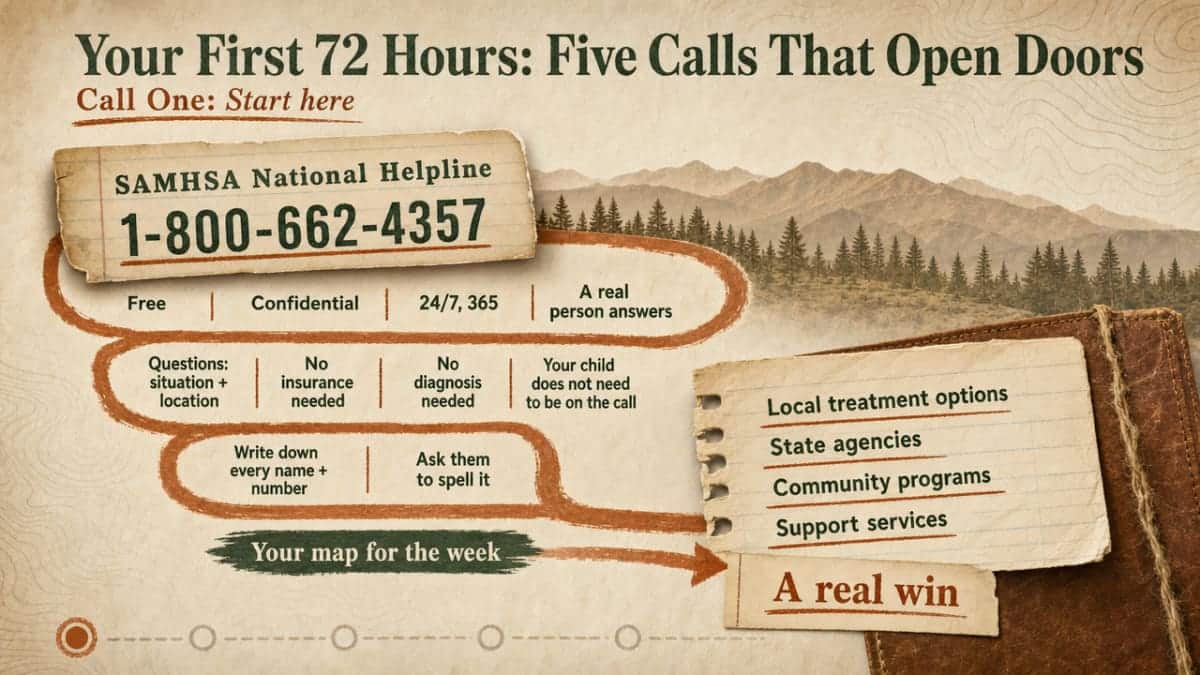
Start here. The SAMHSA helpline is free, confidential, and open 24 hours a day, every day of the year. You can call in the middle of the night when you cannot sleep, and a real person will pick up.
The person on the line will ask a few questions about your adult child’s situation and location, then point you toward local treatment options, state agencies, community programs, and support services in your area 1. You do not need insurance information. You do not need a diagnosis. You do not even need your child on the phone with you.
Keep a notepad next to you. Write down the names of every program, agency, and phone number they mention. Ask them to spell things out. This one call often becomes the map you work from for the rest of the week.
That first call is a real win. You made it.
Call Two: Your State Substance Use Agency
Every state has an agency that oversees substance use treatment, and part of what it does is help people without insurance find care. SAMHSA specifically recommends contacting your state mental health and substance use agency for information on treatment for people without coverage 1.
This is the office that manages state-funded treatment slots, block-grant beds, and the referral lists that community programs use. When you call, tell them plainly: your adult child needs residential treatment, has no insurance, and you are trying to understand what state-funded options exist and how the waitlist works.
Ask two things directly. What state-funded residential programs serve adults in your county? And what does someone need to bring or prove to be considered for one of those beds?
You may get voicemail. Leave a clear message and call again the next morning. Persistence is part of the job.
Call Three: Medicaid Eligibility Screening
Your adult child might qualify for Medicaid right now and not know it. Eligibility is based on their income and household size, not yours. An adult child with little or no income of their own often qualifies even when the family as a whole does not look low-income on paper.
This matters because Medicaid coverage changes what is on the table. Uninsured adults are much less likely to get any substance use treatment or inpatient care than adults with coverage 6. Getting enrolled, even in the middle of a crisis, can open doors that were closed the day before.
Call your state Medicaid office or visit the enrollment site to start an application. Ask if your state offers expedited or presumptive eligibility for people entering treatment. Some states can approve a pending application quickly enough to matter for admission.
Every completed application is progress, even if the answer takes a few days.
Call Four: A Treatment Center’s Admissions Office
Now call an actual residential program. This is the call that scares parents the most, and it should not. Admissions offices talk with uninsured families every day, and most have more flexibility than their website suggests.
When they pick up, do not lead with insurance. Lead with the person. Tell them your adult child’s age, what they are using, how long it has been going on, and that you are looking at a 30, 60, or 90-day residential program. Then say: we do not have insurance, and I want to understand every payment path you offer.
Ask specifically about sliding-fee scales, scholarships, charity care, grants, and payment plans. SAMHSA lists these as the standard ways treatment providers make care affordable without traditional coverage 2. If the first center cannot help, ask them to name two others that might.
You are not begging. You are gathering information. That is a very different posture.
Call Five: A Community Health Center or FQHC
Federally Qualified Health Centers and community health centers see patients on a sliding scale based on income, and many now include behavioral health services or direct referrals into residential care 1. They are not usually the place your adult child will detox or complete a 30-day program, but they can be the bridge that gets you there.
Call the nearest one and ask if they have a behavioral health team, a substance use counselor, or a care coordinator who can help place someone into residential treatment. Ask if they can do a same-week assessment. That written assessment is often what state-funded programs and admissions offices want to see before they hold a bed.
Five calls in three days. That is a real week of work, and it moves things.
Why Persistence Matters: The Treatment Gap Nobody Warned You About
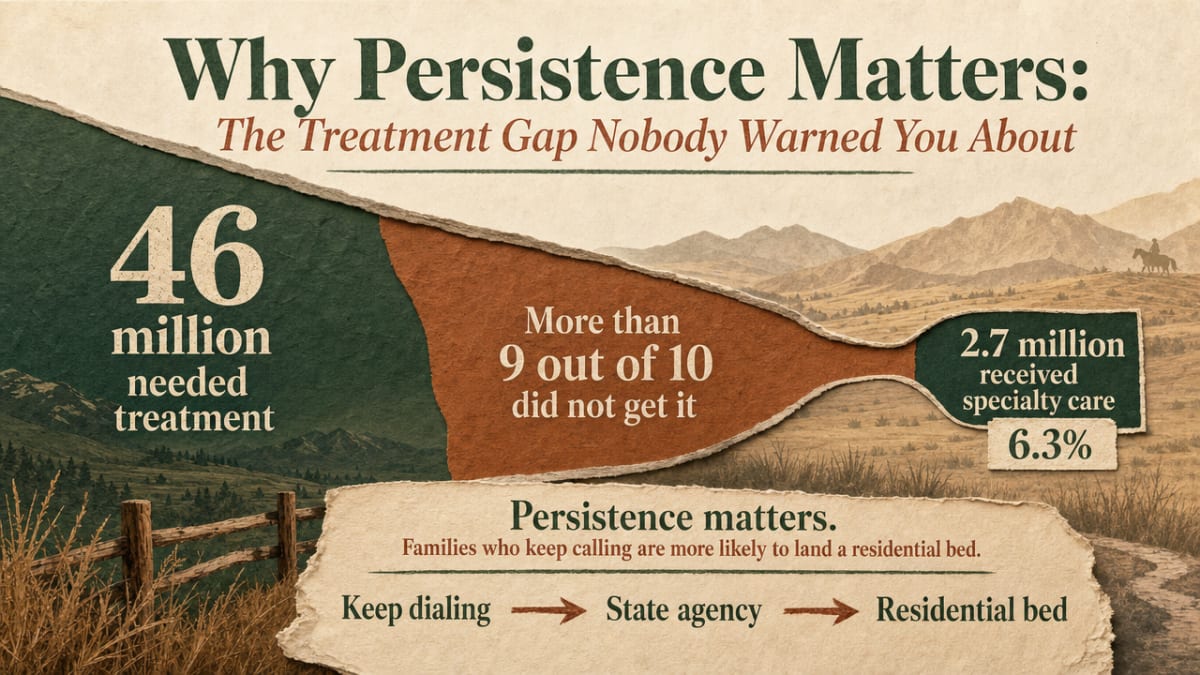
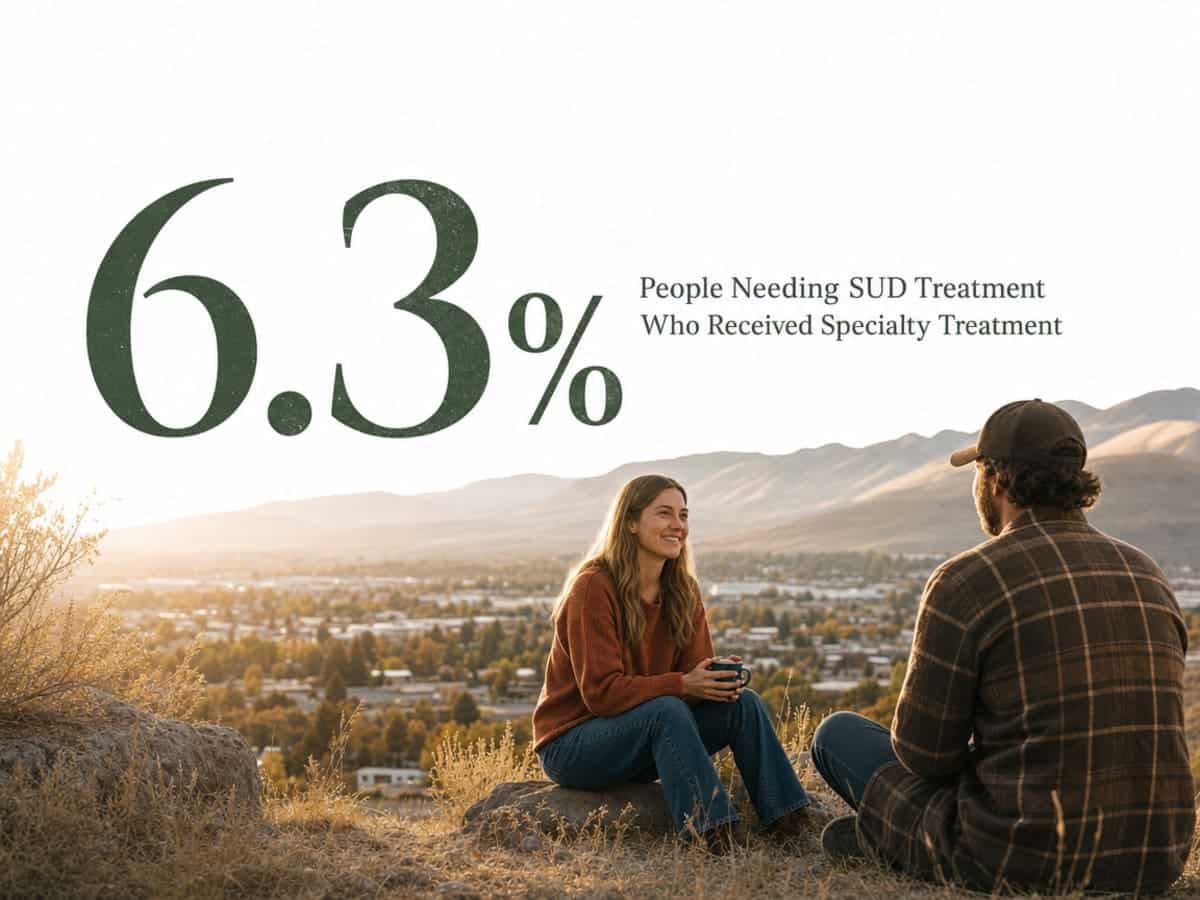
Here is a number that will make sense of your exhaustion. Of the roughly 46 million people aged 12 and older in the United States who needed substance use treatment in 2021, only about 2.7 million — 6.3 percent — actually received specialty care 4. That figure comes from Medicaid’s national data book, and it counts people who reached a program built to treat addiction, not just anyone who talked to a doctor once.
Read that again. More than nine out of ten people who needed real treatment did not get it. The system is not built to make this easy. That is not your imagination, and it is not a reflection of how hard you are trying.
Here is why that matters for you tonight. The families whose adult children do land in a residential bed are almost always the ones who kept dialing. They made the awkward call to the state agency. They filled out the Medicaid application even when they were not sure it would go anywhere. They asked the admissions office a second question after the first answer sounded like a soft no.
The Funding Paths That Actually Get Your Adult Child a Bed
State Block Grants: The Safety Net Most Families Don’t Know Exists
The federal government sends money to every state every year specifically to pay for substance use treatment for people who cannot afford it. It is called the Substance Abuse Prevention and Treatment Block Grant, and it is the reason free and low-cost residential beds exist at all. Even after Medicaid expansion under the Affordable Care Act, this block grant continues to pay for specialty treatment for uninsured, low-income adults 7.
What that looks like on the ground is straightforward. Colorado’s Behavioral Health Administration, for example, describes block-grant funds as money that pays for treatment for people without insurance, people who temporarily lose coverage, and services that insurance does not cover 10. Your state has a version of the same setup, even if the agency name is different.
Here is the practical piece. Block-grant beds are usually held at specific programs the state contracts with, and they are usually accessed through the state substance use agency you called earlier or through a community assessment. Ask directly: is my adult child on a block-grant waitlist, and what number are they on it? A name on a list is a foothold. Keep it.
Medicaid for Residential Rehab: What Changed in 2024
For decades, a rule called the IMD exclusion blocked Medicaid from paying for care at larger residential treatment facilities for adults. That rule quietly cracked open in 2024, and most families have not heard about it yet.
The Consolidated Appropriations Act of 2024 made permanent a state plan option that lets Medicaid cover services for adults receiving substance use treatment in institutions for mental diseases, or IMDs 8. In plain language: states can now choose to pay for adult residential rehab through Medicaid in facility settings that used to be off-limits. South Dakota, for example, announced that Medicaid coverage for medically monitored intensive inpatient treatment in these settings would resume effective June 1, 2024, with providers billing Medicaid for eligible recipients 9.
What this means for you: if your adult child qualifies for Medicaid, the list of residential programs that can accept them is longer than it was two years ago. Not every state has adopted the option yet, and not every program participates. When you call an admissions office, ask specifically whether they accept your state’s Medicaid for residential care, and whether they bill under the new IMD state plan option.
Be honest with yourself about one thing. Not every private residential center accepts Medicaid, and some centers you may be drawn to will not. That does not make the Medicaid path wrong. It means the Medicaid path may lead to a different high-quality program than the first one you called, and that is a real option worth pursuing.
Sliding-Scale Fees, Scholarships, and Charity Care at Private Centers
Private residential centers have more room to help than most families realize. SAMHSA specifically points to sliding-fee scales, grants, scholarships, and charity care programs as standard ways treatment providers make care possible for people without traditional insurance 2. These are not secret. They are just rarely offered before you ask.
A sliding-fee scale means the price of care is adjusted based on your adult child’s income and household size. A scholarship or charity care slot means part or all of the cost is covered by the center itself, often through a foundation or donor fund. Payment plans stretch what remains over months instead of demanding it upfront.
Why does asking matter so much? Because uninsured people with substance dependence almost never receive care on their own. One peer-reviewed study of the U.S. uninsured population found that only 9 percent of uninsured people with alcohol or drug dependence had received any substance use service in the past year 5. That gap does not close by waiting. It closes when a family member picks up the phone and asks a specific admissions counselor what financial help is available for a specific person on a specific day.
Ask by name: sliding scale, scholarship, charity care, grant, payment plan. Then ask what documents they need to consider your adult child.
Payment Plans and Family Financing Without Going Bankrupt
If sliding-scale and scholarship help still leaves a balance, a payment plan is often what bridges it. SAMHSA lists payment plans alongside sliding-fee scales and charity care as a normal part of how providers work with families without standard coverage 2. A good admissions office will walk you through what a monthly payment looks like before your adult child ever arrives.
Before you sign anything, ask three questions:
- What is the interest rate, if any?
- What happens if a payment is late?
- Can the plan be paused if your adult child needs to extend from a 30-day stay to a 60- or 90-day stay?
Some families also use a mix of personal savings, help from siblings or grandparents, and small contributions from a home church or community group. None of it has to be perfect. It just has to be enough to get your adult child through the door.
VA, Indian Health Service, and Medicare-by-Disability: Paths Parents Overlook
Three doors get missed in almost every conversation. Open each one before you rule it out.
If your adult child served in the military, the VA provides substance use treatment, and SAMHSA points families directly to VA services as part of the no-insurance pathway 1. Even a short period of service or a less-than-honorable discharge sometimes qualifies for care. Call the VA and ask; do not assume the answer is no.
If your adult child is a member of a federally recognized tribe or is Alaska Native, Indian Health Service is another route SAMHSA lists for treatment without insurance 1. IHS can connect families to tribal behavioral health programs and residential referrals that most non-tribal families never see.
Medicare is the door parents rarely think about. Adults under 65 can qualify for Medicare through Social Security Disability, and Medicare covers inpatient services for mental health and substance use in hospital settings, along with outpatient counseling and partial hospitalization 11. If your adult child has been out of work due to a documented condition, this may be worth a call to Social Security. It is a longer path, but for some families it becomes the answer.
What Families Typically Pay Out of Pocket
There is no honest single dollar figure for what your family will pay. What is honest is this: the out-of-pocket total depends on which of the funding paths from the last section actually opens for your adult child, and most families end up combining two or three of them.
A state-funded block-grant bed can bring the family cost close to zero, because the grant is designed to pay for treatment for people without insurance 10. A Medicaid-covered residential stay, if your adult child qualifies and the program accepts your state’s Medicaid, can also carry little to no cost to you 8. At a private residential center, a sliding-fee scale lowers the price based on your adult child’s income, a scholarship or charity care slot absorbs part of what remains, and a payment plan spreads the rest over months 2.
Ask each admissions office for a written estimate that shows the sticker price, the sliding-scale adjustment, any scholarship applied, and the monthly payment on the balance. Compare those estimates side by side. That is your real number.
What to Say on the Phone: Scripts for the Calls That Matter
Script for the SAMHSA Helpline
You do not need a polished speech. Try this:“Hi. My adult son (or daughter) is struggling with alcohol (or drugs). He has no insurance. I am trying to find residential treatment. Can you tell me what is available in our area?”Then ask two follow-ups.
“What state agency should I call next?” and “Are there community programs near me that offer sliding-scale or free care?”SAMHSA’s helpline is built to route families toward local treatment and state resources exactly like this 1.
Script for a State Agency or Block-Grant Program
State offices move faster when you are specific. Open with:“I am the parent of an uninsured adult. He needs residential substance use treatment. I am trying to understand what state-funded options are available and how someone gets on the list.”Then ask directly:
“Do you fund residential beds through the Substance Abuse Prevention and Treatment Block Grant?” 7 “What programs in my county accept those funds?” “What does my son need to bring, sign, or complete to be considered?”Ask for the caseworker’s name and a direct callback number. Write both down.
Script for a Treatment Center’s Admissions Office
Lead with your child, not with money. Try:“My daughter is 32. She has been drinking heavily for about three years and tried to stop twice on her own. I am looking at a 30, 60, or 90-day residential program for her. We do not have insurance, and I want to understand every payment path you offer.”Then ask by name:
“Do you offer a sliding-fee scale based on her income? Do you have scholarships or charity care slots? Are grants available? What does a payment plan look like on the balance?”SAMHSA lists all of these as standard options at treatment providers 2.Close with:
“If your program is not the right fit, can you give me two other centers that might help a family in our situation?”A good admissions counselor will.
Why the 30/60/90-Day Model Is Worth the Fight
Every phone call, every form, every voicemail you leave is aimed at one thing: getting your adult child into a program long enough to actually change something. Thirty days is where the body and mind start to steady. Sixty adds the kind of counseling depth that reaches under the surface. Ninety gives your son or daughter time to practice sobriety inside a structured community before the outside world comes rushing back.
The funding paths you have been working through — sliding-fee scales, charity care, grants, scholarships, payment plans, free or low-cost community health centers, and state-funded programs 2 — all lead to this same destination. They are not consolation prizes. They are how uninsured families reach real residential care. A block-grant bed and a scholarship-funded private bed can both put your adult child in a room with counselors, group meetings, and a schedule that does not include the people or places tied to their using.
What makes a longer stay worth the fight is what happens inside it. A well-run residential program includes individual counseling, group work, 12-step support, and family programming that pulls you into the recovery instead of leaving you on the outside guessing. Many centers, including Rocky Mountain Treatment Center in Great Falls, Montana, build in a family week and follow-up check-ins at 30, 60, 90, 180, and 365 days after discharge. That continuity matters. Recovery does not end at the exit door.
So when the fifth call feels like too many, remember what you are calling toward. Not a payment plan. A person coming home different.
One Week From Now: What Progress Actually Looks Like
Progress this week probably will not look like your adult child walking through the doors of a residential program on Friday. It will look smaller than that, and it will still count.
Progress is a filled-out Medicaid application sitting in a state office. It is a name on a block-grant waitlist 10. It is two admissions counselors who now know your son or daughter by name, a written cost estimate with a sliding-scale adjustment on it 2, and a same-week assessment scheduled at a community health center. It is one voicemail returned. It is you, sleeping four hours instead of two.
Keep a short list on the fridge. Cross things off. When the week ends and your adult child is not yet in a bed, look at that list and see what actually moved. Then pick up the phone Monday and make the next call. That is how families reach residential care without insurance. One call, one form, one small win at a time.
Frequently Asked Questions
Can my adult child really get into inpatient rehab without any insurance?
Yes. Uninsured adults reach residential treatment every week through a mix of state-funded programs, sliding-fee scales, scholarships, charity care, grants, payment plans, and free or low-cost community health centers 2. The path takes more phone calls than it should, but the funding paths are real and used every day by families in your exact situation.
What is the SAMHSA helpline and is it actually free to call?
Yes, it is truly free and confidential. Call 1-800-662-4357 any hour of any day. A trained person will ask about your adult child’s situation and location, then point you toward local treatment options, state agencies, and community programs that serve people without insurance 1. Keep a notepad ready to write down every name and number.
How fast can my adult child get on Medicaid if we apply right now?
Timing varies by state. Some states offer expedited or presumptive eligibility for people entering substance use treatment, which can move things in days rather than weeks. Getting enrolled matters because uninsured adults are much less likely to receive substance use treatment or inpatient care than adults with coverage 6. Apply now and ask the caseworker about expedited processing.
What is a sliding-scale fee, and how do I ask a treatment center about it?
A sliding-fee scale adjusts the price of care based on your adult child’s income and household size. SAMHSA lists it as a standard option many providers offer alongside scholarships, charity care, grants, and payment plans 2. Ask admissions directly: “Do you offer a sliding-fee scale? What income documents do you need to calculate it for my son or daughter?”
Will a state-funded program be as good as a private residential rehab?
State-funded beds paid through the Substance Abuse Prevention and Treatment Block Grant provide real specialty care for uninsured, low-income adults 7. Quality varies by program, not by funding source. When you tour or interview a state-funded option, ask about counselor credentials, family involvement, and continuing care after discharge. Those answers tell you more than the funding label does.
As a parent, am I legally responsible for paying my adult child’s rehab bill?
No. Once your child is a legal adult, the bill belongs to them, not you. Any financial help you offer, whether toward a payment plan or a sliding-scale balance 2, is a choice, not a legal obligation. Talk with the admissions office about what your adult child can qualify for on their own income before you sign anything.
References
- Help for mental health, drugs, alcohol: No Insurance. https://www.samhsa.gov/find-support/health-care-or-support/professional-or-program/no-insurance
- Free & Low Cost Treatment Options for Mental Health and Substance Use. https://www.samhsa.gov/find-support/how-to-pay-for-treatment/free-or-low-cost-treatment
- Health Insurance Status of Adult Substance Abuse Treatment Admissions. https://www.samhsa.gov/data/sites/default/files/sr134-health-insurance-2014/sr134-health-insurance-2014/sr134-health-insurance-2014.htm
- T-MSIS Substance Use Disorder (SUD) Data Book, 2021. https://www.medicaid.gov/sites/default/files/2023-12/2021-sud-data-book.pdf
- Substance Use, Dependence, and Service Utilization Among the US Uninsured, 1998–2001. https://pmc.ncbi.nlm.nih.gov/articles/PMC1283119/
- Healthcare Coverage and Service Access for Low-Income Adults. https://pmc.ncbi.nlm.nih.gov/articles/PMC9086121/
- The Substance Abuse Prevention and Treatment Block Grant is still Important even with the Expansion of Medicaid. https://catalog.data.gov/dataset/the-substance-abuse-prevention-and-treatment-block-grant-is-still-important-even-with-the-
- Consolidated Appropriations Act, 2024: Medicaid and CHIP Mental Health and Substance Use Disorder Provisions Explained. https://ccf.georgetown.edu/2024/05/20/consolidated-appropriations-act-2024-medicaid-and-chip-mental-health-and-substance-use-disorder-provisions-explained/
- Substance Use Disorder Treatment Services Provided in an IMD. https://dss.sd.gov/docs/medicaid/providers/Communication/2024/05.28.24_Substance_Use_Disorder_Treatment_Services_Provided_in_an_Institutions_for_Mental_Disease.pdf
- Block grants | Behavioral Health Administration. https://bha.colorado.gov/for-service-providers/funding/block-grants
- Mental health & substance use disorders. https://www.medicare.gov/coverage/mental-health-substance-use-disorder