
Key Takeaways
- Medicaid coverage for inpatient rehab hinges on four questions: eligibility, medical necessity, matching an ASAM level of care your state covers, and prior authorization before admission.
- Coverage flows through one of three pathways — a regular state plan, a managed care contract, or a Section 1115 waiver — and knowing which one applies tells you who to call next 1.
- Medicaid pays for the clinical work inside residential care — therapy, detox, medication support, case management — but generally not for room and board, which facilities cover through other funds 4.
- Federal parity rules mean day limits and prior authorization for rehab can’t be stricter than for inpatient medical care, giving families grounds to push back on arbitrary denials 12.
The four questions that decide whether Medicaid pays for your rehab stay
If you’re reading this, you or someone you love is probably tired. Tired of the drinking or using, tired of the phone calls, and tired of trying to figure out how anyone pays for a real month or two of treatment. Take a breath. The Medicaid answer is not as murky as it feels, and once you see how the pieces fit, you can walk into any admissions call with your shoulders down.
Whether Medicaid will help cover an inpatient rehab stay comes down to four questions. First, are you eligible for Medicaid in your state, and which pathway is paying — a regular state plan benefit, a managed care plan, or a special waiver? 1 Second, is residential care medically necessary for you right now, meaning a licensed clinician can document why a lower level of care won’t work? Third, does your situation match the level of care the state actually covers, usually described using ASAM criteria like Level 3.1 or higher? 13 And fourth, has the treatment been approved in advance — because many states require prior authorization for every single residential admission. 14
Those four questions — eligibility, medical necessity, level of care, and prior authorization — are the whole game. There’s also a fifth wrinkle worth knowing about up front: Medicaid usually will not pay for the room and board portion of a residential stay, only the clinical services inside it. 4 We’ll walk through each piece next, in plain language, so you know what to ask and what to expect.
Are you eligible, and which Medicaid pathway is paying?
Who Medicaid covers for addiction treatment
Medicaid is a joint federal-state health program, and every state runs its own version with its own income limits and rules. If you’re a low-income adult, a pregnant person, a parent of a young child, someone with a disability, or a young adult aging out of foster care, there’s a real chance you qualify — even if you’ve been turned down before. Rules change, incomes change, and the expansion states now cover many adults who used to fall through the cracks.
You don’t need to have this figured out before you call. What matters is that Medicaid does treat substance use disorder as a covered health condition, and CMS points states to a growing set of guidance for detox, residential care, postpartum treatment, and medication for opioid use disorder. 1 Whether you’re on Medicaid already, lost it during a renewal, or have never applied, your state’s Medicaid agency or a treatment center’s admissions team can walk you through a same-day eligibility check. Making that one phone call is a win. Say the words out loud, even if your voice shakes — you’re doing the hard part right now.
State plans, managed care, and 1115 waivers in plain English
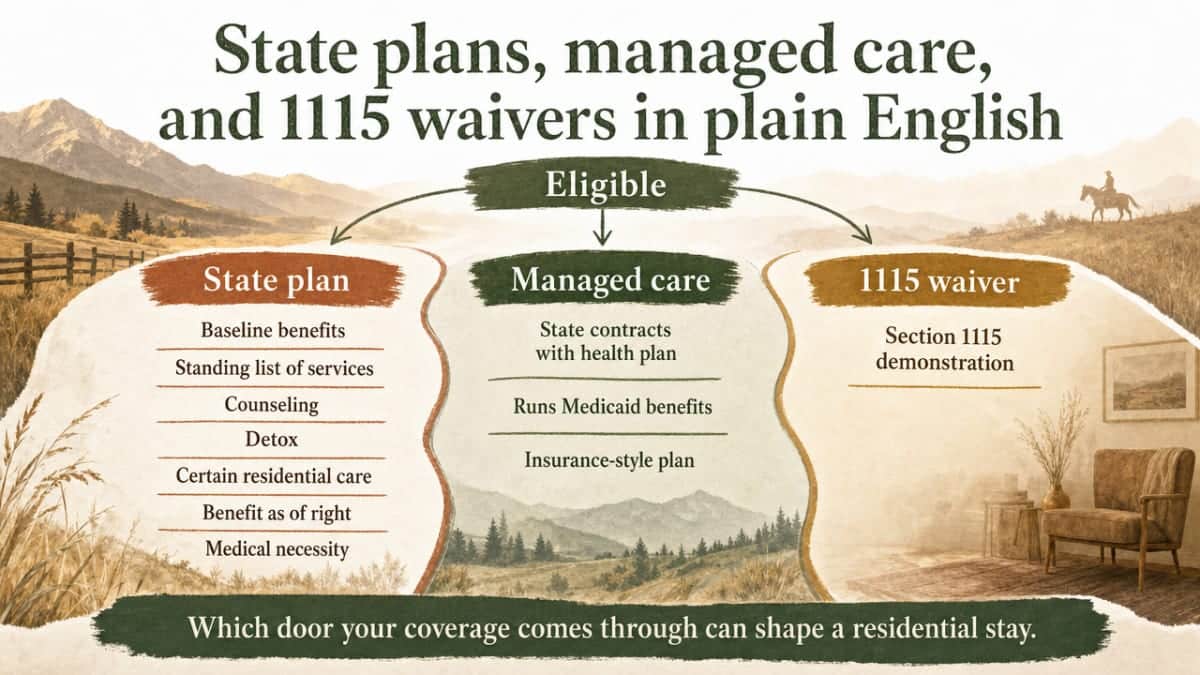
Once you’re eligible, the next question is which door your coverage comes through. CMS notes that states include substance use services in Medicaid through three main pathways: the regular state plan, managed care contracts, and Section 1115 demonstrations. 1 Those names sound bureaucratic, but the differences matter for what a residential stay will look like on your end.
The state plan is your state’s baseline benefit package — the standing list of services Medicaid will pay for, like counseling, detox, and certain residential care. If your state’s plan covers a level of residential treatment, you get that benefit as of right, as long as you meet medical necessity.
A managed care plan is a health plan (think of a familiar insurance-style name) that your state contracts with to run your Medicaid benefits. If you’re in managed care, that plan is who you’ll call for prior authorization, and it’s who decides which residential facilities are in-network. Most Medicaid enrollees today are in some form of managed care.
A Section 1115 waiver is a special federal permission that lets a state try something outside the normal rules — often used to pay for residential SUD treatment in settings that would otherwise be blocked by an old federal rule called the IMD exclusion (more on that in a minute). If your state has an 1115 SUD waiver, more residential options open up.
You don’t need to memorize which door is yours. Just ask, “Am I fee-for-service or in a managed care plan, and what’s the plan name?” That one answer changes who you call next.
Medical necessity and ASAM levels: how a bed gets approved
What ‘medically necessary’ actually means for residential care
“Medically necessary” is the phrase that decides whether Medicaid opens the door to a residential bed or asks you to try something less intensive first. In plain terms, a licensed clinician has to write down why you need 24-hour care right now, and why a weekly counseling visit or day program won’t safely get you through the next stretch.
Clinicians typically document factors such as the frequency and amount of substance use, withdrawal symptoms, previous relapses after outpatient care, co-occurring mental health conditions, and the safety of your home environment for sobriety. If detox is needed, that’s also documented, as residential care can include medication-assisted withdrawal and crisis stabilization alongside therapy. 6
If this feels like a lot, breathe. You don’t have to prove anything on your own. The admissions team at any legitimate treatment center — or a doctor, therapist, or emergency room — can do the assessment with you. Your job is to answer the questions honestly. That’s it. The hardest sentence you’ll say is the first one, and you’ve probably already said it to yourself a hundred times.
How states use ASAM criteria: North Carolina and Arkansas examples
Most states now translate “medically necessary” into a specific level of care using the ASAM criteria — a widely used framework from the American Society of Addiction Medicine that sorts treatment into levels from outpatient (Level 1) up through medically managed inpatient (Level 4). Residential care sits at Level 3, with sub-levels like 3.1 for clinically managed low-intensity residential and 3.5 or 3.7 for higher-intensity settings. The number tells your state’s Medicaid program how much structure and staffing you need.
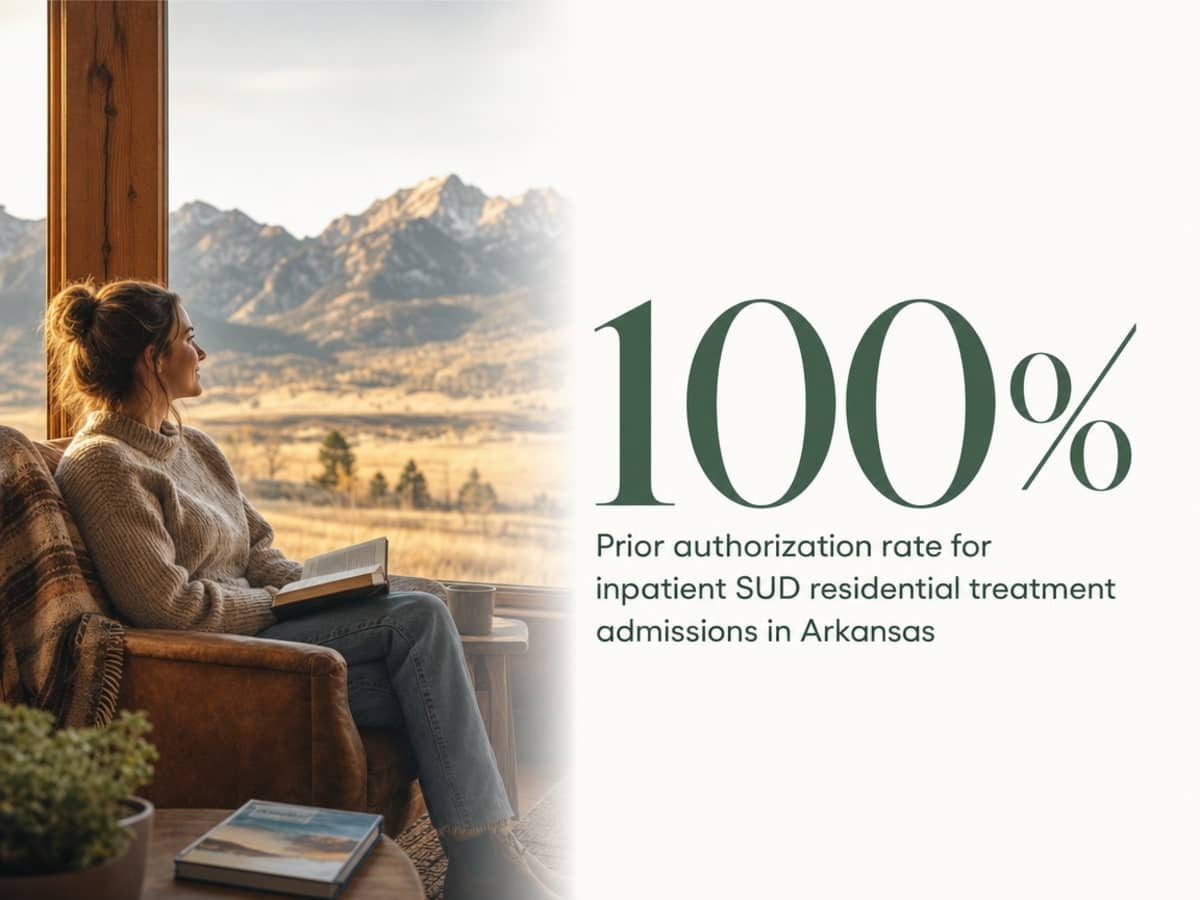
Two real examples show how different states can look on the ground. North Carolina’s Medicaid policy says Medicaid shall cover clinically managed low-intensity residential treatment services when the person meets medical necessity and ASAM Level 3.1 criteria. 13 That’s a clean, direct promise: hit the criteria, you get the benefit. Arkansas takes a different angle. Its state plan says admissions to inpatient substance use disorder residential treatment units follow a 100 percent prior authorization process using ASAM criteria. 14 Every single admission gets reviewed before the stay starts — no exceptions, no “we’ll sort it out later.”
Neither approach is a trap. They’re just different flavors of the same idea: your state wants to see the assessment before it agrees to pay. Practically, that means the admissions team will ask about your using history, your withdrawal risk, your mental health, your living situation, and your past treatment attempts, then match your answers to the ASAM level the state covers. If the paperwork gets sent to the managed care plan the same day, approvals can come through in hours, not weeks.
You can help this move faster. Have your Medicaid ID handy, a list of substances and how much you’ve been using, any medications you take, and the name and number of anyone who has treated you before. If you don’t have all of that, come with what you have. Admissions counselors do this every day. They’re rooting for you.
The room-and-board trap most families don’t see coming
Here’s the part that catches almost everyone off guard, and it has nothing to do with your state or your income. Even when Medicaid agrees you need residential treatment, and even after the prior authorization comes through, Medicaid usually will not pay for the room and board portion of your stay. CMS is direct about it: Medicaid reimbursement is generally not available for room and board in a residential substance use disorder treatment facility. 4 The bed you sleep in, the meals in the dining room, the roof and the laundry — those pieces sit outside what Medicaid covers.
So what does Medicaid pay for inside those same walls? The clinical work. In a 24-hour residential setting, that typically includes individual therapy, group therapy, medication-assisted withdrawal, crisis stabilization, peer support, and case management. 6 That’s the real substance of treatment — the counselor who sits across from you, the group where you finally say the thing you’ve been carrying, the nurse who makes detox safer, the case manager helping you line up housing and a job for after. Medicaid is designed to fund those hours, not the mattress.
What that means in practice depends on the facility. Some residential programs receive Medicaid payment for the clinical services and cover room and board through other sources — state general funds, block grants, sliding-scale fees, charitable dollars, or a Section 1115 waiver in states that have one. Other programs bill you for the room-and-board piece directly, which can feel like a bait-and-switch if no one warned you.
The warm move here is to ask, clearly and early: “Does Medicaid cover my full stay at this program, or will I owe anything for room and board?” A good admissions team will give you a straight answer and, if there’s a gap, walk you through how other patients have closed it. You are not being pushy by asking. You’re being a careful advocate for yourself or the person you love — and that’s the exact energy that carries people through the first week of treatment and every week after.
Parity: why day limits and prior auth can’t be worse than for medical care
There’s a federal rule quietly working in your favor, and it’s worth knowing about before you call anyone. It’s called parity, and the short version is this: your Medicaid plan can’t put stricter limits on addiction treatment than it puts on regular medical care. CMS spells it out directly — treatment limits like inpatient day caps or visit limits can’t be more restrictive for mental health and substance use benefits than for medical or surgical benefits in the same category. 12 Prior authorization rules have to follow the same standard.
Parity divides benefits into four buckets: inpatient, outpatient, prescription drugs, and emergency care. 3 Your residential rehab stay lives in the inpatient bucket, and it gets compared to what your plan does for inpatient medical stays like surgery recovery or a heart procedure. If your plan doesn’t cap medical inpatient days at 14, it can’t quietly cap your rehab at 14 either. If a knee replacement doesn’t need three layers of pre-approval, your detox admission shouldn’t either.
This is why CMS said the final parity rule was designed to guarantee access to mental health and substance use services in the same manner as medical benefits. 7 If a denial letter feels off, or a day limit seems arbitrary, you have the right to ask the plan how the same limit applies to medical care. That question alone can move things.
Why coverage on paper doesn’t always mean a bed tomorrow
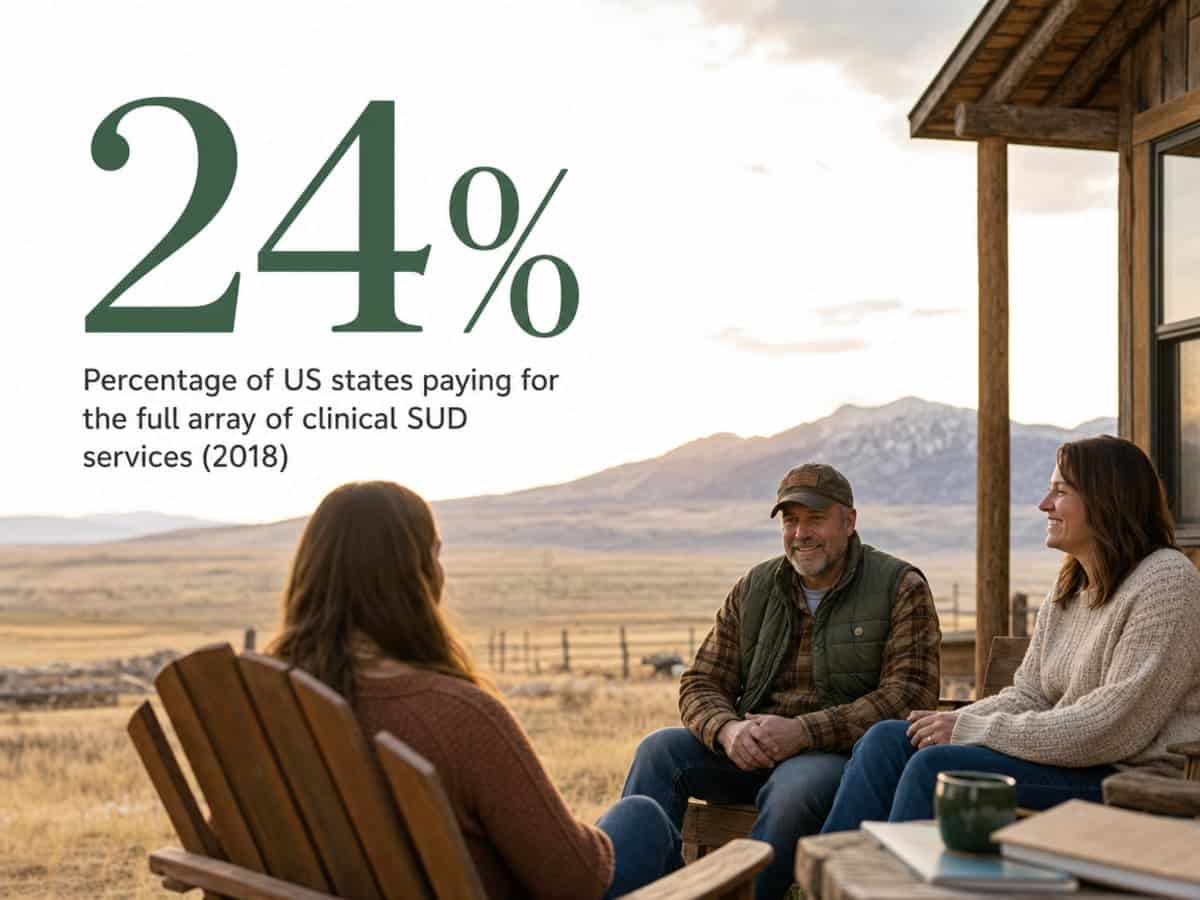
Here’s the honest part nobody prints on the pamphlet. Even in states where Medicaid clearly covers residential treatment, the distance between the benefit on paper and a bed you can walk into this week can feel like a mountain. MACPAC — the federal commission that studies Medicaid — reviewed state coverage back in 2018 and found that only 12 of 50 states were paying for the full array of clinical substance use services, meaning outpatient care at multiple intensities, residential treatment, and medication for addiction all together in one program. 5 That’s fewer than one in four states offering the complete menu. Coverage has expanded in several states since then, but the underlying story hasn’t changed: what your state’s plan promises and what’s actually available near you can be two different things.
The gaps show up in ordinary ways. A residential program might be in your Medicaid network but have a two-week waitlist. Your managed care plan might cover the clinical services but not have a contract with the closest facility. Prior authorization might sail through in one county and stall in another. The program with an open bed might not take your specific plan, and the program that takes your plan might be six hours away.
None of that means you’re stuck. It means the first call rarely gets you the whole answer, and that’s normal. Ask each admissions team three things: do you take my exact Medicaid plan by name, do you have a bed this week, and what’s your prior authorization turnaround? If the answers don’t line up, keep calling. Your state’s Medicaid helpline, your managed care plan’s member services line, and any hospital emergency department can also help place you. Every call is progress, even the ones that end in “not us.”
What a covered residential day actually looks like
If you’ve never been through inpatient treatment, the word “residential” can feel abstract — like a hospital, or a retreat, or something in between. It helps to picture the actual hours, because those hours are what Medicaid is being asked to fund.
A residential day starts early, usually with a check-in from nursing staff, medications if you’re on any, and breakfast with the other people in the house. The building is staffed around the clock — CMS describes residential treatment as staffed 24 hours a day, which is part of why it’s the right level of care when you can’t safely be alone. 6 Morning is often when you sit down one-on-one with your counselor. That’s the individual therapy hour where the real root-cause work happens: what you were using to cope with, what happened before the using started, what you want your life to look like on the other side.
Group therapy fills a big part of the middle of the day. You’ll sit in a circle with people who get it — the shame, the near-misses, the family calls. There’s usually a psychoeducation piece too: how the brain heals, how cravings work, what a relapse warning sign looks like. If you came in needing detox, medication-assisted withdrawal and crisis stabilization are part of your first days, layered right into the schedule. 6 Peer support and case management round out the week, with a case manager helping you line up housing, work, and outpatient care for after discharge. Every one of those pieces — the counselor, the group, the nurse, the case manager — is a Medicaid-covered clinical service when your state plan includes them. The bed and the meals sit outside that line, which is why the earlier room-and-board question matters so much. What you’re paying for, in the truest sense, is the hours in that circle.
When your first-choice program doesn’t take Medicaid
This one deserves an honest paragraph, because it happens all the time. You find a program that feels right — the location, the length of stay, the counselors, the way the family week is set up — and then someone tells you they don’t take Medicaid. That sting is real. Take a beat. It doesn’t have to be the end of the conversation.
Start by asking the program directly what your options are. Many residential centers that don’t bill Medicaid still have ways to help. Ask about a scholarship or grant bed, a sliding-scale rate based on income, a payment plan that spreads costs over months, or a single-case agreement where your Medicaid managed care plan pays an out-of-network facility for one specific admission. Single-case agreements are more common than most families realize, especially when the in-network options have long waitlists or don’t offer the specific level of care you need. Your managed care plan’s member services line is the number to call to ask.
If none of those close the gap, look at the wider map. Your state Medicaid agency keeps a list of in-network residential providers, and your managed care plan can send you a current one by email. A hospital emergency department, a county behavioral health office, or a SAMHSA-style state helpline can also make warm handoffs to programs with open beds. Some in-network programs share the same clinical bones as your first choice: 24-hour staffing, individual and group counseling, medication support during withdrawal, family involvement, and structured aftercare — the pieces CMS describes as the core of covered residential care. 6
Whatever you choose, keep going. The right program is the one that gets you safely into treatment this week, not the perfect one three months from now.
Your next 72 hours: calls to make, papers to gather, words to use
You don’t need a plan for the next month. You need a plan for the next three days. Break it into small, doable moves, and let each finished call be a win worth naming out loud.
Today, make two calls. Call your state Medicaid agency or your managed care plan’s member services number (it’s on the back of your card) and ask three things: Am I active right now? Am I fee-for-service or in a managed care plan, and what’s the plan’s exact name? Does my plan cover residential substance use treatment, and what’s the prior authorization process? Then call one residential program’s admissions line. Say the words: “I need help with alcohol” or “I need help with drugs, and I’m trying to figure out my coverage.” That’s the sentence. You don’t need a script beyond it.
Gather a small stack of papers. Your Medicaid ID card or member number, a photo ID, a list of what you’ve been using and how much over the last week or two, any medications you take, and the name and number of any doctor, therapist, or program that has treated you before. If you don’t have all of it, come with what you have. Admissions counselors build the rest with you.
Know the questions that unlock real answers. Ask every program: Do you take my exact Medicaid plan by name? Will Medicaid cover my full stay, or will I owe anything for room and board? 4 Do you have a bed this week? What’s your prior authorization turnaround? If a program doesn’t take your plan, ask about scholarships, sliding scale, payment plans, or a single-case agreement with your managed care plan. Keep a notebook. Write down who you talked to and what they said.
If the person who needs treatment is someone you love, you can make most of these calls for them with a signed release, or with them on the line for two minutes to give permission. That’s a gift. Nobody in this moment has the bandwidth to hold every phone number, and you already showed up by reading this far. When you’re ready, a place like Rocky Mountain Treatment Center — or whatever program fits your coverage and your life — can walk you through the rest. One call at a time. You’re doing it.
Frequently Asked Questions
Does Medicaid pay for inpatient rehab?
Yes, in most states Medicaid helps pay for inpatient or residential addiction treatment, but the details depend on where you live. CMS notes that states build substance use coverage through their regular state plans, managed care contracts, and Section 1115 waivers. 1 You typically need to be eligible, meet medical necessity, and often get prior authorization first. The clinical services get covered; room and board usually don’t.
Why won’t Medicaid cover my room and board at a residential facility?
It comes down to a long-standing federal rule. CMS says Medicaid reimbursement is generally not available for room and board in a residential substance use disorder treatment facility. 4 Medicaid is designed to pay for the clinical care — therapy, detox, counseling, case management — not the bed or meals. Facilities often close that gap with state funds, grants, sliding-scale fees, or a Section 1115 waiver.
How long of a rehab stay will Medicaid approve?
There’s no single number. Length depends on medical necessity, the ASAM level of care your state covers, and your plan’s rules. Parity helps here: CMS says inpatient day limits can’t be more restrictive for substance use benefits than for medical or surgical care in the same category. 12 Many people start with an initial authorization, then get extensions as their counselor documents ongoing need — sometimes stretching to 30, 60, or 90 days.
What does ‘medically necessary’ mean for getting a bed approved?
It means a licensed clinician writes down why you need 24-hour care right now instead of outpatient. States often match this to ASAM criteria — North Carolina, for example, covers clinically managed low-intensity residential treatment when someone meets ASAM Level 3.1 criteria. 13 The assessment looks at your using history, withdrawal risk, mental health, past treatment attempts, and home environment. You don’t build this case alone — admissions teams do it with you.
What can I do if my preferred rehab doesn’t accept Medicaid?
Don’t hang up yet. Ask the program about scholarship beds, sliding-scale rates, payment plans, or a single-case agreement where your managed care plan pays an out-of-network facility for one specific admission. Call your plan’s member services line to ask directly. Your state Medicaid agency also keeps a current list of in-network residential providers, and many share the same core services — 24-hour staffing, counseling, and medication support during withdrawal. 6
Do I need prior authorization before I can go to inpatient rehab?
In most Medicaid programs, yes. Arkansas is a clear example — its state plan requires 100 percent prior authorization for admissions to inpatient substance use residential treatment units, using ASAM criteria. 14 Other states use similar reviews through managed care plans. The good news: admissions teams do this paperwork every day, and approvals often come through in hours when the assessment is complete. Come with your Medicaid ID and using history ready.
References
- Substance Use Disorders Resources – Medicaid. https://www.medicaid.gov/medicaid/benefits/behavioral-health-services/substance-use-disorders
- Parity for Mental Health and Substance Use Disorder Benefits. https://www.medicaid.gov/medicaid/managed-care/guidance/parity-for-mental-health-and-substance-use-disorder-benefits
- Parity Compliance Toolkit: Applying Mental Health and Substance Use Disorder Parity Requirements to Medicaid and CHIP. https://www.medicaid.gov/medicaid/benefits/downloads/bhs/parity-toolkit.pdf
- Support for Family-Focused Residential Treatment-Title IV-E and Medicaid Guidance. https://www.medicaid.gov/federal-policy-guidance/downloads/cib100520.pdf
- Access to Substance Use Disorder Treatment in Medicaid. https://www.macpac.gov/publication/access-to-substance-use-disorder-treatment-in-medicaid/
- Coverage of Behavioral Health Services for Youth with Substance Use Disorders. https://www.medicaid.gov/federal-policy-guidance/downloads/cib-01-26-2015.pdf
- CMS finalizes mental health and substance use disorder parity rule for Medicaid and CHIP. https://www.cms.gov/newsroom/press-releases/cms-finalizes-mental-health-and-substance-use-disorder-parity-rule-medicaid-and-chip
- Parity – Medicaid. https://www.medicaid.gov/medicaid/benefits/behavioral-health-services/parity
- Requirements Related to the Mental Health Parity and Addiction Equity Act. https://www.cms.gov/files/document/mhpaea-final-rule-omnibus-clean-9424-final-posting508.pdf
- Medicaid and CHIP Managed Care Monitoring and Oversight Tools. https://www.hhs.gov/guidance/document/medicaid-and-chip-managed-care-monitoring-and-oversight-tools-including-states
- Departments of Labor, Health and Human Services, and Treasury Issue Final Rules Strengthening Access to Mental Health and Substance Use Disorder Benefits. https://www.cms.gov/newsroom/press-releases/departments-labor-health-and-human-services-treasury-issue-final-rules-strengthening-access-mental
- cmcs-mental-health-parity-092023.pdf. https://www.medicaid.gov/sites/default/files/2023-09/cmcs-mental-health-parity-092023.pdf
- 8D-3 Residential Treatment Services Amended Date: January 1, 2026. https://medicaid.ncdhhs.gov/media/15770/download?attachment
- Table of Contents. https://www.medicaid.gov/medicaid/spa/downloads/AR-26-0013.pdf
- Table of Contents. https://www.medicaid.gov/medicaid/spa/downloads/CO-20-0001.pdf