Key Takeaways
- Traditional counseling remains the evidence-backed foundation of alcohol recovery, while equine work functions as a complement that helps people engage more fully, not a replacement 1.
- A 2022 systematic review found the evidence for equine-assisted services in substance use disorders is not yet strong enough to support broad implementation as a standalone intervention 12.
- Time with horses can regulate the nervous system and lower defenses, making it easier to walk into counseling ready to do the harder work 8.
- People whose drinking is tangled with trauma may benefit most from the pairing, with six of eight studies in a veterans PTSD review supporting symptom mitigation 10.
- When comparing programs, ask about counseling hours, specific approaches used, staff credentials, and aftercare structure—if horses lead the pitch and counseling feels secondary, keep looking.
The Honest Answer Before You Read Further
If a horse in a Montana pasture sounds like the last thing that could help you stop drinking, you’re not alone. Plenty of people arrive at Rocky Mountain Treatment Center thinking the equine work will be the throwaway part of their day—the nice activity between the real appointments.
Here’s the honest answer, and we want to give it to you before you read another word: traditional talk therapy is the foundation of alcohol recovery. Individual counseling, group therapy, and family work are still the most common and best-supported treatments for substance use disorders 1. Time with horses is a meaningful addition to that work, not a replacement for it.
That matters because it protects you from two mistakes. The first is dismissing equine therapy as a gimmick and missing something that helps many people finally open up. The second is hoping horses can carry the weight that only counseling can carry—and being let down when they can’t.
At RMTC in Great Falls, both modalities live inside the same 30, 60, or 90-day residential stay. Counseling does the heavy lifting on the beliefs and behaviors that keep you drinking. The horses help you show up for that work with your guard down. The staff, more than 80% of whom are in recovery themselves, know how to hold both.
The rest of this article shows you exactly how that pairing works, what the research actually says, and how to choose with your eyes open.
Why Counseling Is Still the Foundation of Alcohol Recovery
When you strip alcohol treatment down to what has been studied the longest and works most reliably, you land on people talking to people. The National Institute on Drug Abuse is direct about it: individual, group, and family counseling or psychotherapy are the most common treatments for substance use disorders 1. That’s not marketing copy from a rehab brochure. That’s the federal research agency describing what actually helps people stop using.
You may be wondering what “counseling” really means once you’re in a residential setting. It’s not a couch and a notepad for 45 minutes a week. It’s a stack of approaches that have been tested for decades:
- Cognitive behavioral therapy to help you spot the thoughts that lead back to a drink
- Motivational enhancement to work with the part of you that still isn’t sure you want to quit
- Family therapy to repair what alcohol frayed
- 12-step facilitation to plug you into a community that will still be there in year three 2
These are the tools that help you stay in treatment longer and handle the triggers that used to end sobriety early 2.
There’s a reason SAMHSA publishes entire competency frameworks for the counselors who do this work 4, 5. Good counseling is a skill, not a chat. It meets you where you are, whether you walked in ready to change or ready to argue 6. Group therapy adds a second layer, giving you a room of people who see through the excuses because they’ve used the same ones 7. At Rocky Mountain Treatment Center, that group room is small on purpose—26 beds total in Great Falls—and more than 80% of the staff have lived through their own recovery. When your counselor says they get it, they mean it in a way that changes how the conversation lands.
So before we talk about horses, know this: the counseling schedule at any legitimate program is where the real change is engineered. Everything else, including time in the pasture, is built on top of that spine.
What Time With Horses Actually Does (and Doesn’t Do)
Let’s get specific about what happens when you walk out to the barn. You’re not trotting in circles or learning dressage. Most of the work is on the ground—brushing, leading, groundwork exercises, sometimes just standing next to a thousand-pound animal and paying attention to your own breathing. Some programs, including RMTC, incorporate mounted work when it fits the client, and the research on mounted sessions specifically points to benefits in emotional regulation and social functioning across a range of populations 14.
Here is what horses seem to do well, based on what researchers have been able to measure so far. They give you something to focus on outside your own head. They react honestly—if you’re wound tight, the horse notices before your counselor does. That immediate feedback loop is part of why a 2023 review of possible mechanisms found considerable preliminary evidence of decreased psychiatric symptoms after equine-assisted work, even as the authors were clear that rigorous studies are still lacking 8. A 2025 systematic review of equine-assisted interactions for PTSD, anxiety, and mood disorders reached a similar mixed conclusion: every quantitative study included reported at least one positive effect, but well-designed controlled trials were sparse 11.
What that means for you, in plain language: showing up to the barn may lower the volume on anxiety, help you sit with feelings you usually drink to escape, and make you more willing to walk into your next counseling session with something real to talk about. Those are not small things when you’ve spent years numbing everything.
Here’s what time with horses does not do:
- It does not teach you to identify the thought pattern that leads from a hard Tuesday to a bottle.
- It does not rebuild trust with a spouse.
- It does not walk you through the fourth step or teach you how to sit in a group and say the thing you’ve never said out loud.
Those are jobs for counseling, and no amount of pasture time replaces them.
The staff at RMTC—more than 80% of whom are in recovery—tend to describe the horses the same way: the barn is where you drop your armor, and the counseling room is where you do something with what’s underneath. Both matter. Neither is optional if you want the full benefit of a residential stay.
Reading the Research Without Getting Spun
You deserve a straight look at the studies, not a curated highlight reel. So here’s what the research actually says about equine work in alcohol and drug treatment, without the marketing gloss.
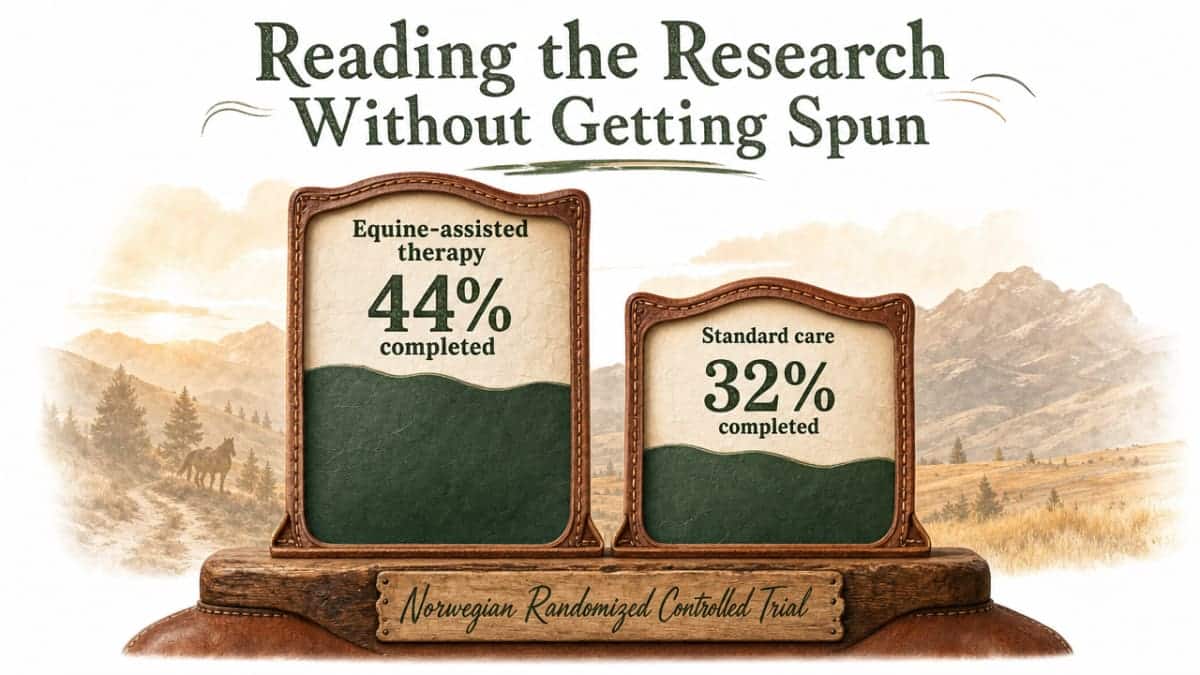
The single most important paper for you to know about is a 2022 systematic review of equine-assisted services for people with substance use disorders. It pulled together the randomized and observational studies that exist and reached a careful conclusion: the quantitative data are not enough to say equine work reliably improves the recovery process, and the authors specifically warned against broad implementation until stronger evidence is in 12. That’s a review of the field saying, in effect, promising but not proven.
The most rigorous single trial inside that review comes from Norway. Researchers ran a randomized controlled trial comparing residential SUD treatment plus complementary horse-assisted therapy against the same residential treatment on its own. More people in the horse group completed treatment—44 percent versus 32 percent—but the difference wasn’t statistically significant, meaning the researchers couldn’t rule out chance as the explanation 13. Overall outcomes between the two groups didn’t differ in a meaningful way 13.
Zoom out beyond alcohol and drug treatment, and the picture holds. A 2023 review of possible mechanisms found considerable preliminary evidence that equine-assisted work lowers psychiatric symptoms across mental health populations, while the same authors flagged that rigorous studies are still lacking 8. A 2025 systematic review of equine-assisted interactions for PTSD, anxiety, and mood disorders reported that every quantitative study included showed at least one positive effect, and in the next breath noted that well-designed controlled trials are sparse 11.
So here is what an honest reading looks like:
- The evidence for equine work as a standalone treatment for alcohol dependence is not strong.
- The evidence for equine work as a complement to counseling in residential care is encouraging, mixed, and still being built.
- The evidence for counseling itself—individual, group, family, motivational, 12-step facilitation—has decades behind it 1, 2.
What that means for your decision is simple. Choose a program because its counseling is serious, its staff know what they’re doing, and its structure gives you real support day after day. Treat the horses as a bonus that helps some people show up more fully to the work that carries the weight. Rocky Mountain Treatment Center is built on that order of priorities, not the reverse, and if a program you’re considering flips those—leading with the horses and treating counseling as an afterthought—that’s worth noticing before you sign anything.
How the Two Modalities Reinforce Each Other in Residential Care
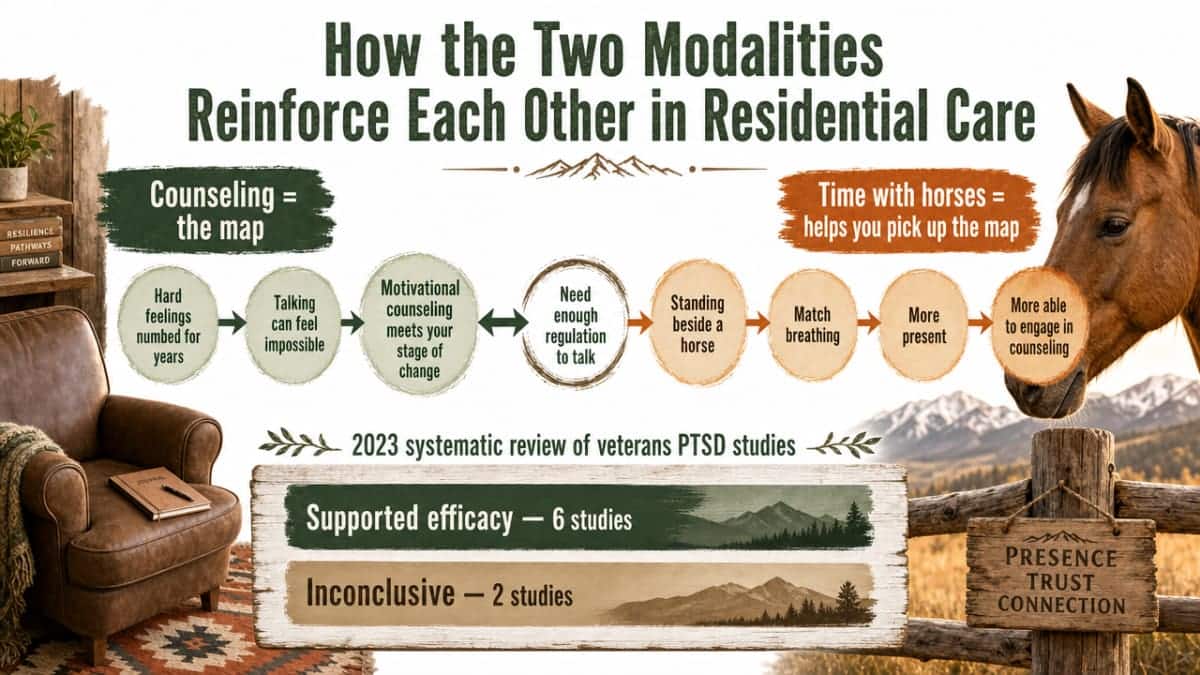
The best way to picture it: counseling gives you the map, and time with horses helps you actually pick up the map instead of throwing it across the room. That’s the pairing worth understanding before you commit to a program.
Start with a familiar problem. If you’ve drunk to numb hard feelings for years, walking into a counseling room and being asked to describe those feelings can feel impossible. Your nervous system is not used to being present. It’s used to being turned down. Motivational counseling accounts for this by meeting you at whatever stage of change you’re actually in, not the one your family wishes you were in 6. But there’s still a threshold problem: you have to be regulated enough to talk in the first place.
This is where the barn earns its keep. Standing next to a horse and matching your breathing to its slower rhythm, or spending twenty minutes brushing a coat without your phone or your usual internal monologue, can lower the noise in your body enough that the next counseling session doesn’t feel like an ambush. A 2023 review of possible mechanisms across mental health populations found preliminary evidence that equine-assisted work decreases psychiatric symptoms, likely through this kind of physiological down-regulation, even as the authors noted the research base is still being built 8.
The reinforcement runs the other direction too. Something almost always comes up in the arena—frustration when a horse won’t move, grief when the animal leans into you, embarrassment when you notice you’re holding your breath. Those moments are raw material. They travel with you into your next individual session or group meeting, where a counselor trained in the SAMHSA competency framework knows how to help you turn that raw material into insight and, eventually, changed behavior 5.
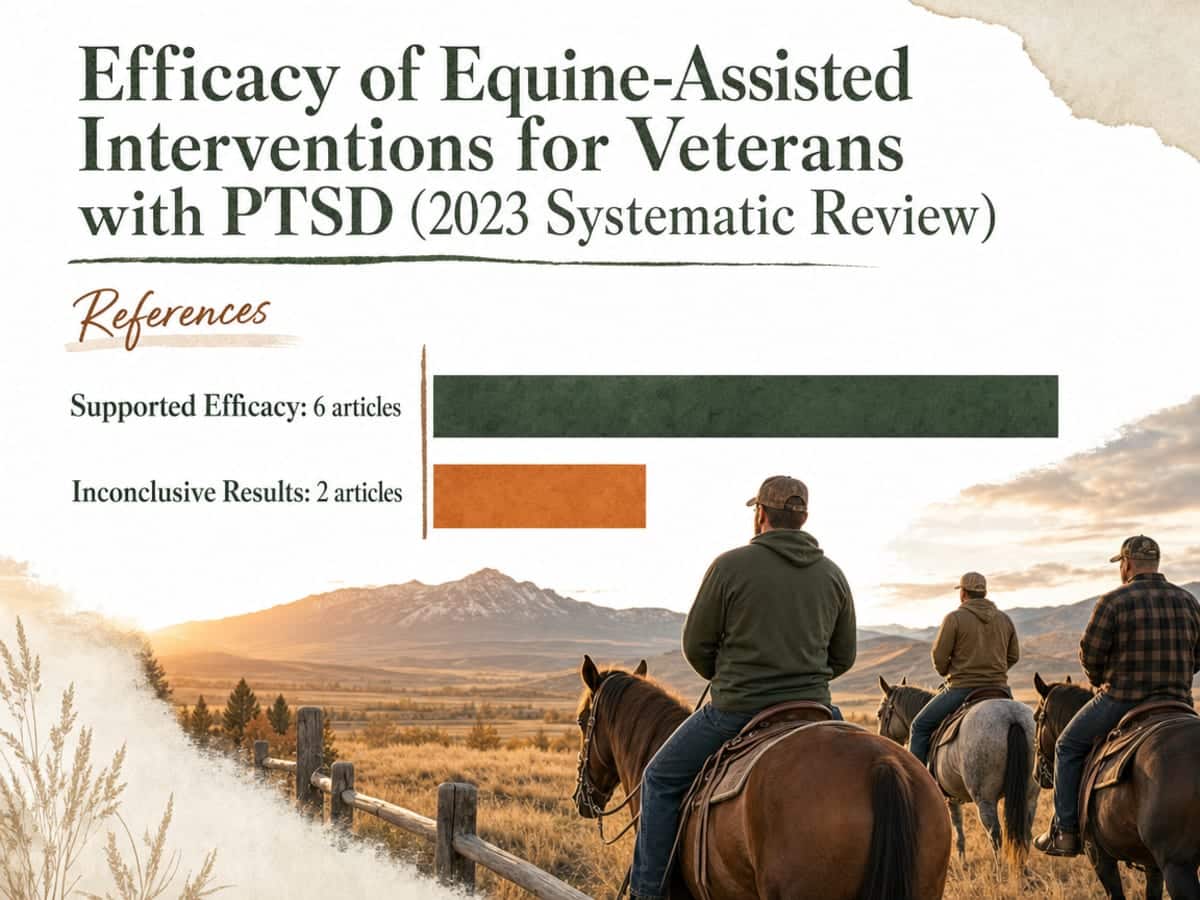
The signal is strongest for people whose drinking is tangled up with trauma. A 2023 systematic review of equine-assisted interventions for veterans with PTSD looked at eight studies and found six supported efficacy for symptom mitigation, while two were inconclusive 10. That’s not a slam dunk, and the authors were careful about it, but it is a real pattern worth naming for readers who came to alcohol because something happened first.
Inside a Rocky Mountain Treatment Center day, this pairing is built into the schedule, not bolted on. You’ll do individual counseling and group work with staff who are more than 80% in recovery themselves. You’ll spend time with horses. You’ll sit in a 12-step meeting and eat dinner with the same 25 or so people you’re moving through the week with. The counseling is the spine. The equine work is one of the reasons your spine stays upright long enough for the counseling to do what it does.
A Week Inside Rocky Mountain Treatment Center
To make the pairing concrete, here’s what a typical week looks like once you’re settled in Great Falls. The rhythm is intentional, not decorative. Each piece has a job.
Your mornings tend to start with a check-in group and then move into individual counseling or a structured group session. If you’re early in your stay, you may still be finishing medically monitored detox, and the day is lighter on purpose. Once you’re past that, group therapy shows up almost daily—sometimes process work, sometimes psychoeducation, sometimes 12-step facilitation. This is the scaffolding SAMHSA describes when it publishes an entire treatment guide on group work as a core modality in substance use care 7. In a 26-bed facility, the group is small enough that you can’t hide in the back row for a month.
Individual counseling is woven through the week. That’s the room where CBT, motivational work, and the harder personal conversations happen 2, 6. Because more than 80% of the staff at RMTC are in recovery themselves, the counselor across from you has walked a version of the road you’re on. It changes the tenor of the sessions in a way you feel by day three.
Equine sessions land a few times a week, not every day. You’ll head out to the horses with a small group and a facilitator. Some days it’s grooming and groundwork. Some days it’s a specific exercise designed to bring up something you can take back into counseling. Afterward, someone usually notices you’re quieter at dinner in a good way.
The rest of the week fills in around that spine: 12-step meetings, family programming (including a three-day Family Week if your people can come), recreation like hiking or the gym, meals with the same 20-some people you’re moving through this with, and quiet time. Nights are for rest, not late-hour scrolling.
By the last week of a 30-day stay, the aftercare piece takes shape. Case management maps out weekly Zoom groups and check-ins at 30, 60, 90, 180, and 365 days after discharge, so the community you built here doesn’t evaporate the day you drive home. That continuity is the part most families don’t see when they picture rehab, and it’s the part that often decides whether the work sticks.
How to Choose: Questions Worth Asking Any Program
By the time you’re comparing programs, the brochures start blurring together. Everyone has smiling staff, mountain views, and a list of therapies that sounds thorough. Here’s how to cut through that and figure out what a program is actually built on.
Ask how many hours a week you’ll spend in individual counseling, and who your counselor will be. If the answer is vague, or if individual sessions happen only once a week, the counseling foundation is thinner than it should be. NIDA is clear that individual, group, and family counseling are the most common and best-supported treatments for substance use disorders 1, so those hours should be the backbone of your schedule, not a side dish.
Ask what kind of counseling they actually practice. You want to hear specific approaches named: cognitive behavioral therapy, motivational work, family therapy, 12-step facilitation 2. If a program can’t tell you what happens inside a session, that’s your answer.
Ask about credentials. SAMHSA publishes competency frameworks for a reason 4, 5. The people running your groups and one-on-ones should be trained to those standards, and it’s fair to ask.
Ask how equine therapy is positioned. If a program leads with the horses and treats counseling as background noise, be careful. The 2022 systematic review of equine-assisted services for substance use disorders found the evidence isn’t strong enough to support broad implementation as a standalone or headline intervention 12. Equine work belongs in the mix, not at the front of it.
Ask about the group size and staff make-up. A 26-bed facility feels different from a 200-bed one, and a team where more than 80% of staff are in recovery themselves brings something you can’t fake.
Ask what happens after you leave. Continuing care matters more than most families realize. Weekly Zoom groups and check-ins at 30, 60, 90, 180, and 365 days after discharge—the kind of structure Rocky Mountain Treatment Center builds in—are the difference between a good month and a life that holds.
If You’re the Family Member Reading This
You may be the one doing the research because the person you love can’t yet. That’s an act of love, and it’s also exhausting. A few things worth holding onto before you make a call.
Your skepticism about equine therapy is healthy. So is your hope. Both can be true at once. What matters is that whatever program you choose treats counseling as the engine of recovery 1 and equine work as one of the ways your person learns to sit still long enough to let that counseling reach them.
Ask about family involvement directly. Rocky Mountain Treatment Center runs a three-day Family Week for a reason—your own understanding, your own boundaries, and your own healing shape what happens when your person comes home. Family therapy is named by NIDA as one of the most common and effective parts of substance use treatment 1, not a courtesy add-on.
You don’t have to have this figured out today. Call, ask hard questions, and trust what you hear when the person on the other end of the line has been through recovery themselves.
Frequently Asked Questions
Can equine therapy replace talk therapy for alcohol addiction?
No, and any program telling you otherwise is overselling it. NIDA names individual, group, and family counseling as the most common treatments for substance use disorders for a reason 1. Time with horses can lower your defenses and help you engage more fully, but it does not do the work of a trained counselor helping you change the thinking and behavior that keep you drinking.
Is equine therapy backed by real research or is it just a nice activity?
The honest answer is both, sort of. A 2022 systematic review of equine-assisted services for substance use disorders found the data are not yet strong enough to support broad implementation as a standalone intervention 12. Reviews across mental health populations report promising signals for lower psychiatric symptoms, while noting rigorous trials are still sparse 8, 11. It is a real practice with real promise and real gaps.
What actually happens during an equine therapy session? Do I have to ride the horse?
Most sessions happen on the ground. You’ll groom, lead, do simple exercises, and pay attention to how the horse responds to you. Some programs add mounted work when it fits, and research on mounted sessions points to gains in emotional regulation and social functioning 14. At Rocky Mountain Treatment Center, no one is forced onto a horse. The point is presence and awareness, not horsemanship.
Who tends to benefit most from adding equine work to counseling?
People whose drinking is tied to trauma, anxiety, or years of numbing their feelings often respond well. A 2023 systematic review of equine-assisted interventions for veterans with PTSD found six of eight studies supported efficacy for symptom mitigation, with two inconclusive 10. If you have trouble sitting with hard feelings long enough to talk about them, the barn can help you get regulated enough to walk into counseling ready.
How does Rocky Mountain Treatment Center combine horses and counseling in one program?
Counseling is the spine of your 30, 60, or 90-day stay in Great Falls: individual sessions, daily groups, family therapy, and 12-step work, delivered by a staff more than 80% of whom are in recovery themselves 2, 7. Equine sessions happen a few times a week and feed directly into the counseling room. What comes up with the horses becomes material you work through with your counselor.
What should I ask a program before choosing equine therapy as part of treatment?
Ask how many hours a week you’ll get in individual counseling and which specific approaches they use—CBT, motivational work, family therapy, 12-step facilitation 2, 6. Ask about counselor credentials against SAMHSA competency standards 5. Ask how equine sessions connect back to your counseling plan. If a program leads with horses and treats counseling as a side dish, keep looking.
References
- Treatment | National Institute on Drug Abuse (NIDA). https://nida.nih.gov/research-topics/treatment
- Treatment and Recovery | National Institute on Drug Abuse – NIH. https://nida.nih.gov/publications/drugs-brains-behavior-science-addiction/treatment-recovery
- Principles of Drug Addiction Treatment. https://nida.nih.gov/sites/default/files/podat_1.pdf
- TAP 21: Addiction Counseling Competencies. https://library.samhsa.gov/product/tap-21-addiction-counseling-competencies/sma15-4171
- The Substance Use Disorder Counseling Competency Framework. https://library.samhsa.gov/sites/default/files/pep20-02-01-017.pdf
- SAMHSA TIP 35: Enhancing Motivation for Change in Substance Use Disorder Treatment. https://library.samhsa.gov/sites/default/files/tip-35-pep19-02-01-003.pdf
- TIP 41: Substance Abuse Treatment: Group Therapy. https://library.samhsa.gov/product/tip-41-substance-abuse-treatment-group-therapy/sma15-3991
- Potential Mechanisms of Action and Outcomes of Equine-Assisted Services for Populations with Mental Health Conditions. https://pmc.ncbi.nlm.nih.gov/articles/PMC10379349/
- Equine-Assisted Activities and Therapies for Veterans With Posttraumatic Stress Disorder: A Systematic Review. https://pmc.ncbi.nlm.nih.gov/articles/PMC7890715/
- Equine-assisted interventions for veterans with posttraumatic stress disorder: a systematic review. https://pmc.ncbi.nlm.nih.gov/articles/PMC10654975/
- Are Equine Assisted Interactions (EAI) a Dark Horse Bet? A systematic review on measuring the psychological and physiological effects of EAI on PTSD, anxiety and/or mood disorders. https://pmc.ncbi.nlm.nih.gov/articles/PMC12410245/
- Equine-assisted services for individuals with substance use disorders: A systematic review. https://pmc.ncbi.nlm.nih.gov/articles/PMC9749232/
- Complementary horse-assisted therapy for substance use disorders: A randomized controlled trial. https://pmc.ncbi.nlm.nih.gov/articles/PMC7001193/
- Mental health benefits of mounted equine-assisted therapies: A scoping review. https://pubmed.ncbi.nlm.nih.gov/35811394/
- Equine-Assisted Services for Children with Attention-Deficit/Hyperactivity Disorder: A Systematic Review. https://pubmed.ncbi.nlm.nih.gov/33835856/
- The effect of equine-assisted therapies on behavioural, psychological and physical symptoms for children with attention deficit/hyperactivity disorder: A systematic review. https://pubmed.ncbi.nlm.nih.gov/32379642/