Key Takeaways
- Equine therapy happens almost entirely on the ground — observing, haltering, leading, and grooming — followed by reflection with a counselor, not riding or performance tasks.18
- Horses read body language instantly, bypassing the verbal defenses people bring to talk therapy and forcing the kind of present-moment honesty that early sobriety requires.12,18
- The work rebuilds three specific muscles alcohol erodes: emotion regulation, self-efficacy, and self-esteem — all measured with significant gains in a 2023 randomized trial.20
- Evidence is promising but not settled; horses function as a complement to detox, counseling, 12-step, and aftercare rather than a standalone cure.17,18,19
The First Time You Walk Into the Barn
You smell it before you see it. That warm, dusty mix of hay, leather, and horse — a smell that somehow tells your nervous system to slow down, even when the rest of you is not ready to. Your boots crunch on the gravel. Somewhere down the aisle, a horse shifts its weight, and a hoof knocks softly against wood. If you have been drinking heavily for years, this moment is equine therapy for addiction recovery explained: the quietest your head has been in a long time.Nobody hands you a worksheet. Nobody asks you to talk about your feelings. A counselor walks with you toward the round pen, points to a horse standing at the far rail, and says something simple like, “That’s Buck. Go say hi.”
And here is the part most articles skip: you will probably feel silly. Maybe nervous. Maybe a little annoyed that this is what your treatment day looks like when you came here to get sober. That reaction is normal. If you have never been around a 1,200-pound animal, a small voice in your chest saying I don’t know what I’m doing is actually the point. That voice is the same one that gets drowned out when you drink. Out here, sober, standing on wood shavings, it finally gets to speak.
At Rocky Mountain Treatment Center in Great Falls, equine work is not a spa amenity or a photo op. It sits inside the same 30, 60, or 90-day residential program as your detox, your counseling, your 12-step meetings, and your family week. The horses are part of the landscape here — Montana ranch country, big sky, cold mornings. They are also, quietly, part of how people learn to feel things again without a drink in their hand.18
So take a breath. Nobody is going to ask you to ride anything today. Let’s walk you through what actually happens next.
What Actually Happens in a Session (No Riding Required)
Let’s clear something up right away: most of what happens in equine therapy takes place with both of your feet on the ground. There’s no saddle waiting for you. No trotting circles. No one is going to ask you to canter across an arena on day three of your treatment. The overwhelming majority of the work happens through what horse people call groundwork — the quiet, deliberate business of standing near a horse, walking with it, brushing it, leading it, and paying attention to what happens between the two of you.18
A typical session usually moves through four phases, and none of them will feel like a therapy session in the way you might picture one.
-
You arrive and settle in. The counselor walks you to the barn or the arena. There is usually a minute or two of just breathing — noticing the temperature, the smells, the sounds of horses moving in their stalls. If you came in from detox that morning shaky and full of noise, this is when your shoulders start to drop. That’s not accidental. Slowing down the body is the first task.
-
You observe. Before you touch a horse, you watch one. The counselor might point out how the horse is standing, where its ears are pointed, whether it is chewing or holding its breath. You start to see that this animal is reading the whole scene — including you — in a language you did not know existed. Some people find this fascinating. Some find it unsettling. Both are useful.
-
You do a task together. This is the heart of the session. It might be putting a halter on the horse, leading it in a figure eight, asking it to stop at a certain spot, or grooming a section of its coat. The task itself is not the point. The point is what you notice about yourself while trying to do it — where you get frustrated, where you rush, where you soften, where the horse mirrors back that something in you shifted.
-
You reflect with your counselor. After the work, you sit down — sometimes on a hay bale, sometimes back inside — and talk through what happened. Not in a clinical way. More like: What did you feel when he wouldn’t move? What did you do with that feeling? This is where the connection to your drinking, your relationships, your patterns quietly gets made.
That’s the whole shape of it. No mysticism, no gimmicks. A 2022 systematic review of equine-assisted services for people with substance use disorders describes this same basic structure — grounded, groundwork-based, and paired with reflection — as the format used across residential programs. It’s simple on paper. It just happens to work in a place most words can’t reach.18
Why a 1,200-Pound Animal Can Reach You When Talk Therapy Can’t
Here is the strange, useful truth about horses: they cannot be lied to. Not because they are magical, but because they are prey animals. Their entire nervous system is built to read the room. A horse notices the tension in your shoulders before you do. It clocks the shallow breath you are holding, the jaw you are clenching, the fear you have been carrying around like a second coat all morning. And it responds — by moving away, by refusing to walk with you, by planting its feet and looking somewhere else.
That feedback is instant. And it is honest in a way that a conversation almost never is.
If you have spent years in and out of therapy, you probably know how to talk about your drinking. You have the vocabulary. You can describe the trigger, name the feeling, use the right words in the right order. Meanwhile, the part of you that actually reaches for the bottle at 3 p.m. never comes to the appointment. It stays hidden, because words are easy to arrange around it.
A horse skips all of that. It does not care what you say. It cares what your body is doing. And when you walk into a round pen wound tight with shame or anger or the ache of a craving, the horse shows you — plainly, without a single sentence — that something in you is not okay. That mirror is what makes the work land. Researchers who reviewed animal-assisted therapy across mental health settings describe it as a tool that improves emotional regulation and strengthens the trust between patient and treatment, partly because the interaction bypasses the verbal defenses people bring into therapy rooms.12
There is also the sheer size of the animal to consider. Standing next to something that weighs 1,200 pounds forces a kind of presence that a couch does not. You cannot scroll away. You cannot rehearse an answer. You have to actually be there, in your body, right now. For someone whose brain has spent years trying to be anywhere but here, that is not a small thing. A 2022 systematic review of equine-assisted services for substance use disorders describes this presence-based, relational quality as central to why participants report feeling more connected, more grounded, and more engaged in the rest of their treatment.18
You do not have to believe any of this on faith. You just have to walk into the pen and let the horse do what it already knows how to do. At Rocky Mountain, that first honest exchange — the one where a horse quietly calls your bluff — is often where a lot of people stop performing recovery and actually start doing it.
The Three Things Horses Help You Rebuild
If you strip equine work down to what it is actually doing inside your recovery, three things keep showing up in the research and in the barn. None of them are riding tricks. All three are quiet, internal skills that alcohol has probably been chipping away at for years — the ability to sit with a hard feeling, the belief that you can actually pull something off, and the sense that you are worth being around when nobody is drinking with you.
A 2023 randomized controlled trial out of Egypt is the clearest snapshot of this. Researchers took 100 patients with substance use disorders and split them into two groups. One received standard care alone. The other received standard care plus weekly equine-assisted therapy for six weeks. At the end, the equine group showed significant improvements in all three of the areas below — emotion regulation, general self-efficacy, and self-esteem — compared with the control group. That is not a cure. It is not a promise. But it does map cleanly onto the three internal muscles that most people in early alcohol recovery are working to rebuild.20
Here is what each of those looks like on an ordinary Tuesday in the pen.
Emotion Regulation: Feeling Hard Feelings Without Numbing Them
Emotion regulation is a clinical term for something simple: staying in your own body when a feeling gets big, instead of reaching for something to make it smaller. For years, that something has been alcohol. Researchers describe impaired emotion regulation as a core feature of substance use disorders — not a side effect, but a piece of the engine.16
Horses give you a live rehearsal for the other option. When you walk into the pen carrying yesterday’s argument, the horse feels it and moves off. You get frustrated. You want to walk out. You want a drink. Instead, you breathe. You drop your shoulders. You try again. The horse turns an ear toward you. Something shifts. You just felt a hard feeling all the way through without numbing it, maybe for the first time in a long time. That is the muscle you are building — small rep after small rep.20
Self-Efficacy: The Quiet Return of ‘I Can Do This’
Self-efficacy is the belief that you can actually do the thing in front of you. Alcohol dependence tends to hollow that belief out. You have told yourself you would stop, or slow down, or handle a hard week without a drink, and you have watched yourself fail at it. After enough rounds of that, the voice that says I can do this gets very quiet.
The research is direct on why that matters: higher self-efficacy during treatment predicts better retention and lower relapse risk after discharge. The Egyptian RCT that measured general self-efficacy in 100 patients getting weekly equine sessions found significant gains in that exact measure. The first time you get a 1,200-pound animal to follow you across the pen because you asked clearly and stayed steady, something inside you registers it: I did that. It is a small proof. Recovery is built out of a lot of small proofs.15,20
Self-Esteem: Being Seen Without Judgment
Self-esteem is the hardest of the three to talk about, because most people in early recovery have very little of it left. Shame has a way of stacking. The missed birthdays, the lies, the mornings you cannot remember, the person your family has been quietly grieving while you were still in the room. You walk into treatment convinced there is something fundamentally wrong with you.
A horse does not know any of that. It does not read your chart, ask about your worst night, or flinch when you cry. It just meets you where you are standing. That kind of contact — presence without judgment — is part of why the same 2023 trial found significant gains in perceived self-esteem alongside the other two measures. At Rocky Mountain, this is often where people first practice being seen sober. The horse does not fix your worth. It just refuses to argue about it.20
Does It Actually Help People Stay Sober? An Honest Look at the Evidence
Here is where a lot of treatment center websites start to oversell. You will see phrases like proven and life-changing and breakthrough. We are going to tell you something different, because you deserve the actual picture.
Equine therapy for substance use disorders is promising. It is not proven the way, say, medically monitored detox is proven. The evidence is real, it is growing, and it points in a good direction — but it is not settled, and any place that tells you otherwise is selling you something. A 2022 systematic review pulled together the quantitative and qualitative studies on equine-assisted services for people with substance use disorders and landed on this exact conclusion: there are signals of positive effects on treatment retention, completion, and mental health, but sample sizes are small and methods vary, so overall effectiveness remains inconclusive. That is the most honest sentence in the field right now.18
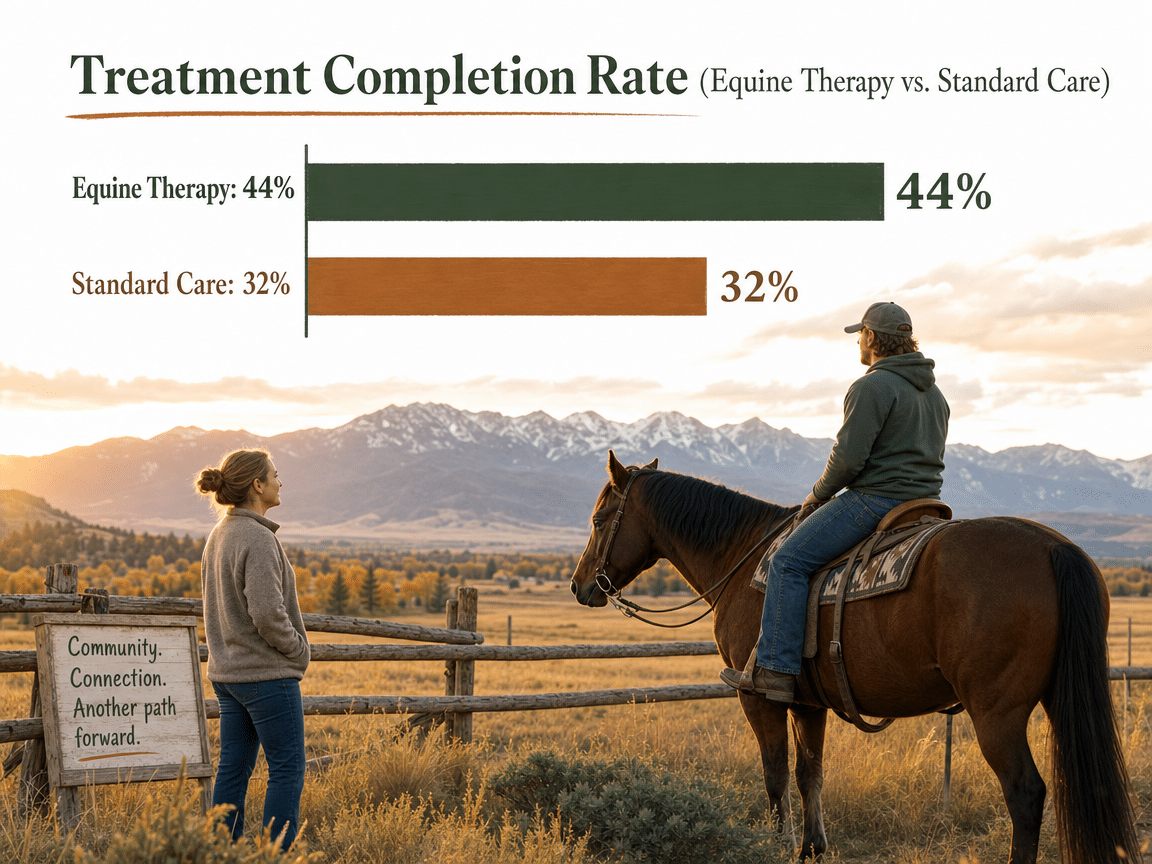
The most talked-about number in this research comes from a 2020 randomized controlled trial run inside a residential SUD program. Patients were split into two groups — one received treatment as usual, the other received treatment as usual plus complementary horse-assisted therapy. In that trial, 44% of the horse-assisted group completed their program compared with 32% of the standard-care group. That is a twelve-point gap, and it points the right way. But here is the caveat that matters: the final sample was only 37 people, and the difference did not reach statistical significance. In plain language: the horses looked like they helped, but the study was too small to say so with confidence.19
The same research team pointed to earlier cohort data that looked even stronger. In that earlier work, 56.9% of horse-assisted therapy participants completed treatment versus 14% of the treatment-as-usual group, an odds ratio of 8.4 — meaning participants who worked with horses had about eight times the odds of finishing their program. That is a big signal. It is also the kind of signal that needs a larger randomized trial to confirm, which the field still does not have.19
So what do you actually do with all of that if you are the person deciding whether to enter a program that includes equine work?
The horses are not doing the sobriety work by themselves. Your detox is doing part of it. Your counselor is doing part of it. Your 12-step meetings, your family week, your Zoom aftercare calls at Rocky Mountain — all of it is doing part of it. Experiential therapies like equine work are consistently framed in the literature as adjuncts, not replacements, for the core evidence-based treatments. That framing is not a knock on the horses. It is a reminder that recovery is built from a lot of pieces, and this one happens to reach parts of you that words alone often cannot.17
Promising, honest, imperfect, worth doing. That is the shape of the evidence — and, if we are being straight with each other, that is the shape of most things worth doing in recovery.
Where Equine Work Fits Inside Residential Treatment at Rocky Mountain
Here is something worth being clear about: the horses are not the whole program. They are one piece of a much bigger structure — one that starts the day you arrive shaky and scared and stretches out for a full year after you go home. Equine work at Rocky Mountain Treatment Center is woven into that structure at specific points, for specific reasons. It is not the main event. It is one of the steadier hands on the wheel.
Here is what that actually looks like across your stay.
Detox and the First Two Weeks
You are not walking to the barn on day one. When you arrive at Rocky Mountain, the first job is your body — medically monitored detox, sleep, food, fluids, and the nurses and counselors who watch over you while your system finds its footing again. That work has to come first.
Once detox settles and you are steady enough to be outside, equine sessions start showing up on your schedule. This timing lines up with research on residential withdrawal programs, where equine interaction during early treatment was linked to real drops in anxiety and depression by the fourth week. Early is not too early. Early is where the horses do some of their quietest, most useful work.1
Counseling, 12-Step, and Family Week
Once you are in the rhythm of the program, equine work sits alongside everything else on your calendar. Individual counseling. Group sessions. 12-step meetings. The three-day Family Week where the people who love you come to Great Falls and start learning the same language you are learning. Experiential therapies like this are consistently framed in the research as complements to core treatment, not substitutes.14,17
What happens in the pen often shows up later in group. A frustration with a horse becomes a doorway into a frustration with your mother. A moment of calm becomes something you can describe to your sponsor. Over 80% of the counselors here are in recovery themselves, so the reflection afterward tends to land honestly.
Aftercare and What You Carry Home
You will not have a horse in your driveway when you go home. What you will have is the muscle memory of staying present when something hard shows up — the same muscle that keeps you from reaching for a drink at 3 p.m. on a Tuesday. That is why aftercare matters so much. Rocky Mountain follows up at 30, 60, 90, 180, and 365 days, with weekly Zoom groups in between. The horses helped you build something. Aftercare is how you keep it.
If You’ve Never Been Around Horses (Or You’re Afraid of Them)
Let’s say it plainly: you do not have to be a horse person to do this work. Most people who walk into the barn at Rocky Mountain have never held a lead rope in their life. Some grew up terrified of anything with hooves. Some had one bad encounter as a kid and never wanted another. All of that is welcome here.
If you are nervous, the counselor will start you slow. You might spend the first session just standing outside the pen watching a horse eat hay. You might brush a shoulder before you ever ask an animal to move. Nobody is going to shove you toward a 1,200-pound animal and hope for the best. The staff — over 80% of whom are in recovery themselves — know exactly what it feels like to be handed something unfamiliar during your most vulnerable weeks. They pace it accordingly.
Here is the quiet thing about the fear: it is useful. That flicker of I don’t know what I’m doing is the same feeling that shows up in the rest of recovery — in a hard conversation with your spouse, in the first meeting where you have to say your name out loud, in the first sober weekend at home. Practicing what to do with that feeling around a horse, where the stakes are low and someone steady is standing right next to you, is part of the point. You are not being tested. You are being introduced.18
And if you never fall in love with horses, that is fine too. You are not here to become a rider. You are here to get sober, and the horses are just one of the ways this place helps you do that.
A Warm Next Step
If any part of this article made you pause — the barn, the round pen, the idea that a horse might quietly show you something you have been avoiding — that is worth paying attention to. You do not have to have it all figured out to pick up the phone.
Rocky Mountain Treatment Center has been in Great Falls, Montana since 1983. The 30, 60, and 90-day residential programs include medically monitored detox, individual and group counseling, 12-step support, family week, equine therapy, and a full year of follow-up after you go home. Over 80% of the counselors here have walked their own recovery. Most major insurance is accepted, and if you are coming from anywhere in Montana, the pickup is on us.
Call when you are ready. Ask the questions you are afraid to ask. Nobody here is going to rush you, and nobody is going to pretend this is easy. The first step is a conversation — that is all.
Frequently Asked Questions
Do I have to ride the horse during equine therapy?
No. The vast majority of what happens in equine therapy is groundwork — standing near the horse, brushing, haltering, leading, and paying attention to what shifts between you. Riding is not required and often not part of the sessions at all. If the idea of climbing on a horse worries you, let that worry go. Your feet stay on the ground.18
What if I’ve never been around horses or I’m nervous about them?
That’s the norm, not the exception. Most people who walk into the barn at Rocky Mountain have never held a lead rope. Your counselor starts you slow — sometimes just watching a horse from outside the pen before you ever touch one. The nervousness itself is useful, because it’s the same feeling that shows up in hard moments of recovery, and practicing what to do with it around a horse is part of the point.
Can equine therapy replace detox, counseling, or 12-step work?
No, and any place that says otherwise is not being straight with you. The research consistently frames equine work as a complement to core treatment, not a replacement. At Rocky Mountain, the horses sit alongside medically monitored detox, individual and group counseling, 12-step meetings, and family week. Each piece does something the others cannot. The horses reach parts of you that words often miss, but they are not the whole program.14,17
How soon in treatment do I start working with the horses?
Detox comes first. Your body needs rest, fluids, food, and medical monitoring before anything else. Once you’re steady on your feet — usually within the first week or two — equine sessions start showing up on your schedule. Research on residential withdrawal programs shows that equine interaction added during early treatment was linked to real drops in anxiety and depression by the fourth week. Early is not too early.1
Is equine therapy scientifically proven to help with addiction?
The honest answer: it’s promising, not proven. A 2022 systematic review of equine-assisted services for people with substance use disorders found signals of positive effects on treatment retention, completion, and mental health, but concluded that small sample sizes and methodological limitations make overall effectiveness inconclusive. Translation: the research points in a good direction, but the field still needs larger trials. Anyone selling it as a proven cure is overstating what the evidence actually says.18
What does a typical equine session actually look like?
A session usually moves through four quiet phases: you arrive at the barn and settle your breathing, you observe the horse and notice what it’s telling you, you do a groundwork task together — haltering, leading, grooming — and then you sit down with your counselor to reflect on what came up. No riding, no worksheets. Just presence, a task, and an honest conversation afterward about what the horse showed you.18
References
- Impact of Equine Interaction during Psychotherapy on Anxiety and Depression for Residential Treatment Program Patients Experiencing Substance Withdrawal. https://docs.lib.purdue.edu/cgi/viewcontent.cgi?article=1137&context=paij
- A pilot observational study of horsemanship skills training in veterans with a history of trauma. https://pubmed.ncbi.nlm.nih.gov/36535458/
- Complementary horse-assisted therapy for substance use disorders: a randomized controlled trial. https://pmc.ncbi.nlm.nih.gov/articles/PMC7001193/
- An evaluation of the effect of equine-facilitated psychotherapy on patients with substance use disorders. https://pubmed.ncbi.nlm.nih.gov/37379304/
- Equine-assisted therapy effectiveness in improving emotion regulation, self-efficacy, and perceived self-esteem among patients suffering from substance use disorders. https://pmc.ncbi.nlm.nih.gov/articles/PMC10576391/
- Equine-assisted interventions for veterans with service-related traumatic brain injury, PTSD, and other conditions: a scoping review. https://pmc.ncbi.nlm.nih.gov/articles/PMC6714435/
- Horses Helping Veterans (VA Salt Lake City Health Care). https://www.va.gov/salt-lake-city-health-care/programs/horses-helping-veterans/
- Horse Sense: Veterans Reap Benefits Of Equine Therapy. https://www.va.gov/milwaukee-health-care/stories/horse-sense-veterans-reap-benefits-of-equine-therapy/
- Animal-assisted interventions for trauma: a systematic review. https://pubmed.ncbi.nlm.nih.gov/27482509/
- Effects of equine-assisted activities on the psychological well-being of participants: a systematic review. https://pubmed.ncbi.nlm.nih.gov/31136732/
- A randomized controlled trial of animal-assisted therapy in psychiatric inpatient treatment. https://pubmed.ncbi.nlm.nih.gov/31949310/
- Animal-assisted therapy: A therapeutic adjunct in mental health care. https://pubmed.ncbi.nlm.nih.gov/27378494/
- Efficacy of animal-assisted therapy: A systematic review. https://pubmed.ncbi.nlm.nih.gov/25047311/
- Integrating experiential therapies into substance use disorder treatment: A review. https://pubmed.ncbi.nlm.nih.gov/33238011/
- The role of self-efficacy in substance use disorder treatment outcomes. https://pubmed.ncbi.nlm.nih.gov/28317041/
- Emotion regulation and substance use disorders: A critical review. https://pubmed.ncbi.nlm.nih.gov/25881764/
- Complementary and alternative therapies in addiction treatment: An overview. https://pubmed.ncbi.nlm.nih.gov/31714383/
- Equine-assisted services for individuals with substance use disorders. https://pmc.ncbi.nlm.nih.gov/articles/PMC9749232/
- Complementary horse-assisted therapy for substance use disorders: a randomized controlled trial. https://www.ncbi.nlm.nih.gov/pmc/articles/PMC7001193/
- Equine-assisted therapy effectiveness in improving emotion regulation, self-efficacy, and perceived self-esteem among patients suffering from substance use disorders. https://pubmed.ncbi.nlm.nih.gov/37833688/
- The Benefits of Equine Assisted Therapy for Veterans in the VA Healthcare System. https://extension.usu.edu/tribal-rural-wellness/files/2023-benefits-of-equine-assisted-therapy-for-veterans-presentation.pdf
- The Power of Support from Companion Animals for People Living with Mental Health Problems: A Systematic Review and Narrative Synthesis. https://www.ncbi.nlm.nih.gov/pmc/articles/PMC4304783/